

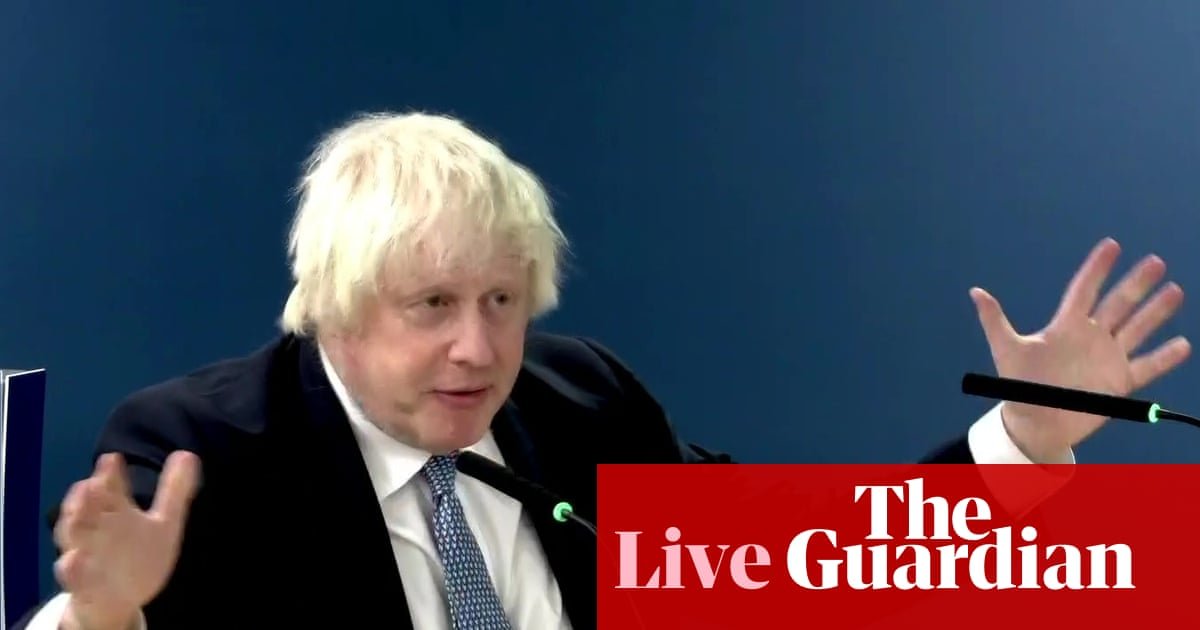
Johnson: the ‘full horror’ of Covid was ‘slow to dawn’ on government
Former prime minister Boris Johnson has said “it was slow to dawn on government generally about the full horror of of Covid.”
He told the Covid inquiry in London “that’s something that we’ve been around many times.”
Addressing the issue of school closures, he says:
Look, I understand the criticism that we should have planned better for school closures, and we should have alerted schools earlier to the possibility of school closures and spelt out in more detail what might happen in the context of school closures.
All I can say to you is that is to imagine a much greater state of knowledge about Covid and what was likely to happen than we actually had at the time. In particular a greater state of knowledge about the speed with which the disease was progressing.
Share
Key events
Show key events only
Please turn on JavaScript to use this feature
Johnson: children were ‘paying a huge price’ to protect the rest of society
Boris Johnson is now being asked “whether children’s interests were sufficiently well represented, when you made those decisions.”
It is being put to him by Clair Dobbin KC that the DfE did not have a “seat at the table” at crucial moments.
She is trying to understand from the prime minister if decisions were being made at cabinet, or decisions were being made by Johnson and then communicated to ministers. Gavin Williamson in his evidence appears to have implied that he was blind-sided by an annoucement about primary schools reopening.
Johnson speaks about the sacrifice children were making, telling the Covid inquiry:
It felt to me as though children who are not particularly vulnerable to Covid were paying a huge, huge price to protect the rest of society. And it was an awful, awful thing. As I said, I wish it had been otherwise. I wish we could have found another solution.
Johnson has a slight dig at Williamson’s evidence, saying “I’m afraid I don’t remember the details of that. It seems a bit paradoxical to be criticised both for wanting to close schools and wanting to get them open.”
Williamson contended in his evidence that Johnson had undermined confidence in the DfE from schools, because the prime minister was flagging to families and parents that kids could go back to school, when schools knew that because of social distancing requirements they could not cope with full schools.
This passage seems rather bogged down in the personal political gripes between Johnson and Williamson.
Share
Clair Dobbin KC has put to Boris Johnson a quote from Gavin Williamson’s evidence that the switch in government policy was a “discombobulating sea change.”
Johnson says he can’t speak for Williamson “but my impression was that everybody understood that school closures was part of the the toolkit that we might sadly have to use. And we were being forced by events and by the spread of the disease to deploy that solution much earlier than we we wanted.”
Dobbin says “So I think, Mr Johnson, your evidence is that it wasn’t a sea change. It was simply a speeding up of that which was going to happen in any event.”
Williamson was sacked by both Theresa May and Boris Johnson when in their governments, and resigned from Rishi Sunak’s government in November 2022 after messages emerged showing him berating a former Conservative chief whip for not ensuring he was invited to the Queen’s funeral.
Share
Johnson: the ‘full horror’ of Covid was ‘slow to dawn’ on government
Former prime minister Boris Johnson has said “it was slow to dawn on government generally about the full horror of of Covid.”
He told the Covid inquiry in London “that’s something that we’ve been around many times.”
Addressing the issue of school closures, he says:
Look, I understand the criticism that we should have planned better for school closures, and we should have alerted schools earlier to the possibility of school closures and spelt out in more detail what might happen in the context of school closures.
All I can say to you is that is to imagine a much greater state of knowledge about Covid and what was likely to happen than we actually had at the time. In particular a greater state of knowledge about the speed with which the disease was progressing.
Share
Clair Dobbin KC is pressing former prime minister Boris Johnson on whether there was a systemic failure of planning on behalf of the government, using school closures as the example.
She has shown him a bleak assessment of how many children would be affected by school closures, and picks up that government was trying to seek options for keeping schools open only to u-turn within 24 hours.
Johnson insists “my impression was that they’d done a lot of of work” at the DfE. Dobbin is asking “what work was it that you thought was being done in the background to prepare schools for the eventuality of having to close? What was it you saw that gave you the confidence that this planning was going on in the background?”
He says “I think people responded pretty heroically to the challenge. You say so late in the day, but so late in the day is, of course, a phrase that is only open, or judgment only open, to people who are operating with hindsight. We didn’t know how Covid was being transmitted. We didn’t know to what extent children and young people were affected by it.”
Dobbin responds “You’ve accepted that the implications of closing schools were enormous for Almost every school age child in this country. Correct? You must accept that that therefore put a responsibility on government to grasp the nettle and really think about what it needed to do if schools were, in fact, going to close to most children.”
Share
Johnson: I remain ‘very proud’ of the way teachers responded to pandemic
Boris Johnson has said he remains “very proud” of the way teachers and education staff responded to the pandemic, and that he takes responsibility for any mistakes made.
He told the Covid inquiry “as I said, [and] told this inquiry before, I take full responsibility for all the decisions that we took and all mistakes that were made, were mistakes that I am accountable for and take responsibility for.
“Insofar as we got things wrong, then, of course, I apologise for them, [and] as I’ve done before to this inquiry.
“I remain very proud, of course, of a lot of things that I think the teachers, the schools did to cope with this unbelievably difficult set of circumstances. And I think that on the whole, they acquitted themselves outstandingly well.”
Share
Former prime minister Boris Johnson tries to give the inquiry context around the decision making on the closure of educational settings. He says:
Don’t forget that we didn’t know the effect this disease had on kids. We didn’t know much about the transmissibility of the disease. There were all sorts of things that were simply unknown and difficult to plan for. And the thing was moving very fast.
And from the point of view of No 10, we were focused very much on trying to stave off, trying to avoid an appalling public health crisis, and we were focused on getting enough ventilators, on getting enough PPE, trying to avoid a significant number of casualties, and I think it’s important for the inquiry to focus, to remember that at the time that the school closures were first mentioned, they were seen as something you put in at the peak of the pandemic, and we didn’t think we were yet at the peak of the pandemic.
School closures were clearly going to be part of the panoply of things that we might be able to do to defeat Covid. I wanted to keep it to the very, very last. It was something that I thought was … [a] terrible thing to do, and it would have awful consequences for for young people, particularly those who were least able to cope.
Share
Johnson: my memory of the pandemic has been ‘contaminated’ by reading inquiry documents
Former prime minister Boris Johnson is being questioned about what preparations had been made to close schools during Covid. He is insisting that there had been various discussions, and suggests that it should have been down to the department of education to organise this planning.
Clair Dobbin KC asks him “Do you accept that until mid-March 2020, there hadn’t been a cross-government focus on closing schools.”
He says he does not, telling the inquiry “I think that there had already been conversations about the possibility of closing schools, and it looked to me as though the DfE was was preparing for that.”
The former prime minister then appears to assert that reading documents produced by the inquiry so far has affected his ability to accurately recall his role in events. He tells the inquiry “one of the difficulties is my memory is now contaminated by what I’ve recently read.”
Share
Johnson: closing schools during pandemic was ‘a nightmare idea’ to him
Clair Dobbin KC is questioning the former prime minister. She is counsel to the Covid Inquiry. She leads its work in Northern Ireland and, separately, its work in relation to children.
She has opened by asking about Gavin Williamson’s evidence which suggested there had been very little preparation for the closure of schools. She says his evidence was that “he didn’t seek assessment of the impact of school closures, and nor did he seek to develop planning for mass school closures because, and these were the words he used in his oral evidence, the steer I was hearing – whether it was in cabinet or anything else – was to keep things open, not about closing things.”
Former prime minister Boris Johnson disagrees, saying “I not sure I agree with the the idea that there was no planning for school closures, because if you look at the sequence from February onwards, it’s clear that sage is talking about the possibility the cabinet is discussing it in in March. Certainly, I remember the subject coming up repeatedly.”
He is shown a statement from the permanent secretary for the Department of Education at the time – Jonathan Slater – giving evidence that there was no contingency plan for closing schools before 17 March 2020.
Johnson suggests Slater should “have picked up from discussions that would be going on from February onwards, that there was work to be done in this area.”
Johnson says “I was very much hoping that we wouldn’t have to close schools. I thought it was a nightmare idea.”
Share
Boris Johnson begins giving evidence to Covid inquiry
Former prime minister Boris Johnson has begun giving evidence at the UK Covid inquiry, which is currently investigating the impact that pandemic measures had on children and young people. You can watch a livestream of Johnson’s evidence here, and we will bring you the key lines as they emerge.
Boris Johnson gives evidence at Covid-19 inquiry – watch live
I should add that the live stream from the inquiry comes with the following content warning: “This module contains references to child death and harm to children through illness, abuse, suicide and crime.”
Share
The news wires are carrying some pictures of former prime minister Boris Johnson arriving for his Covid inquiry appearance earlier this morning.
Former prime minister Boris Johnson arrives at the Covid 19 Public Inquiry in London, on 21 October, 2025. Photograph: Anadolu/Getty ImagesShare
If Boris Johnson takes a similar tack to Chris Whitty yesterday, then we can probably expect the former prime minister to say that the decisions taken during the pandemic inevitably had some negative impacts on young people and children – which they knew they would in advance – but that the worst case scenarios they were picturing suggested the impacts would be much worse without intervention.
It is difficult to know in advance how political Johnson’s evidence will be. His government collapsed in July 2022 after the chancellor Rishi Sunak and health secretary Sajid Javid published damning resignation letters within minutes of each other. Johnson stayed on as an MP until June 2023, when he abruptly resigned in disgrace after an investigation into the Partygate scandal found he misled parliament and recommended a lengthy suspension from the House of Commons. The impression Johnson has given subsequently is that he still feels rather aggrieved about how his parliamentary career ended.
Share
Whitty defended closure of schools at Covid inquiry
Yesterday at the inquiry England’s chief medical officer Chris Whitty suggested that at the time decision makers were faced with a series of “very bad” choices, where some of them were “a bit worse and some of them were a lot worse.”
He defended closures of school, saying:
What I am confident about saying is that had schools not closed, and based on the evidence we had at the time and I don’t think evidence subsequently has undermined that, the peak of the pandemic would have been higher and that would have had obviously direct effect from deaths from Covid in the first wave, but would have increased the risk of all the indirect effects from health services being be unable to function.
So I think not closing schools would have had a material effect on the pandemic being significantly worse.
At the point we did it with the Alpha variant [January 2021], the numbers were incredibly high already, and three or four doubling times from that was an extraordinarily dangerous place for us to get to.
So waiting for another couple of doubling times to see what happened would have been, in my view, potentially catastrophic. And that really was the foundations of the decisions that were made at this point in time.
Share
If you need a reminder of some of the decisions that were taken during lockdown, the Institute for Government has this PDF which shows a timeline from March 2020 to December 2021.
This research briefing from the House of Commons library, published in September 2021, is a comprehensive guide to measures taken in parliament to do with the pandemic.
There is also this interactive timeline we published after twelve months of the pandemic, which is described as “a journey through a year of announcements, U-turns, lockdowns, denials, tests – and more than 100,000 deaths.”
Share
Today’s hearing is about the impact of the pandemic on children and young people
The inquiry’s hearings have been broken into different modules with a focus on different aspects of the UK’s response to the Covid pandemic. The provisional outline of scope for today’s hearing covers:
The extent to which children and young people were considered as part of any preparedness and planning for a pandemic
The extent to which children and young people were considered by the UK government and the devolved administrations in respect of the application of non-pharmaceutical Interventions (NPIs) and the impact of those decisions
The impact of the pandemic on the education of, and the early years provision for, children and young people (including further and/or higher education, apprenticeships)
The impact of the pandemic on children and young people’s physical and mental health, wellbeing, development, family lives and on their access to healthcare services
The impact of the pandemic on children and young people in relation to access to and engagement with social care services and other agencies with a role in supporting the safety of children
The impact of the pandemic on children and young people in contact with the criminal justice system including those in the youth custody estate, youth defendants and offenders and those whose parents or primary carers were in custody during the pandemic
The impact of the pandemic on children and young people in contact with the immigration system
The impact of the pandemic on children and young people in relation to their access to and use of the internet, social media and online resources
There are also documents outlining the scope of the inquiry in a simpler form to aid the understanding of children under 12, and children over 12.
The version for younger children explains it all this way, saying:
The UK Covid-19 inquiry is a big investigation to understand what happened during the pandemic and what we could have done better.
We are looking at how the pandemic affected children and young people from different backgrounds from across the UK. This includes children who need extra help at school, in life, or are new to our country. We also want to hear from teachers, parents and carers on what life was for children during the pandemic and what they wish could have been different.
We want to learn how the pandemic affected children and young people and what can be done to help them if it ever happens again. We also want to help the people who make decisions understand the needs of children and young people in case there is another pandemic. We want to make sure that we understand how the pandemic is still affecting children and young people now, so we can learn from this.
Share
Welcome and opening summary …
Welcome to the Guardian’s live coverage of the UK’s Covid inquiry, with Boris Johnson set to appear to give evidence this morning.
At the present time the inquiry is gathering information about the impact of the pandemic on children and young people, which will be the focus of the questions that the former prime minister is asked today.
It is worth noting at the outset that health is a devolved matter, and so during the pandemic England, Scotland, Wales and Northern Ireland all had different responses. The Covid inquiry is UK-wide. Scotland has been holding its own Covid inquiry into its devolved response, and the Senedd has this year debated its own report into how prepared Wales was for the pandemic.
It is Martin Belam blogging for you today, and you can reach me via email at martin.belam@theguardian.com.
Share
