

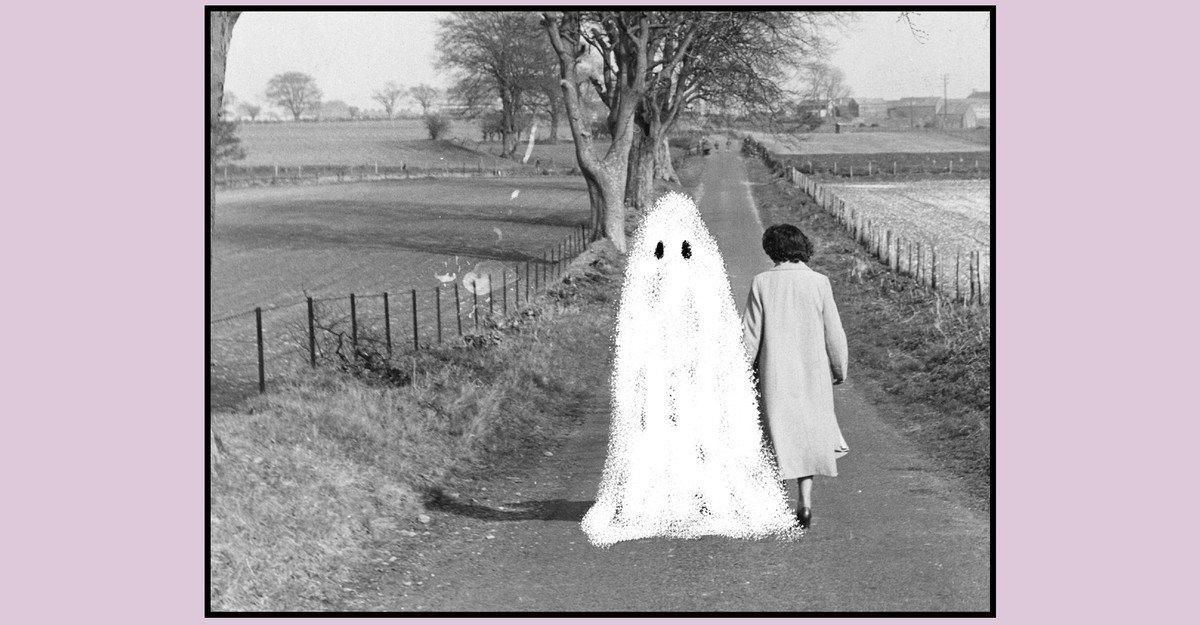
Ghosting existed in some form long before modern technology made it ubiquitous. “Disappearing without word or warning is no doubt as old as the human race,” the cultural theorist Dominic Pettman notes in his slim new book, Ghosting. The infant first detecting maternal absence, the pet abandoned in an alley, the friend suddenly iced out have all felt the sudden departure of someone who was expected to be there. What has changed in recent years, Pettman argues, is the ease—and cruelty—with which people can enter and exit one another’s lives. Today’s version of ghosting, he writes, “is abandonment with a contemporary garnish”; a plethora of options for ignoring others have turned it into a “universal, even banal, experience.” Or, as he puts it pithily, “when we came up with texting, we also came up with not texting.”
I was curious to read Pettman’s book, because I’d been thinking about the banality of ghosting—or, rather, how it can seem so commonplace as to be expected and, at the same time, be hurtful and infuriating. Culturally, ghosting is a paradox. It can be something you brush off even as it lives rent-free in your head. It’s still considered rude, and people on both sides tend to feel bad about it, albeit in different ways. It’s also extremely common: 90 percent of respondents to one 2021 study reported that they had ghosted someone. Last month, the New York Times columnist Maureen Dowd bemoaned the fact that online dating has become a “digital derecho, with oh so many ways” to “make and drop connections.”
But perhaps ghosting—or being ghosted—doesn’t need to be so upsetting. I recall a text I received at the end of the summer that illustrated, for me, the ways we apparently still tiptoe around ghosting. It was from a guy I had been on three dates with and then hadn’t heard from in weeks. I’d thought the third date was the best of them—a nice dinner with lots of talking, a little making out at my place—so I was surprised when the guy, a divorced dad, offered a tepid response to a follow-up text I sent before disappearing completely.
In the new text, prefaced by a cheery “Hello!,” he apologized, telling me he “didn’t intend to ghost” and that he’d been “focused on other connections (and life in general).” Mulling my response, I decided on “thanks—be well!” and then blocked him. The blocking was superfluous—he and I were unlikely to ever talk again—but it spoke to a twofold annoyance on my part. At the point that the guy texted back, I had mostly forgotten about him and moved on; his outreach was an unnecessary coda. I also felt like I should appreciate the fact that he reached out at all, though it seemed like he was doing so to make himself, not me, feel better; to, essentially, correct the record: I’m not someone who ghosts. It came across like a performance of nicety.
Contemporary ghosting, according to Pettman, is a by-product of what he calls an “overly social world,” one in which the real and the virtual are so intertwined that we can lose sight of another person’s humanity while engaging (or disengaging) with them. Ghosting can also often undermine a person’s perception of reality. In the case of the guy who ghosted me, my surprise stemmed from both his unanticipated disappearance and what I believed to be true: that he and I had had a genuinely good time together.
Ghosting – On Disappearance
By Dominic Pettman
Some of this was projection. “We love an avatar more than a specific being,” Pettman writes, “a gestalt abstraction, lifted from all the love stories we’ve imbibed since childhood.” I wanted this guy to be the sort of guy who liked and wanted me. As for my irritation when he reappeared? Research shows that people who acknowledge or apologize for rejection risk activating the rejectee’s ire, rather than alleviating hurt feelings. Gili Freedman, a social psychologist who has studied both ghosting and apologies, told me that although apologies after a ghosting can in some cases provide closure, ghostees can also interpret ghosters’ apologies as insincere or self-serving.
Apologies also put ghostees into a double bind, she said. Ghostees can feel pulled back into a dynamic they didn’t choose to be part of, or be forced to confront the feeling of a wound being reopened, a sort of secondary rejection. The guy’s apology, I found, reminded me of the ghosting infraction in the first place, reasserted his control (he dictated the timing and the terms of communication), then created a social obligation for me to respond—a sort of obligatory forgiveness that can erode the ghostee’s sense of agency or even humanity.
The guy’s ghosting of me also dehumanized him. When he vanished after that seemingly promising third date, he quickly went back to being an idea of a man I had met: a profile picture on an app. After he apologized and I replied and blocked him, he became a different sort of ghost—one of my, not his, making. His belated effort had left me more dismissive of him than if he had simply stayed gone.
Many of us might have been ghosted enough times over the years that we’ve developed a thicker skin about what appear to be arbitrary disappearances. The cultural critic Kyle Chayka, for one, recently mused in The New Yorker about whether ghosting was such a “persistent feature of twenty-first-century life” as to be unavoidable. Pettman considers detaching a “necessary skill” and an “emerging discipline” for “the typical citizen of the new millennium.” And with the benefit of thicker skin, perhaps there’s room for more curiosity, room for ghosting to be, if not embraced, at least better understood.
Pettman is useful on this front. Ghosting may indicate individual cowardice, he writes, but “it also doesn’t get us very far to demonize individual behavior, as if the answer to structural social woes was to simply instill better moral codes in everyone’s hearts and minds.” (What to do about this? He doesn’t really say.)
The phenomenon is also perhaps indicative of our alienation from a sense of shared community. We’re spending more and more time alone, and some have suggested that we’re in the midst of a crisis of societal rudeness. One writer recently posited that contemporary self-help books might be encouraging people’s selfishness and self-interest (even at the cost of alienating or hurting others) by espousing the idea that “it’s OK to be a little bit of a jerk.”
It’s worth considering a slightly counterintuitive idea too: that ghosters do care about their interactions, and the people who are affected by them. Somewhat. As Freedman told me, ghostees tend to underestimate ghosters’ contrition, and ghosters’ choice to disappear can actually be evidence of their complicated feelings. I’d add that not being informed of the reason for a ghosting might save many of us from embarrassment or self-loathing. One study on ghosting in a hiring context—say, an employer’s nonresponse to a job applicant—found that those who were ghosted had more self-esteem than those who got personal feedback.
Is this an argument for accepting ghosting in its contemporary form? Probably not—especially in the case of being stood up, which has always felt particularly egregious. And a new study that examined the consequences of being ghosted or rejected directly found that the adverse psychological effects of the former appear to last longer than those of the latter, because of ghosting’s “unique consequences linked to its ambiguity and lack of closure.” But I do sense that a certain softness might be found under the surface of this particular expression of our so-called epidemic of rudeness.
Maybe we can extend some empathy, or at least the benefit of the doubt, to those who disappear on us. Perhaps, in reaching out to me, even six weeks after our previous communication, my date was showing evidence of care, though he expressed it in a ham-handed way. Or, as Pettman puts it, “in a world of atomized, liquified, symptomatic and transactional relations,” maybe the act of ghosting can also “be a merciful one.”
When you buy a book using a link on this page, we receive a commission. Thank you for supporting The Atlantic.
