

At first, the stoat looks like a faint smudge in the distance. But, as it jumps closer, its sleek body is identified by a heat-detecting camera and, with it, an alert goes out to Orkney’s stoat hunters.
Aided by an artificial intelligence programme trained to detect a stoat’s sinuous shape and movement, trapping teams are dispatched with the explicit aim of finding and killing it. It is the most sophisticated technology deployed in one of the world’s largest mammal eradication projects, which has the aim of detecting the few stoats left on Orkney.
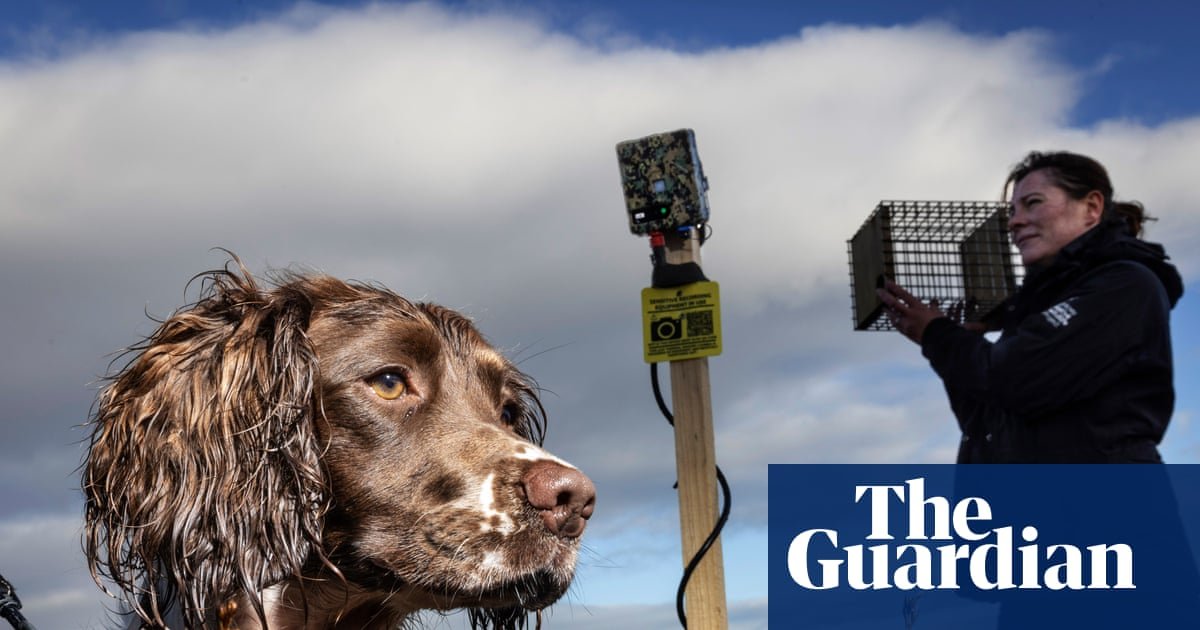
Conservationists on the islands, which sit in the far north of Scotland, have already used an array of 9,000 lethal traps and eight specially trained tracking and detection dogs to dispatch nearly 8,000 stoats over the past six years. At least 30 of those digital cameras will soon be staked out across the moors and coasts of Orkney’s mainland, building a network that connects hits from the cameras to computers and mobile apps used by the trapping teams.
A stoat is captured on a heat-detecting cameraA stoat is captured on a heat-detecting camera
The stoat is an existential threat to native ground-nesting birds for which Orkney is famous – it is home to 11% of all the UK’s breeding seabirds and about 25% of its hen harriers, as well as its most treasured native rodent, the Orkney vole.
The Royal Society for the Protection of Birds Scotland, which runs the Orkney Native Wildlife Project, believes stoats arrived from the Scottish mainland in about 2011. Since then, the population has exploded, colonising Orkney’s mainland and the nearby islands of Burray and South Ronaldsay and the peninsula of Deerness – stoats can swim several kilometres – with devastating effects.
Sarah Sankey, the area operations manager for RSPB Scotland, says the stoats’ greatest advantage is they have no predators on Orkney. “They’ve nothing to control them: we’ve no foxes, and very few buzzards. We’ve seen this all over the world. That stoat population would’ve kept going until it had removed everything,” she says, holding a laminated map of Orkney with thousands of red dots marking the trap network.
“We saw it before we started eradicating them. There were stoats running between people’s legs, stoats in people’s kitchen cupboards, there were stoats in people’s lofts.”
In well under a decade, they had spread across 58,000 hectares (143,260 acres). A feasibility study said that if they spread across all Orkney’s islands, it would be financially and logistically impossible to control them. So the project, which will last for at least 10 years, has been given a £16m budget and 46 staff.
Stoats penetrate the burrows of voles, search out eggs and chicks in thousands of curlew, lapwing and hen harrier nests, and also hunt along Orkney’s extensive shoreline for seafood, feeding off starfish and urchins.
“Here we’ve got a perfect disaster where we’ve loads and loads of food year-round,” Sankey says. “Nothing to control the stoats and lots of native wildlife to lose, and a tourism economy that kind of depends on it.
“Why did we start all of this? Orkney is less than 1% of the UK’s land area, but we’ve around a quarter of all Arctic terns and hen harriers, about a third of Arctic skuas, and we’re the only place with Orkney voles. So there was a lot to lose, basically.”
The Orkney Native Wildlife Project has a network of about 8,000 humane lethal trap boxes and Europe’s first stoat detection dogs. Photograph: Murdo MacLeod/The Guardian
The latest survey data suggests the project has succeeded. Since it began in 2019, there has been a 1,267% increase in the chance of curlew hatchings, a 218% rise in vole activity and a 64% increase in hen harriers numbers. Heavily persecuted by gamekeepers on the UK mainland, Orkney is now home to 160 hen harriers.
“Against a background of a massive population decline, particularly of curlew and lapwing, we are managing to stabilise the population in Orkney,” Sankey says.
Sourced from New Zealand, where conservationists face an uphill battle to remove millions of non-native predatory mammals, the AI system is supplemented by thermal binoculars and drones, says James Geluk, the project’s lead technologist and a New Zealander who has worked on an eradication project near Wellington.
The thermal detectors are far more sensitive to movement than the trail cameras normally used by conservationists, he says. They operate perfectly in darkness and send live alerts in real time after video footage is uploaded to a cloud server. The AI has learned to distinguish stoats from otters and voles.
“It’s a much more accurate monitoring tool than a usual trail camera would be,” Geluk says.
After six years of concerted trapping efforts, including the interruption of lockdowns during the Covid crisis when stoat numbers soared again, the RSPB hopes to begin the “mop-up” phase in December – a threshold that will be reached after the eradication of 95% of stoats.
They estimate there are only about 100 pregnant stoats left on Orkney. “We are all conservationists who work here,” Sankey says. “None of us are here because we want to kill an animal. We’re here because we want to protect the nature of Orkney.”
