
Close Menu

    Subscribe to Updates

    Get the latest creative news from FooBar about art, design and business.

    What's Hot

    Why attacking UNRWA is attacking Gaza’s survival | Gaza

    UK new car buyers drive a bargain as average discount nears £6,000 | Automotive industry

    ‘They’re taught that showing feelings is shameful’: eight reasons men don’t go to therapy – and why they should | Life and style

    Facebook X (Twitter) Instagram
    Facebook X (Twitter) YouTube LinkedIn
    Naija Global News |
    Saturday, January 31
    • Business
    • Health
    • Politics
    • Science
    • Sports
    • Education
    • Social Issues
    • Technology
    • More
      • Crime & Justice
      • Environment
      • Entertainment
    Naija Global News |
    You are at:Home»Science»Time-resolved fluorescent proteins expand the microscopy palette
    Science

    Time-resolved fluorescent proteins expand the microscopy palette

    onlyplanz_80y6mtBy onlyplanz_80y6mtOctober 18, 2025004 Mins Read
    Share Facebook Twitter Pinterest LinkedIn Tumblr Email
    Time-resolved fluorescent proteins expand the microscopy palette

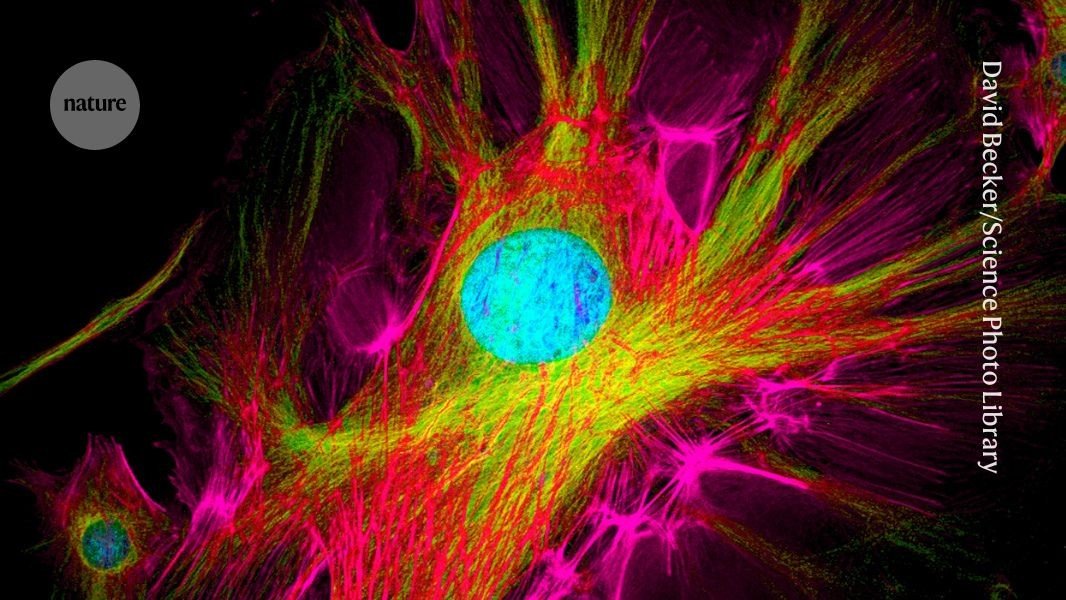
    Fluorescent dyes can help researchers to visualize the structure of a cell — but it can be difficult to use more than a handful.Credit: David Becker/SPL

    Share
    Facebook Twitter LinkedIn Pinterest Email

    Fluorescent dyes can help researchers to visualize the structure of a cell — but it can be difficult to use more than a handful.Credit: David Becker/SPL

    When working with fluorescent dyes or proteins, researchers typically focus on two variables: the wavelength of light at which the molecules are stimulated to fluoresce, and the wavelengths at which they emit light — that is, their colour. By balancing those properties, researchers can distinguish between half a dozen or so fluorescently tagged molecules in the same sample.

    But there’s more to fluorescence than colour, and scientists can now more easily use another property of fluorescent molecules to increase the number of proteins that can be visualized at the same time.

    Led by Xin Zhang, a chemist at Westlake University in Hangzhou, China, the team designed more than two dozen fluorescent proteins that differ not only by colour, but also in how much time they spend in their excited state — a property called the fluorescence lifetime. The researchers call these molecules time-resolved fluorescent proteins, or tr-FPs. Their findings were published online last month in Cell1.

    “It’s brilliant work,” says Conor Evans, a physical chemist at Massachusetts General Hospital and Harvard Medical School in Boston. The team has given researchers a “dial-able palette” from which they can pick both a colour and a lifetime to get what they need, he says. “That’s very powerful.”

    Expanding the palette

    Suppose that a scientist wants to map a cellular process associated with a specific protein. To work out where in the cell that process occurs, the researcher can use fluorescent dyes to highlight cellular landmarks — blue for the nucleus, red for the cytoskeleton and green for the mitochondria, for instance. Viewing other proteins of interest against this background would require still more colours. However, because the visible spectrum is relatively narrow and fluorescent molecules emit light over a range of wavelengths, standard microscopes can handle only a handful of colours simultaneously. After that, the emission spectra start to bleed together, making it difficult to discern which signals are coming from which molecule.

    The fluorescence lifetime provides a way to expand that palette.

    When a fluorescent molecule absorbs light, its electronic energy levels increase to enter what is called the excited state. The molecule hovers in this excited state for pico- to nanoseconds, and then begins its luminous descent to the ground state, emitting excess energy in the form of photons. The time a molecule spends in an excited state — that is, between absorbing and emitting photons — is called the lifetime.

    To change the lifetimes of existing fluorescent proteins, Zhang’s team mutated some of the amino-acid residues to destabilize the region in which the fluorescent signal is generated. The researchers then screened the resulting proteins to identify variants with different lifetimes, but identical emission spectra, to those of their wild-type counterparts. In all, they produced 28 variants, spanning most of the visible spectrum.

    Zhang’s group then put this palette to work, fusing the tr-FPs to various target proteins and testing their behaviour in various subcellular locations. They also examined how the tr-FPs performed in a wide range of applications, including super-resolution microscopy, and showed that the technology enables live-cell imaging of nine target proteins using only three colour channels.

    Zhang notes that lifetime-based imaging is not a new concept, but he hopes the tr-FPs will help more researchers to take advantage of the technique. “I think this is more like an addition to the broad and powerful family of fluorescent proteins,” he says, rather than some kind of paradigm shift.

    The researchers did, however, test the tr-FPs in what they say is a new application: quantifying the relative concentrations of two proteins in a single living cell, something that is difficult to determine from fluorescence intensity alone.

    expand fluorescent microscopy palette Proteins Timeresolved
    Share. Facebook Twitter Pinterest LinkedIn Tumblr Email
    Previous ArticleRussia-Ukraine war: List of key events, day 1,332 | Russia-Ukraine war News
    Next Article Trump’s Next Potential Deal: Ukraine.
    onlyplanz_80y6mt
    • Website

    Related Posts

    Briefing Chat: What Brazilian centenarians could reveal about the science of ageing

    January 31, 2026

    Light-powered bacteria become living chemical factories

    January 31, 2026

    A bomb cyclone and extreme cold will freeze the eastern U.S.—again

    January 31, 2026
    Add A Comment
    Leave A Reply Cancel Reply

    Top Posts

    Watch Lady Gaga’s Perform ‘Vanish Into You’ on ‘Colbert’

    September 9, 20251 Views

    Advertisers flock to Fox seeking an ‘audience of one’ — Donald Trump

    July 13, 20251 Views

    A Setback for Maine’s Free Community College Program

    June 19, 20251 Views
    Stay In Touch
    • Facebook
    • YouTube
    • TikTok
    • WhatsApp
    • Twitter
    • Instagram
    Latest Reviews

    At Chile’s Vera Rubin Observatory, Earth’s Largest Camera Surveys the Sky

    By onlyplanz_80y6mtJune 19, 2025

    SpaceX Starship Explodes Before Test Fire

    By onlyplanz_80y6mtJune 19, 2025

    How the L.A. Port got hit by Trump’s Tariffs

    By onlyplanz_80y6mtJune 19, 2025

    Subscribe to Updates

    Get the latest tech news from FooBar about tech, design and biz.

    Most Popular

    Watch Lady Gaga’s Perform ‘Vanish Into You’ on ‘Colbert’

    September 9, 20251 Views

    Advertisers flock to Fox seeking an ‘audience of one’ — Donald Trump

    July 13, 20251 Views

    A Setback for Maine’s Free Community College Program

    June 19, 20251 Views
    Our Picks

    Why attacking UNRWA is attacking Gaza’s survival | Gaza

    UK new car buyers drive a bargain as average discount nears £6,000 | Automotive industry

    ‘They’re taught that showing feelings is shameful’: eight reasons men don’t go to therapy – and why they should | Life and style

    Recent Posts
    • Why attacking UNRWA is attacking Gaza’s survival | Gaza
    • UK new car buyers drive a bargain as average discount nears £6,000 | Automotive industry
    • ‘They’re taught that showing feelings is shameful’: eight reasons men don’t go to therapy – and why they should | Life and style
    • “Digital Twins” and the Prescience of Cheesy Science Fiction
    • Briefing Chat: What Brazilian centenarians could reveal about the science of ageing
    © 2026 naijaglobalnews. Designed by Pro.
    • About Us
    • Disclaimer
    • Get In Touch
    • Privacy Policy
    • Terms and Conditions

    Type above and press Enter to search. Press Esc to cancel.