

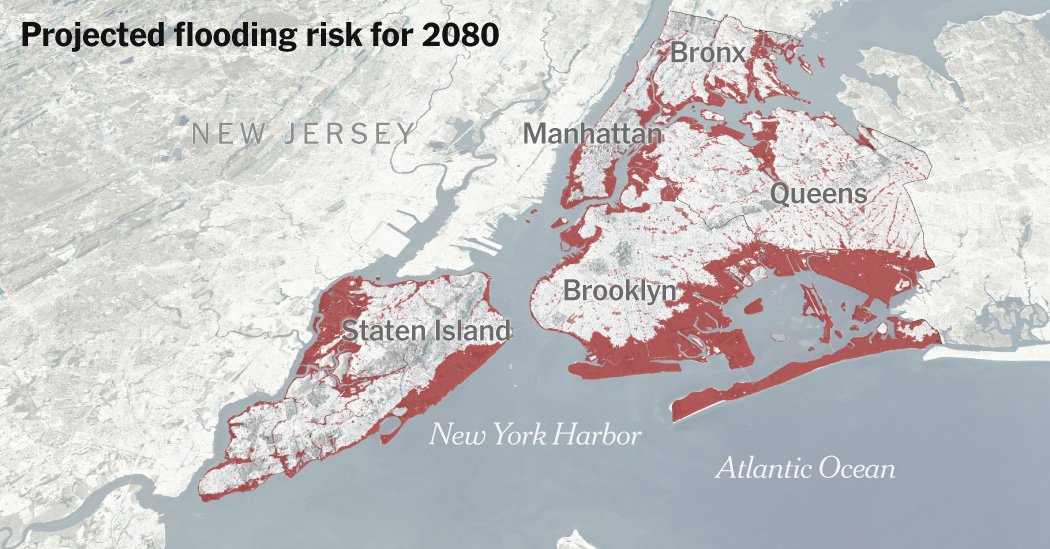
New York is experiencing extreme rainfall events with increasing frequency and intensity, according to a 2024 study in Nature.
Since 1970, the city’s stormwater system has been built to handle up to 1.75 inches of rain per hour. Hourly precipitation recorded by Central Park’s rain gauge didn’t exceed this limit until 1995. It’s been eclipsed in three of the last five years.
Annual maximum hourly rainfall at Central Park
One major problem is how little of that rainfall is absorbed or stored before reaching the stormwater system. A whole suite of solutions focuses on building and expanding the city’s capacity to do so.
Understanding New York’s historical environment is crucial to imagining a more resilient urban future, one based on the city’s past topography, according to Eric Sanderson, a landscape ecologist and vice president for Urban Conservation Strategy at the New York Botanical Garden and the author of “Mannahatta: A Natural History of New York City.”
“I was trying to imagine a configuration of the landscape that could work with the understanding of climate change at the time,” Sanderson said of his book. “Part of that is restoring streams, wetlands and agricultural lands, connecting the urbanized parts of the city, and depaving a lot of what we have.”
He and a team of researchers have spent years reconstructing the past ecological landscape of the city, producing data that they hope will inform its future.
Embracing absorption could allow the city to restore those natural features, allowing floodwater places to drain.
Rain gardens, curbside planted pits designed to siphon water away from drainage systems, and permeable pavement are already turning streets and sidewalks into sponges. And as part of its Cloudburst program, the city is designing parks and public spaces to flood intentionally, enhancing their innate ability to act as natural catch basins. The first to be completed, a basketball court in South Jamaica, Queens, recently opened.
Rain gardens in Gowanus, Brooklyn, absorb and redirect water away from the sewage system.
Lucía Vázquez for The New York Times
A basketball court in Jamaica, Queens, can contain up to two feet of flood water, which drains into an underground storage tank.
Lucía Vázquez for The New York Times
But these initiatives are in their infancy. Only a handful of Cloudburst sites have been identified, and the need is most likely far greater: Sanderson and his team mapped out 540 potential locations.
Policymakers have offered several incentives to private property owners, making it easier for real estate developers to install green infrastructure. Similarly, waterfront properties above a certain size are now required to provide stormwater solutions.
Sewer and storage upgrades are also on the table. In Gowanus, Brooklyn, Department of Environmental Protection engineers recently installed an eight-million-gallon underground tank at an artificial canal, redirecting water that would otherwise flood the space. The agency is planning another tank, and once it is complete, a new public park will sit on top of it.
Then there’s daylighting, in which onetime waterways, covered by buildings, pavement and landfill, are unearthed and restored, allowing floodwater to go elsewhere.
A project at Tibbetts Brook in the Bronx will test the concept. Concrete and other artificial materials will be removed to reroute water aboveground and into a dedicated underground pipe, reducing sewer overflow that ends up in the Harlem River.
Tibbetts Brook in the Bronx currently drains into an underground tunnel and, eventually, into the sewage system.
Lucía Vázquez for The New York Times
A more dramatic example of leveraging the city’s natural landscape is the successful Bluebelt project in Staten Island, which strings together streams, ponds and wetlands — some natural, some engineered. It has already reduced flooding in parts of the borough.
But for greater effect, the city will have to rapidly expand this work to feasible locations. “Our imaginations have not caught up to what nature can and will do,” Sanderson said.
On a recent tour of the Staten Island Bluebelts, Rohit Aggarwala, the commissioner of the New York City Department of Environmental Protection, said the agency had listed 86 “priority areas” citywide for flood mitigation. “We’re asking, ‘What is the solution for this specific place?’” he said.
That work has its hurdles, though, and not every part of the city is as spacious as Staten Island. A major overhaul of local sewer capacity in Bushwick, Brooklyn, for example, will cost $390 million and take years. Expect disruption, Aggarwala said: “The residents will be less happy when they find out how long Knickerbocker Avenue will have to be ripped up.”
But for too long, he added, the city’s work was not focused enough on the future: “We have to build for 2075, not 1975.”
