

October 14, 2025
4 min read
The U.S. Won’t Win the New Space Race by Defunding NASA
The U.S. wants to remain a superpower in space. It can’t without supporting NASA
In the early 1400s, nearly a century before Columbus’s fateful voyage to the Americas, China seemed most poised to use maritime might to create a global empire. Beginning in 1405, Ming Dynasty admiral Zheng He commanded a fleet of immense “treasure ships” on a series of expeditions across the Indian Ocean, showcasing China’s wealth and strength as far afield as the eastern coast of Africa. But by 1433 the state-sponsored voyages had ceased.
Scholars still debate what led 15th-century China to turn inward, ceding its power—and ultimately the discovery of what would become the New World—to others. But regardless of its cause, the missed opportunity is unquestionable.
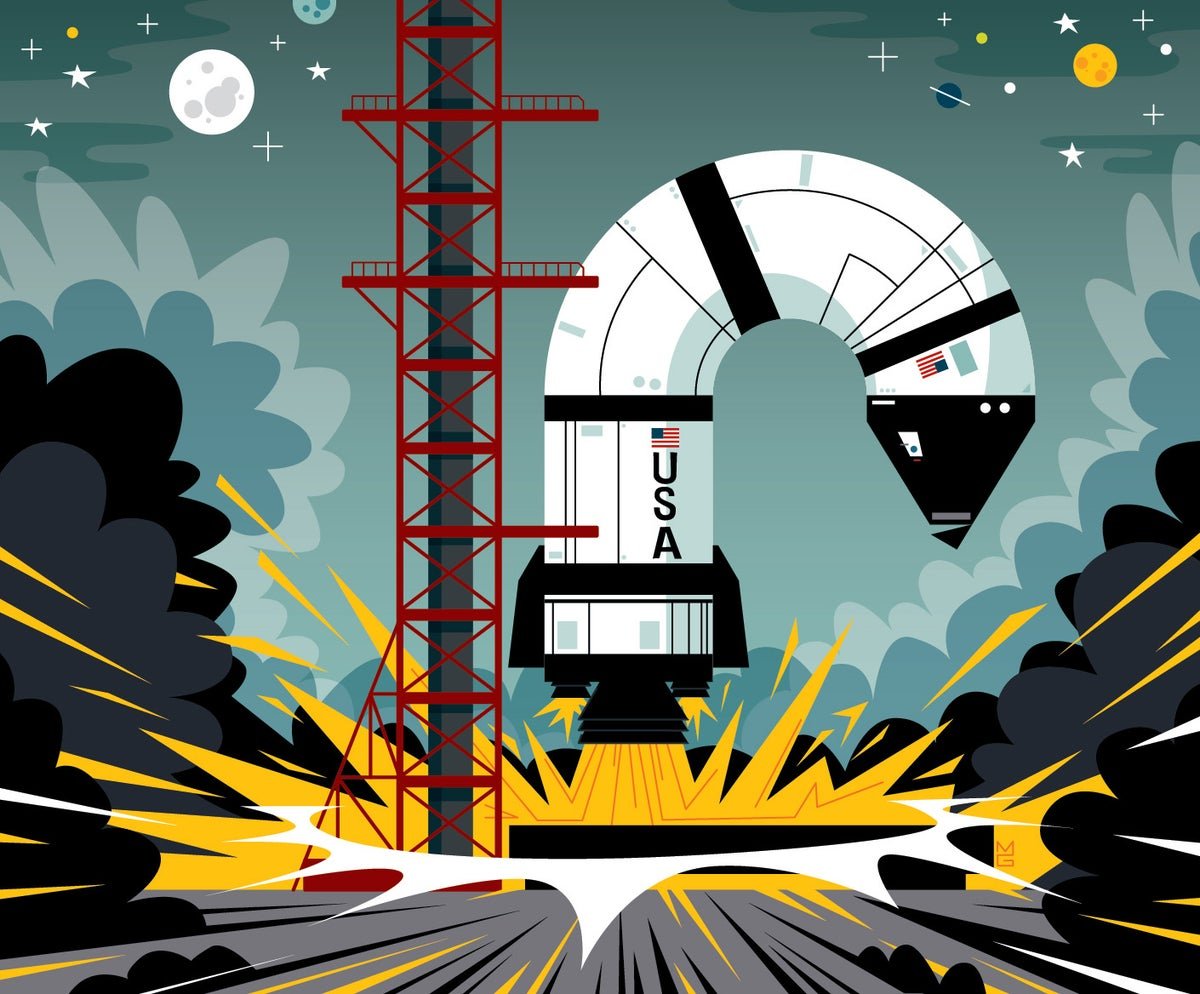
Today a strange echo of this episode is unfolding—on the high frontier of space rather than the high seas. This time, however, China is rising to prominence as the U.S. squanders its advantages. Unlike the Ming court that made no secret of decisively abandoning China’s naval aspirations, some U.S. leaders now embrace space as a vital, contested domain. But while they insist they’re setting a course for America’s continued dominance in space science, technology and exploration, their actions are contradicting and undermining that goal.
On supporting science journalism
If you’re enjoying this article, consider supporting our award-winning journalism by subscribing. By purchasing a subscription you are helping to ensure the future of impactful stories about the discoveries and ideas shaping our world today.
Skepticism about, if not outright scorn for, civilian space spending is practically a bipartisan tradition in U.S. politics, but we are talking chiefly about the “Make America Great Again” policymaking of President Donald J. Trump.
While [U.S. leaders] insist they’re setting a course for America’s continued dominance in space science, technology and exploration, their actions are contradicting and undermining that goal.
On July 20, the 56th anniversary of the Apollo 11 moon landing, the White House released a statement in which Trump proudly declared his administration was “reigniting the United States’ leadership in space” and pledged to return Americans to the moon and send them to Mars. Weeks earlier, thanks to Trump’s signature budget-reconciliation bill (the “Big Beautiful Bill”), NASA had received nearly $10 billion in additional funding for heavy-lift rockets, crewed spacecraft, and other things crucial to the Artemis program, which officially began during Trump’s first term. Acting NASA administrator Sean Duffy has repeatedly parroted similar talking points. During a September press conference, he said “we’re in a second space race right now; the Chinese want to get back to the moon before us. That’s not going to happen. America has led in space in the past, and we are going to continue to lead in space in the future.” The U.S., Duffy asserted, would achieve this feat in 2027. (Duffy’s remarks came a week after his Trump-appointed predecessor, Jim Bridenstine, more realistically testified to Congress that “unless something changes, it is highly unlikely the United States will beat China’s projected timeline [of 2030] to [send humans to] the moon’s surface.”)
The Trump administration does deserve credit for some sound space policy—such as two executive orders, one in 2020 seeking to extend the economic sphere of the U.S. and its allies beyond low-Earth orbit and another in 2025 to supercharge U.S. capabilities by streamlining regulations for domestic commercial space companies. Similarly, this past August, Duffy announced the administration’s plans for NASA to fast-track readying a nuclear reactor for launch to the moon by 2030—a bold move meant to secure valuable lunar territory and eventually power U.S. outposts there.
But these acts must be considered alongside other policies and proposals that influence U.S. scientific and technological prospects off-world and on Earth.
Chief among these is the White House’s proposed spending budget for fiscal year 2026. Despite the boost to the Artemis program, Trump’s FY2026 proposal called for cutting NASA’s overall budget by about 25 percent, with the agency’s science division being slashed by nearly half. Advocacy groups such as the Planetary Society—as well as all seven living former NASA science chiefs—have condemned these proposed cuts as catastrophic for U.S. space science. The cuts, they warned, would lead to the cancellation of more than 40 ongoing and planned U.S. space missions. On Trump’s chopping block are high-profile, decades-in-the-making projects such as NASA’s Mars Sample Return mission and the next-generation Nancy Grace Roman Space Telescope. These have counterpart competitors in China, which is proceeding unimpeded toward space leadership.
The cuts proposed for FY2026 are not the administration’s only harmful moves: White House actions have led to the shedding of more than 2,500 NASA staffers, most of them senior employees. Innumerable federal research grants have been canceled, suspended or delayed because of ideological litmus tests. Thousands of foreign students and skilled professionals have been blocked or discouraged from living and laboring in the U.S. by immigration and guest-worker policies. As the federally funded scientific enterprise staggers and a U.S. brain drain accelerates after these heavy blows, affecting both new and longtime workers, China and other nations are opening their doors to international students and scientists, including American ones, offering generous financial incentives and building state-of-the-art research hubs to attract talent from around the world.
It’s hard to see how America’s losses across these myriad domains won’t lead to other nations’ gain, even if we can’t predict the marvelous opportunities we’ll be missing out on. And, just as with China’s befuddling decision to retreat from maritime greatness nearly 600 years ago, it’s harder still to understand why U.S. leaders today seem so eager to lose this new space race. Trump’s push to make America great again in space presumes America isn’t already the world’s greatest spacefaring power—which it demonstrably is, albeit perhaps not for much longer.
Our nation’s continued greatness in space requires giving more support to government-sponsored R&D rather than less and respecting, not disdaining, science—irrespective of politics.
It’s Time to Stand Up for Science
If you enjoyed this article, I’d like to ask for your support. Scientific American has served as an advocate for science and industry for 180 years, and right now may be the most critical moment in that two-century history.
I’ve been a Scientific American subscriber since I was 12 years old, and it helped shape the way I look at the world. SciAm always educates and delights me, and inspires a sense of awe for our vast, beautiful universe. I hope it does that for you, too.
If you subscribe to Scientific American, you help ensure that our coverage is centered on meaningful research and discovery; that we have the resources to report on the decisions that threaten labs across the U.S.; and that we support both budding and working scientists at a time when the value of science itself too often goes unrecognized.
In return, you get essential news, captivating podcasts, brilliant infographics, can’t-miss newsletters, must-watch videos, challenging games, and the science world’s best writing and reporting. You can even gift someone a subscription.
There has never been a more important time for us to stand up and show why science matters. I hope you’ll support us in that mission.
