

Astronomers have yet to find irrefutable proof for any natural satellites of exoplanets—so-called exomoons—but as circumstantial evidence accumulates and the list of candidates grows, the discovery of a true-blue exomoon seems to be looming on the horizon.
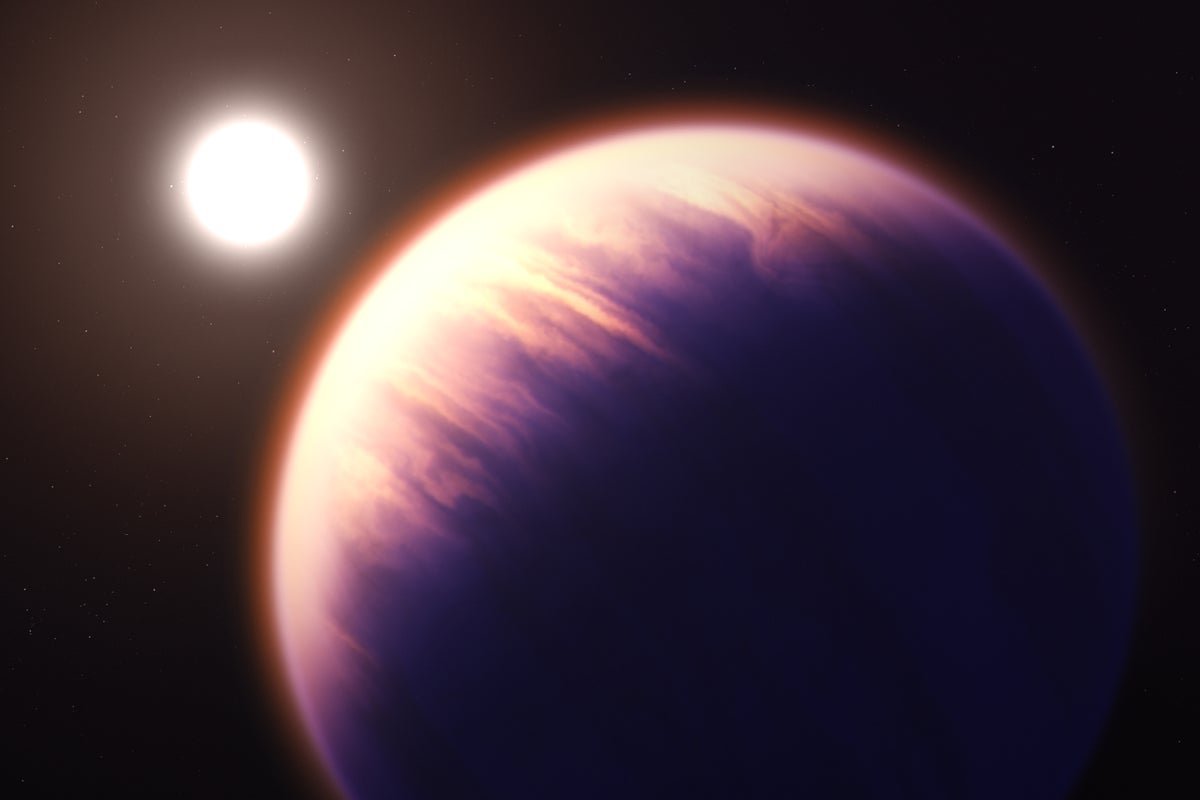
The latest not-quite-smoking-gun claim concerns a potential exomoon that may be erupting to spew debris onto and around its host planet. Using NASA’s James Webb Space Telescope (JWST), astronomers have identified a cloud of gas in the vicinity of the gas giant exoplanet WASP-39b that may come from an accompanying satellite. But even if that purported lunar companion proves illusory, this new method of tracking down mysterious sources of unexplained material around giant exoplanets could become a definitive pathway for future exomoon finds.
Since its discovery in 2011, WASP-39b has been a frequent target for astronomers; the planet’s large size, short-period orbit and shadowy transit (crossing the face of its star as seen from Earth) make it favorable for more in-depth studies. In 2023 researchers announced the detection of sulfur dioxide in the planet’s atmosphere. Now a new preprint study, accepted for publication in the Monthly Notices of the Royal Astronomical Society, is challenging some details of that conclusion. The sulfur dioxide’s source, this new study claims, is a hypervolcanic exomoon, similar in many ways to Jupiter’s satellite Io. Caught in a gravitational tug-of-war between Jupiter’s intense gravity and that of other nearby large moons, Io’s innards are kneaded like dough by tidal forces, generating immense heat that powers enormous eruptions.
On supporting science journalism
If you’re enjoying this article, consider supporting our award-winning journalism by subscribing. By purchasing a subscription you are helping to ensure the future of impactful stories about the discoveries and ideas shaping our world today.
For this exoplanet and its putative moon, the process would be “nearly identical with that of Io [and Jupiter] except that [WASP-39b] is very close to the star,” says Apurva Oza of the California Institute of Technology, who led the new study. “The star is really cooking it, gravitationally and thermally as well.”
An Exo-Io?
The most volcanically active body in the solar system, Io ejects material that is then swept into space by Jupiter’s magnetosphere at a rate of roughly a ton per second. The result is a torus of gas, dust and other debris stretching around Jupiter, constantly replenished by Io’s incessant eruptions.
In 2006 researchers posited that similar clouds around exoplanets could reveal the presence of moons. Oza began working with one of those researchers a few years later, considering how sodium could become “a beacon for exomoons and exorings.” In 2019 he and his colleagues put together a list of potential targets to prioritize in hunting for such beacons. WASP-39b was one of the contenders.
Although JWST was the first to spot sulfur dioxide around WASP-39b, other observatories such as NASA’s Hubble Space Telescope and the European Southern Observatory’s Very Large Telescope in northern Chile have detected sodium and potassium there as well. Oza and his colleagues pulled together all of the observations and tracked how they varied over more than a decade. Rather than being uniform and unambiguously associated with WASP-39b itself, the fluctuating signals of the compounds suggested episodic behavior to Oza and his colleagues, while the composition hinted at an external source.
“The fact that these particular species are varying really points to something that’s more of a solid body, like a moon would be,” says Kurt Retherford, a planetary scientist at the Southwest Research Institute in San Antonio, Tex., who was not involved with Oza’s study. At various professional meetings in recent years, Retherford has emerged as a persistent critic of Oza’s preferred exomoon-hunting technique, showing up to Oza’s talks to ask tough, skeptical questions.
But that may have shifted since Oza presented the research about WASP-39b last month at the joint Europlanet Science Congress/Division of Planetary Sciences (EPSC-DPS) conference in Helsinki, Finland.
“Before I saw his talk, I would have leaned more toward the planet itself” as the likely source of sulfur dioxide, Retherford says. Now, however, he’s changed his mind. An external, nonplanetary source for strange readings from WASP-39b is more sensible, he says, “maybe with an exomoon being the best explanation for the data as it stands right now.”
Hunting Exomoons
Oza and his team are already applying the technique around other stars. They’ve already found another transiting world, WASP-49Ab, they think is a strong candidate to host an exomoon. Like its sibling, WASP-49b is a “hot Jupiter”—a gas giant orbiting extremely close to its star. A cloud of sodium orbits the star in fits and bursts that suggest eruptions. That study was published last year in the Astrophysical Journal Letters.
Recently, Oza’s collaborator and co-author on the new study Athira Unni of the University of California, Santa Cruz, released measurements of the movement of the gas itself around WASP-49b, citing the rapid velocity around the system as a clue toward the origin being a volcanic satellite rather than stellar eruptions or other astrophysical sources. Those measurements appear to suggest a moon with an eight-hour orbit around its host planet, according to Oza. If observations of gas velocities around WASP-39b revealed similar patterns, Retherford speculates, “that would be the smoking gun as an exomoon.”
A composite view of Jupiter and its volcanic moon Io, assembled from images captured by NASA’s New Horizons spacecraft during its Jupiter flyby in early 2007.
But the signals aren’t completely unambiguous. All of the targets on Oza’s 2019 list are hot Jupiters. WASP-39b is about the size of Saturn and whips around its sunlike star once every four days; that broiling orbit heats the planet’s dayside to 1,430 degrees Fahrenheit (776 degrees Celsius). WASP-49Ab orbits every 2.8 days and is even hotter. Most astronomers think these scorching giants formed farther away from their star and then migrated inward.
That creates some problems when it comes to satellites.
Planets form from the disk of gas and dust that surrounds a newborn star, and moons are thought to typically emerge from the dregs left over from a planet’s birth. Giant planets coalesce farther out in the cooler regions of their stars’ natal disks, where ice and gas are more abundant; hot Jupiters are thought to have been hurled inward soon after their formation. Their moons would have presumably formed alongside them. But the chaos that kicks hot Jupiters inward would most likely strip away their satellites, according to David Kipping, an exomoon-hunting astronomer at Columbia University.
“We can think of lots of plausible ways for a moon to be lost,” Kipping says. “Holding onto it is hard.”
Fellow exomoon hunter René Heller of the Max Planck Institute for Solar System Research in Göttingen, Germany, is less skeptical on that front. He argues that a less extreme inward migration probably happened around our own sun, too, and that Jupiter and Saturn managed to bring their largest moons along for the ride. “Our solar system acts as an example for moving things inward and carrying their moons along with them,” Heller says.
Heller is more concerned about how close the moon would have to orbit around WASP-39b to avoid being stripped away by the star. According to Oza’s analyses, the erupting orb would have to be within one planetary radius of WASP-39b—practically skimming the planet’s cloud tops. That’s a fine line to walk without crashing into the giant or veering off into the sun.
“I think it’s very implausible,” Heller says. “Stability is a tough criterion.”
Both Heller and Kipping also raise concerns about falsifiability and the need to test predictions. Planet-star interactions, they each independently argue, could be misinterpreted as lunar activity. Stellar activity could affect the gas cloud, causing episodic behavior that could mimic eruptions. Heller points to “unknown unknowns,” noting that the planet’s proximity to its star could result in signal sources scientists have not yet discovered.
“I think it’s questionable whether we understand stars enough to confidently assert that any variability we see, spectroscopically especially, cannot be the result of some process happening on the surface of the star itself,” Kipping says.
One downside of Oza’s model, Kipping notes, is that any fluctuations in the levels of sulfur dioxide, sodium and potassium observed on WASP-39b can be easily explained away as variability in eruptions.
“When your hypothesis can explain everything, it becomes very difficult to disprove it,” he says.
Heller expresses similar concerns about how to clearly determine whether material came from a moon rather than from a planet or some other source. But for Retherford, the origin seems fairly straightforward.
“It’s more of a challenge for me to imagine the sodium, potassium and sulfur dioxide in the upper parts of the gas giant atmosphere,” he says.
The outermost atmospheric layer of the solar system’s gas giants is typically filled with light elements such as hydrogen and helium. Heavier material sinks farther down and would be more challenging to strip off. This would presumably hold true for hot Jupiters as well, but certainty about such arcana is elusive for these far-distant worlds.
Even with that in mind, Retherford says that the exomoon explanation provides “a much simpler explanation” for observations of the gas.
Next Steps
What would it ultimately take to convince Heller, Kipping and other skeptics?
“I guess we would need a complementary method,” Heller says, “an independent method to prove any predictions you have.”
One option is to further capitalize on the fact that WASP-39b transits its star as seen from Earth. A sufficiently hefty accompanying moon could, for instance, tug enough on the planet to subtly alter the timing of those transits, potentially allowing vigilant astronomers to infer its presence.
Kipping points out, however, that over nearly a decade and a half, astronomers have already lavished attention on WASP-39b, and numerous transits have been captured. It is possible, he says, that the transit-timing signal for the new moon could yet be hidden within existing data. But Oza suspects that any such signal would be too small to be detected.
“This technique is extremely sensitive to the mass of the moon, which could be smaller than our own moon or Io,” he says.
Meanwhile, Oza says, Unni’s measurements for the velocity of the cloud around WASP-49Ab provide strong support for the existence of a moon there.
“Having that extra dimension of Doppler shifts definitely strengthens the analysis,” Kipping says.
Oza hopes to obtain similar measurements of WASP-39b in the near future.
“It’s a really intriguing signal that demands an explanation, and an exomoon can explain it,” Kipping says. “I think we should pursue it.”
