

There is, allegedly, a commonly held belief among landscape architects familiar with New York City: for Calvert Vaux and Frederick Law Olmsted, the designers of both Central Park and Prospect Park, the former was merely practice for the latter.
Located in Brooklyn, Prospect Park, 300 acres smaller than the Manhattan landmark, has a specifically insular quality. A surrounding urban horizon is obscured from view by old-growth forest and 175 species of trees; the park is beholden to its own rhythms, with waterfalls, grand lawns stretched across the borough’s glacial rock formations, and fewer adjacent towering buildings. Visiting feels like a quiet reprieve. For the Brooklyn-born photographer Jamel Shabazz, Prospect Park has long been, as he writes in his newly released book, Prospect Park: Photographs of a Brooklyn Oasis, 1980 to 2025, “one of my best teachers … a giver of life”.
Shabazz has lovingly documented his city since 1980 (or earlier, if you count an adolescent stint with his mother’s Kodak Instamatic), photographing Black and brown New Yorkers of all ages with tender reverence: on the train, at the boardwalk, impeccably dressed, always camera-ready; Shabazz ensures his subjects are collaborative participants in the image-making. He has chronicled his work across several chapters – New York’s Pride parade, its emerging hip-hop scene, young romance – and into, by his count, 12 books, including A Time Before Crack, The Last Sunday in June and Back in the Days. At his home in Long Island during the Covid-19 lockdown – a curse of mass death, Shabazz says, that forced him to slow down – he examined his archives “and structured my work into themes, a gift and lesson I learned from my father, a professional photographer. It was an opportunity to look at my creative process, frame by frame.”
Prospect Park, 1988. Photograph: Jamel Shabazz
Prospect Park continually reappeared, as backdrop and muse. He compiled the park negatives and in 2021, they were presented publicly at an exhibition organized by Photoville and the Prospect Park Alliance, which prompted the attention of Prestel Publishing. The previously exhibited works are featured in the book amid a much larger selection; in one of Prospect Park’s five texts (including two by Shabazz himself), the New Yorker photo editor, Noelle Flores Théard, writes: “His photographic process in the park was more organic than his purpose-minded portraits on the street.” The Prospect Park portraits contain Shabazz’s signature throughline of care alongside a palpable ease bestowed by the titular oasis, a feeling the photographer remembers affecting him early and instantly.
Shabazz was seven, maybe eight, when he visited the park for the first time. School was closing for the season, and the sun was shining. “It was a beautiful summer day,” he says. “The air smelled fresh. We had pizza and took the bus to the park, and I’ll never forget the exhilarated feeling of being free in this new space.” An avid reader with unfettered access to his parents’ vast library of books and magazines, he pored over articles about animals in Life and National Geographic, learning, he explains, to empathize equally with humans and non-humans. (He recalls an early affinity for the work of Jane Goodall.) Prospect Park enabled him to see wildlife up-close, an experience that “transformed” him. Shabazz and his cousins loved to chase butterflies; they’d bring mayonnaise jars from their homes in Red Hook “and have competitions: who can catch the best butterfly or bee? It was a joy to step into a place surrounded by this serenity, this atmosphere of natural beauty.”
Prospect Park, 1995. Photograph: Jamel Shabazz
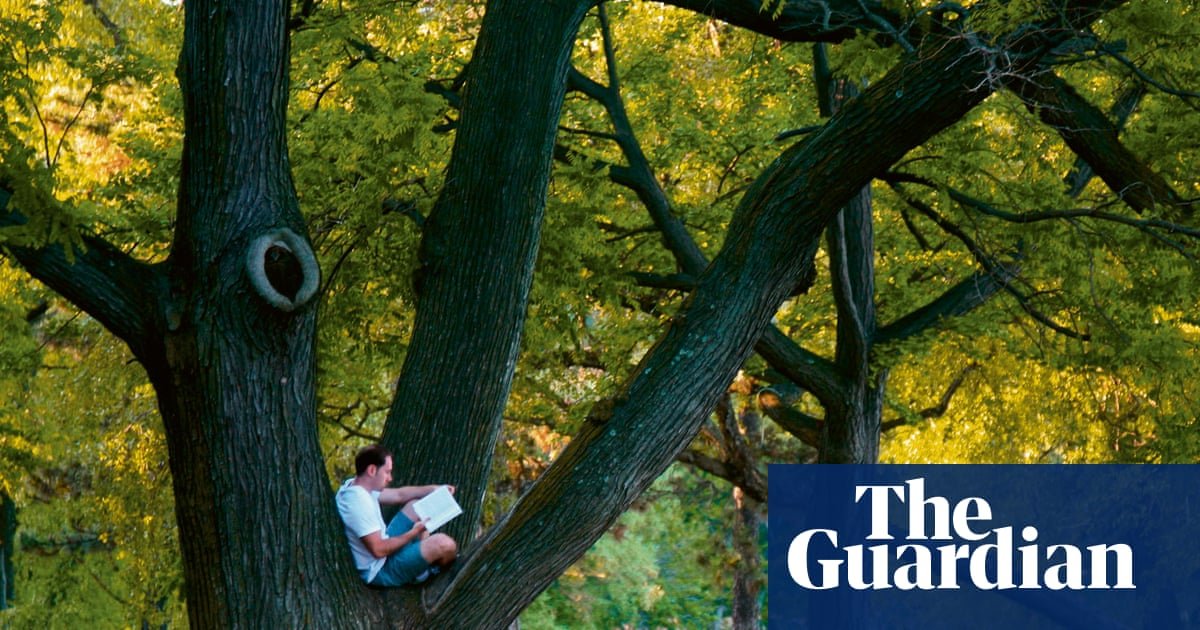
The natural beauty abounds in Prospect Park: in one image, a girl blows a dandelion, a blur of whirled petals at her side. In another, a father sits in a tree and reads a book aloud to his son, who watches from below. “When I saw that, it blew me away,” Shabazz shares. “There’s something artistic about the beauty of the tree, too. It’s an ideal backdrop.” In 1977, still in his youth, Shabazz enlisted in the military and was stationed in Germany’s Black Forest, where the petrichor and greenery made him nostalgic for home. “It reminded me of Prospect Park: being in the field, in the woods, the smell,” he says. When he returned to the city in 1980, “I came home to war. A lot of young men were at odds with each other, and lives were being taken.” He began making portraits with his Canon AE-1, partly inspired by the creativity of his parents. “My father put me on assignment,” he says. “He directed me to look deeper.”
Prospect Park, for Shabazz, was no longer simply thrilling but hallowed. In between spontaneous shoots, he’d walk to Lookout Point, nearly 180ft above sea level, and write. “That was my sacred spot,” he says. “When you’ve been in the military, it takes a while to reacquaint yourself with civilian life. The park served as a transitional space to separate myself from the noise, to be alone.” Shabazz had also joined the New York corrections department, with which he’d spend the next 20 years. Six of those were at Rikers Island, where the conditions were disheartening and the circumstances surrounding the inmates’ detention troubling. “After what I experienced and saw at work, the park was therapeutic.” His co-workers from the academy were among the first people with whom he shared his growing portfolio; eventually, he began mentoring the inmate population. “The photographs started conversations about life, about atonement. If someone came upon a photograph of Prospect Park, it might take them back to a point in their lives when they’d gone there as a child.”
Prospect Park, 1982. Photograph: Jamel Shabazz
Parkgoers, he realized, had a shared objective: seeking comfort. It was easier to approach his subjects there, to ask for permission. “It’s a slower pace. The heart rate goes down. My style was brick walls and gates, but in the park, I had sunrises and sunsets.” The photographs’ light often reveals the season: the red, stained-glass sun of fall; the dappling of glowing gold, marking the dawn of summer. A couple in twin cerulean coats embrace on a snow-dotted bridge. In the spring, another couple do the same, on a tree stump carved with a face (Shabazz has a knack for finding his oeuvre’s parallels; mirror-images poses, snapped decades apart, appear throughout). A man paints an autumnal soccer game en plein air. A woman and two girls feed a paddling of ducks. At Drummer’s Grove, a gathering place where Shabazz met the Vietnam veteran and activist Richard E Green – who contributed an essay to the book’s pages – revelers encircle each other, dancing, wailing on trumpets. If the book has a theme beyond the setting, it is time. In the park, Shabazz had more of it to share. In return, everyone pictured granted him theirs.
Prospect Park, 1982. Photograph: Jamel Shabazz
Shabazz has spoken of spotting his subjects’ beauty, how compelled he feels to hold it up to the light and create what he calls “visual medicine”. He wants to capture love, he says; in doing so, he hopes to give it back. One black-and-white photograph, made in 1982 and featured in a two-page spread in Prospect Park, depicts four smiling women on a bench. When Shabazz posted it on his Instagram, where much of his archive is showcased, a young man contacted him to thank him and share that those were his sisters, three of whom had since passed away. The connections he made back then, even briefly, keep resonating.
Today, he visits Prospect Park infrequently, finding new sacred quiet at Jones Beach, his “second home,” in the fall and winter. When he does return, it’s a reunion. “I go to Drummer’s Grove, because a lot of the people I photographed back in the days are still there. I bring my portfolios and we reconnect.” He describes his camera as a compass, he continues, that “leads me to the people who I need to meet. My objective is to make sure that the history is preserved, to secure my legacy and, importantly, that of all the people who’ve stepped in front of my lens.”
