

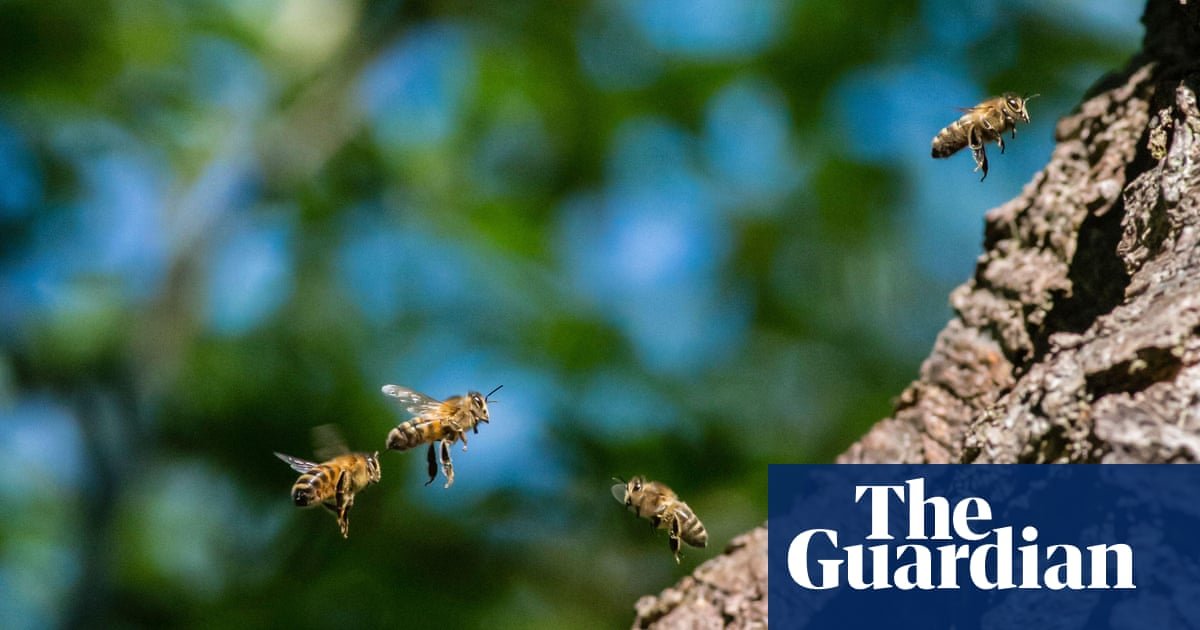
The number of wild bee species in Europe at risk of extinction has more than doubled over the past decade, while the number of endangered butterfly species has almost doubled.
The jeopardy facing crucial pollinators was revealed by scientific studies for the International Union for Conservation of Nature (IUCN) red list of threatened species, which found that at least 172 bee species out of 1,928 were at risk of extinction in Europe.
The number of butterflies threatened with extinction in Europe has increased from 37 to 65 since the last study, conducted 14 years ago. One species, the Madeiran large white (Pieris wollastoni) has now been declared extinct.
“Beyond their beauty and cultural significance, pollinators like bees and butterflies are lifelines for our health, our food systems and our economies – sustaining the fruits, vegetables and seeds that nourish us,” said Grethel Aguilar, the IUCN director general. “The latest European red list assessments reveal serious challenges, with threats mounting for butterflies and crucial wild bee species.”
The causes of the rapid recent declines are the continuing destruction or damage of habitats caused by agricultural intensification and land abandonment, draining wetlands, overgrazing by livestock, and the use of fertilisers and pesticides including neonicotinoids. The fragmentation of pollinator-friendly habitat greatly increases the risk of local extinctions.
Global heating is also revealed to be a major threat: 52% of all endangered butterflies in Europe are imperilled by the climate crisis – approximately twice as many as a decade ago.
Up to 90% of flowering plants in Europe depend on animal pollination, according to Dr Denis Michez, lead coordinator of the wild bee assessment. “Sadly, wild bee populations are in drastic decline and cannot be easily replaced by managed colonies,” he said. “If wild bees disappear, many wild plants might be at risk too – of which flower-rich meadows and beautiful orchid species are just a few examples.”
Fifteen species of bumblebees, which play a crucial role in pollinating peas, beans, peanuts and clover, and 14 species of cellophane bees, known for pollinating trees such as willows and red maples, are now classified as threatened. Simpanurgus phyllopodus, a mining bee unique to the continent and the only species of this genus in Europe, is now assessed as critically endangered – the scientific category closest to extinction in the wild.
Butterflies that are only found on mountain tops are particularly vulnerable to global heating as they need to move uphill as their habitats become warmer but eventually run out of space. In southern Spain, the Nevada grayling and the Andalusian anomalous blue are among more than 40% of European endemics (only found in Europe) threatened with extinction.
In the Mediterranean, species such as the critically endangered Karpathos grayling are imperilled by extreme drought and wildfires.
Meanwhile, in the Arctic Circle, global heating is causing the tree line to move north by tens of metres each year, with scrub encroaching on bog and tundra. Warmer conditions also mean reindeer can no longer cross the ice to graze Arctic grasslands and keep them open. Eight butterfly species are threatened with extinction in this region, including Freyja’s fritillary and the Arctic ringlet.
“The biggest habitat for all these pollinators is flower-rich grassland and that is disappearing very fast across Europe because of all these factors,” said Martin Warren, one of the lead coordinators of the butterflies assessment. “The positive thing is that so many people care now and there’s a lot more awareness. Under the EU nature restoration legislation, all member states have to reverse the decline in pollinators by 2030, and they are going to have to start doing something. There are landowners who are interested. Let’s hope they can get the incentives that will help them on their way.”
According to Warren, there is “low-hanging fruit” in terms of action for pollinators which won’t reduce food production – and may enhance it – such as farmers creating flower-rich margins around their fields.
Jessika Roswall, EU commissioner for environment, water resilience and a competitive circular economy, described the conservation status of wild bees, butterflies and other pollinators as “dire”.
“Urgent and collective action is needed to tackle this threat. Together with member states, the European Commission has put in place an EU-wide monitoring system for pollinators based on the EU nature restoration regulation, which will help to track our progress. Now, we need to focus on implementation and cooperation with member states to protect our pollinators,” she said.
The publication of the bee and butterfly assessments comes after the first Europe-wide assessment of hoverflies, another crucial pollinator group. Published in 2022, it revealed that 37% of all hoverfly species in Europe were threatened with extinction.
