

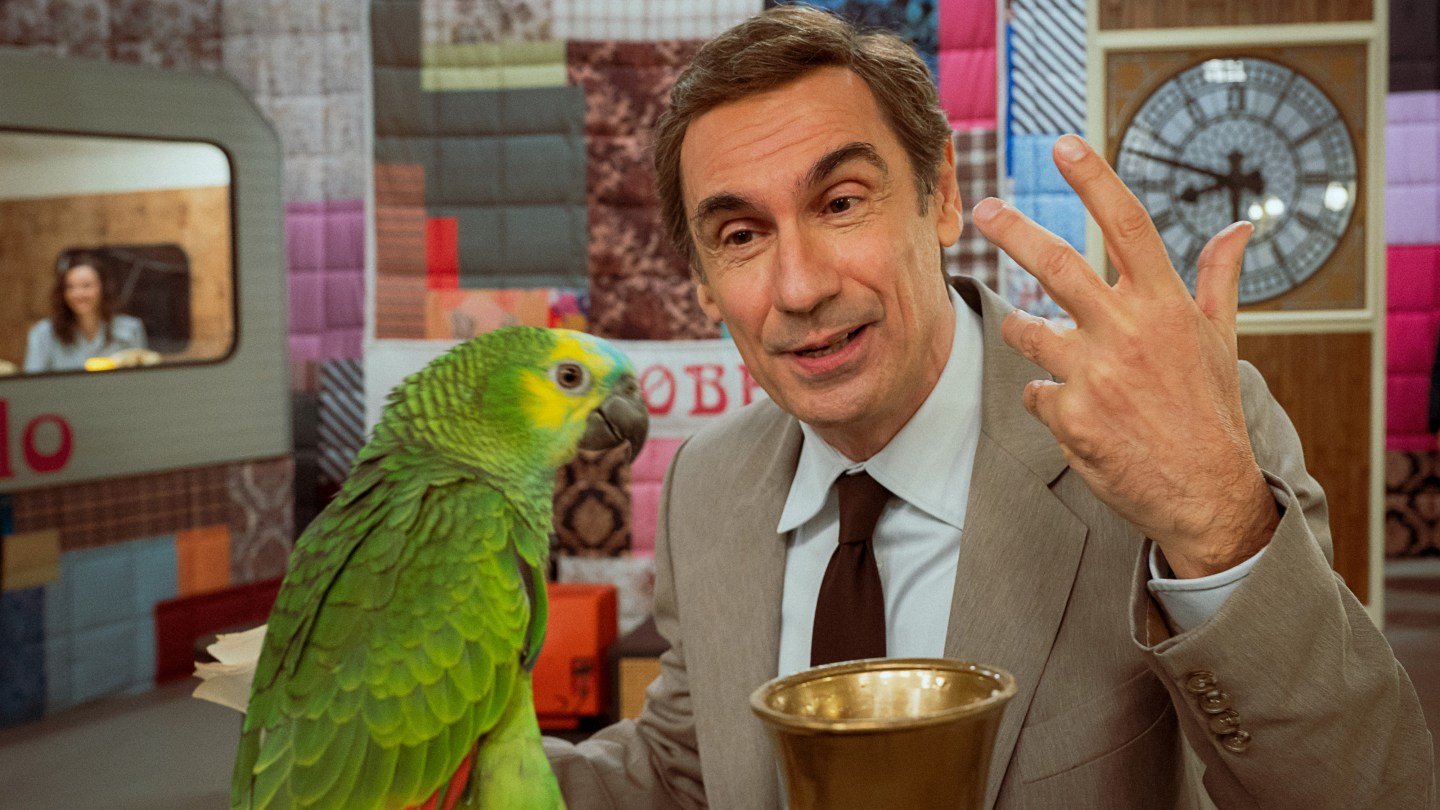
For Portobello, its first Italian original production, HBO Max is taking us back to 1980s Italy and one of the most infamous miscarriages of justice in the country’s history. Legendary Italian auteur Marco Bellocchio (The Traitor, Kidnapped) directed and co-wrote the six-episode series, which tells the story of the downfall and imprisonment of popular TV host Enzo Tortora, an innocent man.
“1982. Enzo Tortora is at the height of his success,” reads a synopsis for the show, whose first two episodes world premiered at the Venice Film Festival before screening at the BFI London Film Festival on Saturday afternoon. “He hosts Portobello, a show reaching 28 million viewers in prime time, where contestants try to make the parrot, the show’s mascot, speak. Tortora is the king of 1980s television, and the president of Italy, Alessandro Pertini, even appoints Tortora Commander of the Republic. During this time, the Irpinia earthquake delivers the final blow to the already fragile balance of the New Organized Camorra criminal organization [that originated in the region of Campania and is one of the oldest and largest criminal organizations in Italy, dating to the 18th century]. Giovanni Pandico, a trusted friend of crime boss Raffaele Cutolo and a regular viewer of Portobello, decides to repent. Interrogated by the judges, he names an unexpected person: Enzo Tortora.”
What follows? “When, on June 17, 1983, the Italian police knock on Tortora’s hotel room, he thinks it’s a mistake, but it is only the beginning of an odyssey that will drag him from the heights to the abyss,” notes the plot summary.
The production by Our Films, a company of the Mediawan group, and Kavac Film, in co-production with ARTE France and in collaboration with Rai Fiction and Fremantle’s The Apartment Pictures, stars Fabrizio Gifuni as Tortora. The series is written by Bellocchio, Stefano Bises, Giordana Mari, and Peppe Fiore, with cinematography by Francesco Di Giacomo.
Portobello will debut in 2026 on HBO Max, where it is available globally, including in upcoming launch markets Italy and the U.K., but excluding France and Germany.
Bellocchio talked to THR, via a translator, about the legacy of the infamous fall of an Italian TV icon and how he enjoyed telling the story for TV rather than film, while maintaining his cinematic style.
Portobello is a true story of police power, failures of the justice system, and the power of media to create and then tear down stars or icons. It is set in the 1980s, but some of the themes may sound familiar to audiences today. Did you ever think about parallels to modern times?
I didn’t think of the fact that it could be timely or contemporary. I was fascinated by this story, which contains aspects that can be considered small or minimal, but also big or high-level elements, such as the fact that it involves the Camorra, involves the justice system, and the Italy of that time, which was already preparing for the Berlusconi era, and in a situation where political parties were already in crisis.
There is this innocent man, but he’s not a saint. This interested me. He’s not a saint, he’s not a hero. This man, however, is kind of forced to take on this role of a hero, which he doesn’t do intentionally, but the injustice against him is so fierce that he, despite his will, becomes a hero. He becomes the herald of the rights of those who suffer injustices in this justice system, which did really everything wrong to him.
Marco Bellocchio on the set of ‘Portobello.’
Courtesy of Anna Camerlingo
There’s so much ambiguity in the character. I am curious how difficult it was for you as a storyteller to convey these layers, these shades of gray. And you have worked with Fabrizio before. Why did you feel he could bring to life this ambiguous personality and character?
As an actor, Fabrizio was certainly the right person. First of all, because he’s an intellectual. He is very highly educated. He’s the son of a judge, so he knew how the judicial system actually worked. Apart from that, he is really an extremely talented actor, and he learns a lot, he studies a lot, he prepares for the character.
He brought exactly this ambiguity I wanted to show because the character has his moral standards, but at the same time, he was worried about defending his own success, the success of his show and his own personal success.
So, I did not want to make it a crusade against the judges, the magistrate who actually made a mistake, which is absolutely impossible to understand. They were completely blind in terms of this case and him. They were not part of any plot or any ploy. They were not accomplices. I’m not saying they were corrupt. They were not part of a ploy, machinery, or anything against him. The only justification that we might mention is the fact that in those years, Camorra was killing maybe a person a day. So the judges were kind of trying to set an example. They were absolutely blind to the situation.
What else do we know about Tortora as a person?
He was not considered a nice person. He was not liked very much. In particular, he was not liked by the left-wing media, because he was not taking any sides, and he was showing off the fact that he was an intellectual a bit, a great or important intellectual. And this was disliked by intellectuals.
Interesting! Did you ever think about making Portobello a movie? And why did you choose a series as the appropriate medium?
Actually, the reason is a very simple one. It is more of a time issue. During the preparation, I was discussing, in particular with the other screenwriters, whether to make this into a movie or to make it into a series. There were moments where we wondered which would be best, but then the idea of making a series out of it prevailed, because there were many, many things that we wanted to tell and wanted people to know, which could not be contained in just one movie. So we decided to make a series out of it.
But clearly, the perspective, the point of view, and the style are those of a film. Many people have told me that they liked the first two episodes, but they would have rather liked to see the whole series. So, basically, the series should all be seen together.
‘Portobello’ with Fabrizio Gifuni
Courtesy of Anna Camerlingo
What was the hardest thing to get right about the show and its look and feel?
The most difficult part was highlighting the connections. Portobello at that time was a very, very popular show, which was able to get an audience of up to 28 million viewers, which is something unthinkable today. But at that time, there were no [streaming] platforms. There was nothing else. So for us, it was extremely important to be able to condense the representation of the show, while at the same time also showing what was happening in parallel.
These parallel stories were key. For instance, the members of the Camorra would accuse him, and they were complete liars. They were lying about him. Clearly, this was done a lot during editing, but it also needed to be in the screenplay, in the script. And it needed to be done also from the filming and shooting point of view. You needed to be able to show the things that were running in parallel to be able to show the connections. So, we had to show that Tortora was moving towards the abyss without knowing it.
For example, at that time, there was also the earthquake in Irpinia, one of the coincidences that led the Camorra people to start accusing Tortora because it was convenient for them. They started seeing that this was something that would be to their advantage, so we needed to give time to these details through screenwriting, filming, and editing.
What role does religion play in the series, given that it often seems to play a key role in Italy?
Actually, there are two levels, the conscious and the unconscious level. On the conscious level, in the third episode, there is a scene about Tortora being a non-believer. He was not an activist against religion. On the contrary, he was very tolerant and he had very good relations with the church, with priests and nuns. He wouldn’t say of himself that he was a non-believer or an atheist, but he would say that he was a liberal person. And at that time, in Italy, religion was very strongly present, with the very strong presence of a Catholic party, the Christian Democrats. So, religion was also very present in the background, for example, in the education of people. I’m referring to myself as well. I don’t know whether today young people are being brought up like this, but as far as I’m concerned, for instance, I describe myself as a non-believer, but my way of reasoning, my way of thinking, is still kind of imbued and permeated by my Catholic upbringing.
What will you work on next? Will we see more TV work from you, or will you go back to film?
I would like to make a movie which has already been announced and which is about an Italian but also North American person and character, Sergio Marchionne, who was an industry leader and manager. He was the CEO of Fiat and managed to save the company, which was about to go bankrupt. He gave this company back the energy. I wouldn’t say he resurrected it, because it was nothing religious. It was very materialistic.
He is very interesting because Marchionne was a real capitalist. He believed in capitalism, but not the type of Italian capitalism where there is always a strong reliance on the welfare state, state support, and where you need to reconcile the interests of the weakest people, while at the same time taking into account the interests of what, at the time, were called the owners, the masters, the entrepreneurs. He chose the road of capitalism and went against two giants in the United States, General Motors first, and then Chrysler. And he managed to take over Chrysler.
This was a fearless and courageous person. He was not a very good person. He was not even completely bad, but certainly he was very interesting as a character. So I was offered to make this movie, accepted, and I’m preparing it.
