

October 8, 2025
3 min read
Annual COVID Vaccines Protect People against Severe Disease, Even with Prior Immunity
A new study shows that receiving an updated COVID vaccine reduced people’s risk of severe disease and death in all age groups, regardless of immunity from prior infection or vaccination
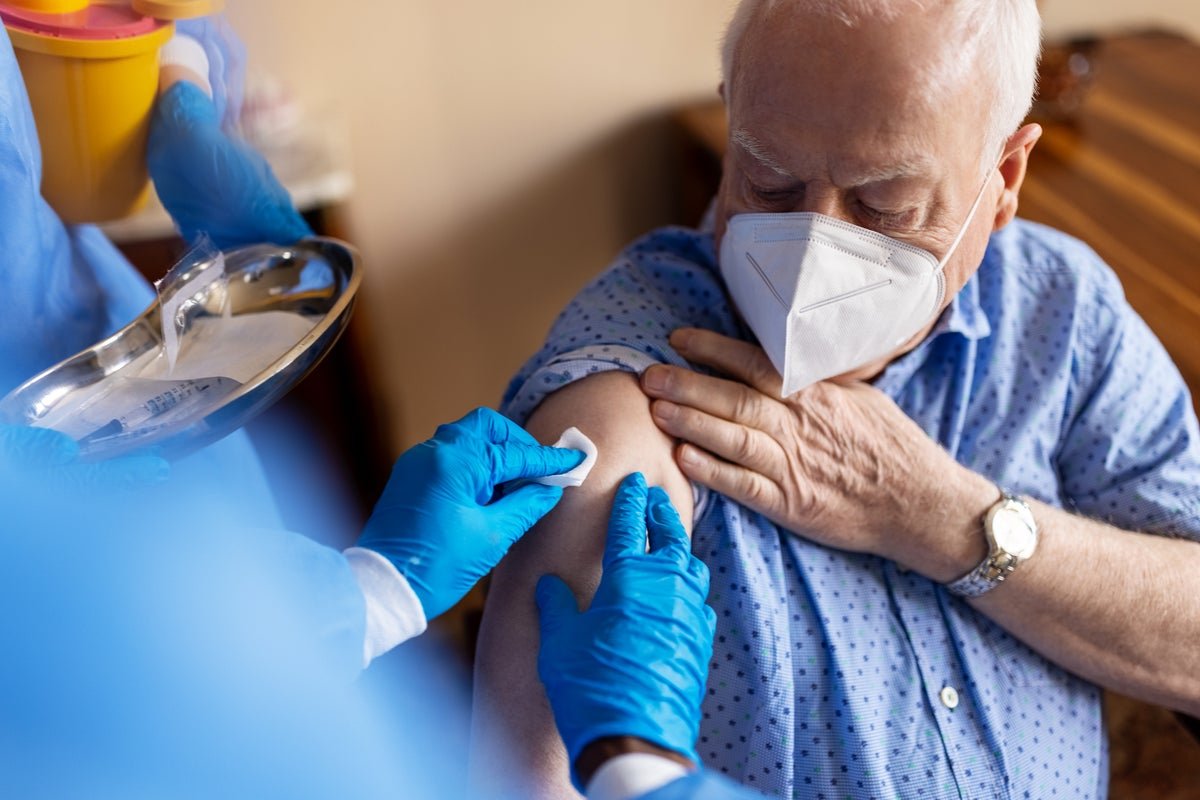
Luis Alvarez/Getty Images
Getting a COVID booster could save your life, even if you’ve had multiple prior infections and vaccinations.
A study, published on Wednesday in the New England Journal of Medicine, showed that last season’s 2024–2025 mRNA COVID vaccines reduced people’s risk of emergency department visits by 29 percent, their risk of hospitalizations by 39 percent and their risk of death by 64 percent. Of the nearly 300,000 U.S. participants in the study, 35 percent received the Pfizer vaccine (COMIRNATY), and 64 percent received the Moderna vaccine (Spikevax). According to the study’s authors, COVID vaccination was effective in all age groups and “in persons with or without major chronic conditions.”
The research is in line with what scientists have seen in previous years. “The vaccine is efficacious, particularly against severe disease,” says Stanley Perlman, a coronavirus researcher and a professor of microbiology and immunology at the University of Iowa, who was not involved in the study. And he and other experts expect the new 2025–2026 COVID vaccines’ performance will follow suit. The study’s authors declined to comment on the new findings.
On supporting science journalism
If you’re enjoying this article, consider supporting our award-winning journalism by subscribing. By purchasing a subscription you are helping to ensure the future of impactful stories about the discoveries and ideas shaping our world today.
The COVID vaccines’ effectiveness against symptomatic disease has generally waned since the first year they became widely available: the 2024–2025 shots offer 29 to 64 percent protection compared with the 94 percent protection given by the vaccines in 2019. This dip, however, is expected in a population with some prior immunity, Perlman says. Nisha Viswanathan, an internal medicine doctor and medical director of the University of California, Los Angeles, Long COVID program, who was not involved in the study, agrees that changes in immunity—and the subsequent response to the vaccines—were anticipated as more people were exposed to the COVID-causing virus, either through prior infection or vaccination.
The new research also “calls into question the idea that younger individuals and those without risk factors don’t need the vaccine,” Viswanathan says. Instead the data show that, while the shot is most effective for older individuals and those with comorbidities, “it was also protective in those without risk factors,” she says. Additionally, Viswanathan says that the study design made the evidence “more compelling” because the authors included enough women and younger individuals, which made the results more balanced and provided a fuller picture of vaccine effectiveness for all cohorts. The Centers for Disease Control and Prevention recommended this year’s COVID shots to adults aged 65 and older and those with underlying health conditions that increase risk of severe disease but decided that vaccination for healthy people older than the age of six months should be based on shared clinical decision-making.
While the research only includes data for last year’s vaccines, Perlman contends that the findings are still relevant to the current season. The virus that circulated last year, just like the one that is circulating now, derives from a single precursor virus called JN.1. Both variants are similar in terms of severity. Because vaccine manufacturers base their formulas on the circulating variant, it’s expected that the current COVID shots will stack up similarly to last season’s.
Real-world data on effectiveness for the new COVID vaccine are still limited, but researchers can make some predictions based on neutralizing antibody levels, known as titers, which indicate the strength of the immune system’s protective response to the virus the vaccines are based on. Both of the 2025–2026 mRNA vaccines, Spikevax and COMIRNATY, target the LP.8.1 variant. COMIRNATY showed a fourfold increase in neutralizing antibody titers above baselines levels, whereas Spikevax showed an eightfold increase. Higher titers generally signify that a formula provides better immune protection, especially against severe disease. Perlman says that Spikevax’s higher titers could be the result of the vaccine including a larger amount of synthetic mRNA molecules. Still, he adds, a twofold difference will not offer meaningfully more protection for most people.
Just 21 percent of the adult U.S. population got vaccinated against COVID last year—a proportion that has been steadily declining. With less vaccine-induced immunity, Perlman says, more people “would benefit even more from getting vaccinated this year.”
It’s Time to Stand Up for Science
If you enjoyed this article, I’d like to ask for your support. Scientific American has served as an advocate for science and industry for 180 years, and right now may be the most critical moment in that two-century history.
I’ve been a Scientific American subscriber since I was 12 years old, and it helped shape the way I look at the world. SciAm always educates and delights me, and inspires a sense of awe for our vast, beautiful universe. I hope it does that for you, too.
If you subscribe to Scientific American, you help ensure that our coverage is centered on meaningful research and discovery; that we have the resources to report on the decisions that threaten labs across the U.S.; and that we support both budding and working scientists at a time when the value of science itself too often goes unrecognized.
In return, you get essential news, captivating podcasts, brilliant infographics, can’t-miss newsletters, must-watch videos, challenging games, and the science world’s best writing and reporting. You can even gift someone a subscription.
There has never been a more important time for us to stand up and show why science matters. I hope you’ll support us in that mission.
