

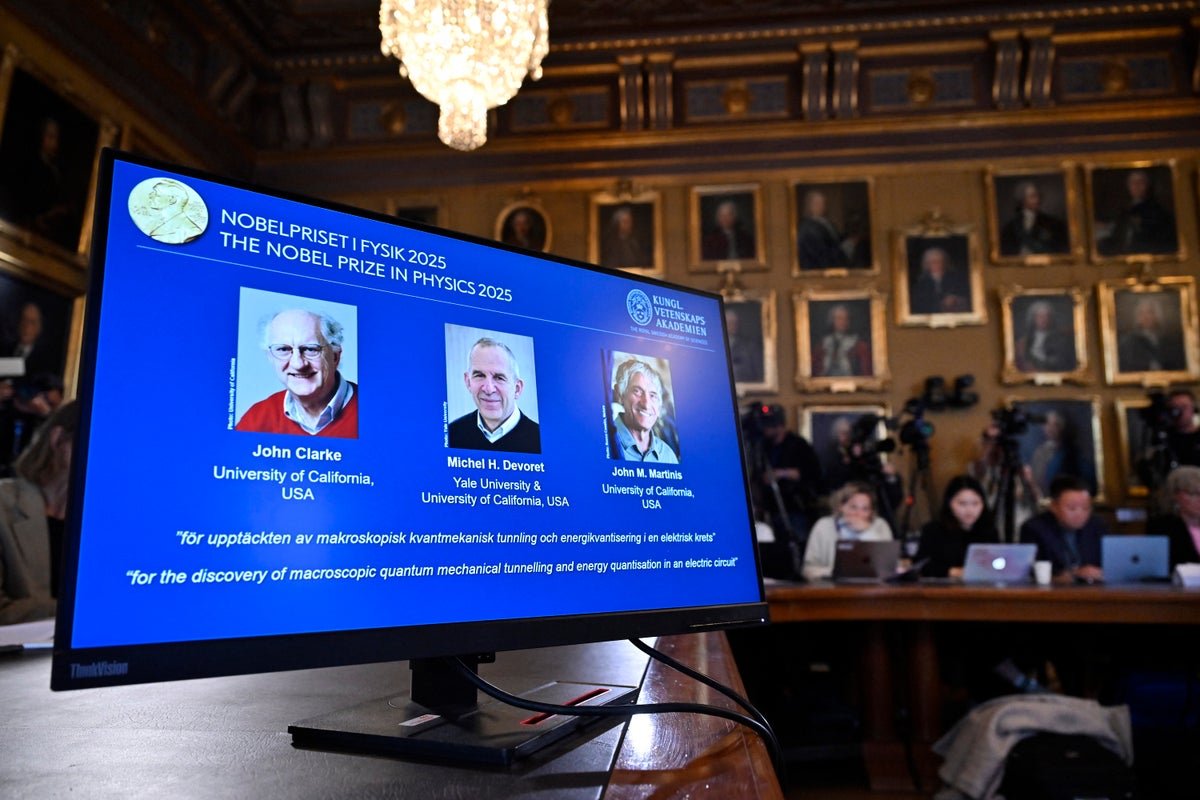
On Tuesday the field of quantum mechanics received a thoughtful 100th-birthday present from the Royal Swedish Academy of Sciences: three shiny new medals, 11 million Swedish kronor (to be divided equally) and bragging rights for a theory that works at all scales.
The 2025 Nobel Prize in Physics went to John Clarke, Michel Devoret and John Martinis for research done 40 years ago at the University of California, Berkeley. There, the trio tinkered with ultracold electronics to show that unruly quantum effects could be made macroscopic and controlled.
Quantum mechanics, it’s often said, only describes the strange behavior of very small things. Electrons do not orbit an atom’s nucleus in well-defined loops; rather, they exist as a hazy cloud of probability. At this quantum level, a smeared-out particle can sometimes “tunnel,” probabilistically passing through barriers it shouldn’t have energy to overcome. All of this is at odds with our classical experience, in which planets have well-defined orbits and balls bounce off or go over walls rather than phasing through them.
On supporting science journalism
If you’re enjoying this article, consider supporting our award-winning journalism by subscribing. By purchasing a subscription you are helping to ensure the future of impactful stories about the discoveries and ideas shaping our world today.
Clarke, Devoret and Martinis showed that a circuit visible to the unaided eye could do the classically impossible: not one but some 100 quadrillion electrons could collectively tunnel in its confines. “It’s a redefinition of what we mean by quantum physics,” says Alexandre Blais, a quantum physicist at the University of Sherbrooke in Quebec. “If you put yourself in the right conditions, quantum effects will emerge.”
The fundamental discovery also paved the way to practical applications. “It’s really the beginning of quantum electrical engineering,” says Steven Girvin, a physicist at Yale University. Researchers have since used circuits inspired by the trio’s work for simulating atoms and sensing otherwise undetectable particles. And these days the circuits are perhaps best known for being qubits, a building block of quantum computers—an application that went largely unmentioned by the Nobel Committee for Physics.
Tunnel Vision
If you were the size of a proton, you could perform a neat quantum party trick by tunneling through a wall 10,000 times thicker than yourself and emerging unperturbed.
“There’s this mystery,” Girvin says. “Why is it that small things look quantum mechanical and large things like footballs and satellites and planets follow the laws of classical mechanics?” The answer, generations of quantum physicists have worked out, has to do with environmental noise. An individual particle can find some peace; a trillion billion are like a mosh pit. Increase the number of particles and you tend to shred delicate quantum conditions, rendering things classical and turning your wall-tunneling party trick into a hospital visit.
There are ways to stay quantum even at a macroscopic scale. In superconductors, such as the multiton magnets inside magnetic resonance imaging (MRI) machines, electrons are cooled below a critical temperature. In this frigid state, electrons become complaisant enough to forgo their usual resistance and flow frictionlessly.
But in 1981 it was still unclear if macroscopic quantum systems could also be put into a superposition, or combination of distinct states. In other words: Could a large number of electrons get caught between being “dead” and “alive,” like Erwin Schrödinger’s hypothetical cat? Two theoretical physicists, Tony Leggett and Amir Caldeira, both then at the University of Sussex in England, realized that looking for quantum tunneling in a superconducting circuit might be the ideal way to answer the question.
Over the next few years, groups at IBM and Bell Labs attempted to spot macroscopic tunnelling in devices called Josephson junctions, which are circuits made from two superconductors separated by a thin insulating barrier. (The devices are named for Brian Josephson, who won a portion of the 1973 physics Nobel for his work on the system.) Electrons can be in two states: they can be blocked by the barrier, registering zero voltage, or they can clear it, generating a nonzero voltage. These two states correspond to the unfortunate feline’s indeterminate alive-or-dead status in Schrödinger’s original thought experiment. “It’s really a superposition of the ‘cat’—dead or alive,” says Caldeira, who is now at the University of Campinas in Brazil.
The trouble is that just detecting a voltage doesn’t mean there’s tunneling. Electrons can clear the barrier the classical way, too, with a leg up from random thermal energy, instead of tunneling through it. Unable to eliminate the possibility of thermal noise even at temperatures of one kelvin (that is, just one degree above absolute zero), the teams at IBM and Bell Labs could not definitively claim they’d seen macroscopic tunneling.
Cool It
To meet Leggett and Caldeira’s challenge, the Berkeley group went to great lengths to isolate their system from the environment by putting their centimeter-sized chip at the end of a tube packed with powdered copper to tamp down noise. Then they cooled their Josephson junction down to 0.01 kelvin.
With their device cooled and isolated, they drove a current in the circuit and measured the voltage. Repeated tests showed that electrons passed the barrier even when thermal noise essentially vanished. Clarke, Devoret and Martinis had conclusive proof that macroscopic quantum objects, such as a multitude of electrons, could tunnel, too.
When Schrödinger proposed his thought experiment in 1935, he had meant it as a critique of the seemingly paradoxical conclusions quantum mechanics implied about the classical world. Unlike a particle in superposition, a cat could not actually be blurred between being “dead” and “alive.” Any confusion about the cat’s state could be addressed by a direct measurement. “That prevents us from so naively accepting as valid a ‘blurred model’ for representing reality,” Schrödinger wrote at the time, according to a translation by physicist John D. Trimmer. “There is a difference between a shaky or out-of-focus photograph and a snapshot of clouds and fog banks.”
What Clarke, Devoret and Martinis showed is that even macroscopic reality can be blurred if it is shielded from direct contact with the wider environment. By isolating their electrons from noise and staying at ultralow temperatures, they were able to bring the foggy indeterminacy of quantum mechanics into a circuit one could hold in the palm of a hand. “It’s quantum mechanics all the way up,” Girvin says.
Circuit Breaker
The Berkeley group’s discovery also had a second component. By shining microwaves at the right frequency on the circuit, they found that it emitted and absorbed energy in discrete “quantized” chunks (a hallmark of quantum systems but not of classical objects). This kind of quantized system has found a number of uses, such as modeling atoms.
On the surface, the superconducting circuit looks nothing like an atom, which is more than a million times smaller. But fundamentally it shares the same physics of an atom shifting between ground and excited states. In recent years, researchers have used this artificial atom concept to design and study all kinds of novel atomic systems.
The circuits’ sensitivity also makes them ideal detectors for subtle phenomena that release microwaves. Over the past decade they have been incorporated into the search for hypothetical dark matter particles called axions—Clarke, in fact, is a collaborator on one such project, the Axion Dark Matter Experiment. “This was not the goal” of the Berkeley group, Blais says. “But that’s the beauty of fundamental science. You have surprises.”
After the trio’s breakthrough in the mid-1980s, circuit designs improved over the next decade so that by 1999, physicists at the Nippon Electric Company in Japan could boast of creating a superconducting circuit that quickly and reliably oscillated between two energy levels—what we now call a qubit. Superconducting circuits are one of the leading architectures for quantum computers, used by companies such as Google and IBM and by researchers around the world. Martinis, in particular, is known for work with a team at Google using such qubits to make record-breaking quantum computers.
Fueled by this frenzy of research activity, quantum computing has garnered massive and ever-increasing amounts of publicity and funding as companies and countries try to capitalize on the technology. Overstated claims are rampant, in many cases verging into baseless hyperbole. Quantum computers are not, in fact, going to solve climate change.
So it came as something of a surprise when the Nobel Committee for Physics avoided almost all mention of quantum computing during its announcement of this year’s physics prize. In the announcement’s official scientific background information, the topic received only two mentions. The committee’s careful message discipline paid off, and news headlines focused more on the fundamental physics and less on the buzzy application.
For many physicists, the absence of hype was a relief and the downplay of quantum computing a reasonable choice. “You can fully justify the importance of this experiment without those practical implications,” Girvin says. After all, “we don’t yet know how practical quantum computing is actually going to be.”
