
Close Menu

    Subscribe to Updates

    Get the latest creative news from FooBar about art, design and business.

    What's Hot

    Chemical suppression: why the UK is exploring libido control drugs to treat sex offenders | Crime

    US kindergarten vaccination rates dip as exemptions hit record high | Vaccines and immunisation

    Thousands of sex offenders in England and Wales could get libido-suppressing drugs | Prisons and probation

    Facebook X (Twitter) Instagram
    Facebook X (Twitter) YouTube LinkedIn
    Naija Global News |
    Sunday, August 23
    • Business
    • Health
    • Politics
    • Science
    • Sports
    • Education
    • Social Issues
    • Technology
    • More
      • Crime & Justice
      • Environment
      • Entertainment
    Naija Global News |
    You are at:Home»Science»Groundbreaking quantum-tunnelling experiments win physics Nobel
    Science

    Groundbreaking quantum-tunnelling experiments win physics Nobel

    onlyplanz_80y6mtBy onlyplanz_80y6mtOctober 8, 2025004 Mins Read
    Share Facebook Twitter Pinterest LinkedIn Tumblr Email
    Groundbreaking quantum-tunnelling experiments win physics Nobel

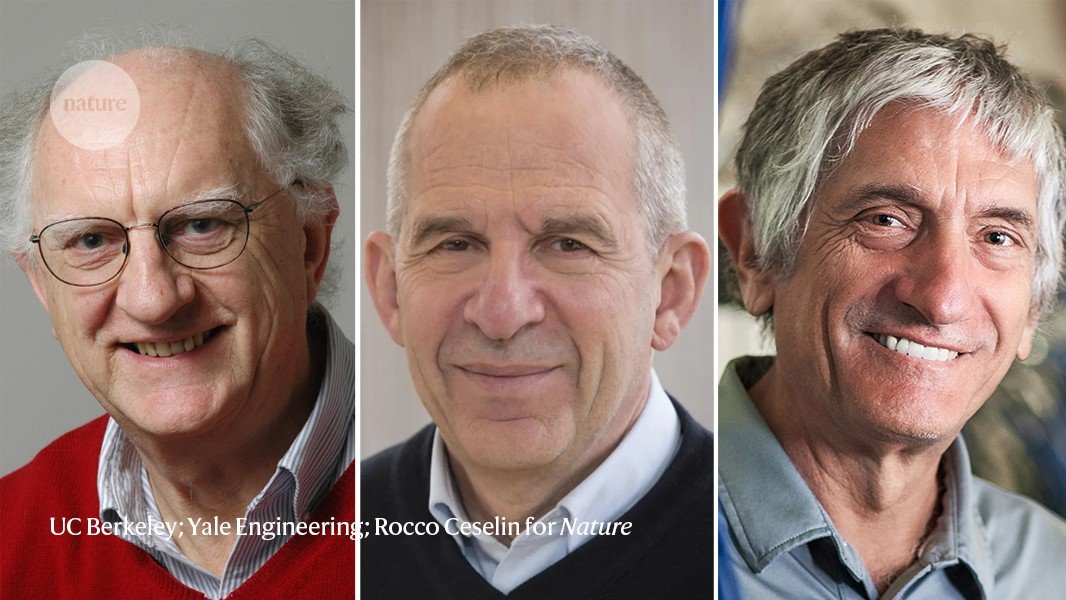
    John Clarke, Michel Devoret and John Martinis revealed quantum physics on a macroscopic scale. The work was a milestone for the development of superconducting quantum circuits.Credit: UC Berkeley; Yale Engineering; Rocco Ceselin for Nature

    Share
    Facebook Twitter LinkedIn Pinterest Email

    John Clarke, Michel Devoret and John Martinis revealed quantum physics on a macroscopic scale. The work was a milestone for the development of superconducting quantum circuits.Credit: UC Berkeley; Yale Engineering; Rocco Ceselin for Nature

    Three physicists have been awarded the 2025 Nobel Prize in Physics for demonstrating quantum physics on the macroscopic scale.

    The research, including into the bizarre phenomena of quantum tunnelling and quantum superposition, has helped to underpin some of today’s most advanced quantum computers.

    John Clarke at the University of California, Berkeley, Michel Devoret at Yale University in New Haven, Connecticut, and the University of California, Santa Barbara (UCSB), and John Martinis, also of USCB will share the prize of 11-million Swedish kronor (US$1.2 million), announced by the Royal Swedish Academy of Sciences in Stockholm on 7 October.

    “I am completely stunned; it had never occurred to me in any way that this might be the basis for a Nobel prize,” said Clarke, speaking to journalists gathered for the announcement. “I think that our discovery in some ways is the basis of quantum computing,” he said, adding that although he led the trio’s work in the 1980s, the contributions of the other two were “overwhelming”.

    Martinis told Nature that his wife had gotten the news in the middle of the night — in California time — but decided not to wake him up quite yet. “I woke up a little bit before 6. Then I opened my computer and saw John and Michel’s and my pictures.”

    “It is wonderful to be able to celebrate the way that century-old quantum mechanics continually offers new surprises. It is also enormously useful, as quantum mechanics is the foundation of all digital technology,” said Olle Eriksson, a physicist at Uppsala University in Sweden and chair of the Nobel Committee for Physics.

    Quantum tunnelling of electrons brings ultrafast optical microscopy to the atomic scale

    Macroscopic quantum mechanics

    The foundations of quantum mechanics were laid down 100 years ago. But many of its strange implications have taken decades to unravel.

    One is the phenomenon of quantum tunnelling — the ability of particles to pass straight through a barrier that shouldn’t be possible according to classical physics, given its energy. Tunnelling explains radioactive decay, in which, despite being confined inside an atom, an alpha particle still has a small probability of escaping the nucleus. Another is quantum superposition, in which an object can exist simultaneously in two states.

    Both tunnelling and superposition were known at the atomic scale but hadn’t been observed in macroscopic systems. In the late 1970s, Anthony Leggett, who won the 2003 Nobel Prize in Physics for his theoretical work on superconductors, asked whether the phenomena would be observable at the macroscopic scale using superconducting circuits — loops of wire which, when chilled to a fraction of a degree above absolute zero, can conduct electricity without resistance1.

    “We took the question very seriously — would quantum mechanics be obeyed by these large systems? And we thought very carefully how we would prove that,” Martinis recalls. In the 1980s, Clarke, Devoret and Martinis, working at Berkeley, were among those exploring quantum effects in superconducting loops2. The trio set up an experiment in which two superconductors were separated by a thin barrier, known as a Josephson junction3. In this state, a supercurrent can flow with zero resistance, like a river that runs without friction — but also with zero voltage, so without a downhill gradient that gives the current a push. In classical physics, the system would stay stuck like this, unless given enough energy to escape.

    By carefully monitoring the system, and slowly increasing the current, Clarke, Devoret and Martinis showed that the entire tiny circuit could break out into a higher energy state — by quantum tunnelling, which they observed by measuring a voltage spike. Yasunobu Nakamura, a physicist at the University of Tokyo, says that it still came as a surprise to many that quantum mechanics could manifest itself at such large scales.

    “They are really pioneers of this field,” says Nakamura, who in the late 1990s became the first physicist to demonstrate a superconducting qubit bit or ‘qubit’ using a similar principle.

    Experiments Groundbreaking Nobel Physics quantumtunnelling win
    Share. Facebook Twitter Pinterest LinkedIn Tumblr Email
    Previous ArticleWhite House memo says federal workers may not get automatic backpay: Report | Donald Trump News
    Next Article A Compact for Control (opinion)
    onlyplanz_80y6mt
    • Website

    Related Posts

    The Guardian view on Shabir Ahmed: changing the law to deport one man will not win back the public’s trust | Editorial

    July 13, 2026

    Andy Burnham can win back Labour voters by supporting migrants | Immigration and asylum

    July 9, 2026

    Fall in NHS waiting lists is not a Labour win | NHS

    June 28, 2026
    Add A Comment
    Leave A Reply Cancel Reply

    Top Posts

    The science influencers going viral on TikTok to fight misinformation

    February 17, 20262 Views

    How Paul Newby Made North Carolina a Blueprint for Conservative Courts — ProPublica

    October 30, 20251 Views

    Watch Lady Gaga’s Perform ‘Vanish Into You’ on ‘Colbert’

    September 9, 20251 Views
    Stay In Touch
    • Facebook
    • YouTube
    • TikTok
    • WhatsApp
    • Twitter
    • Instagram
    Latest Reviews

    At Chile’s Vera Rubin Observatory, Earth’s Largest Camera Surveys the Sky

    By onlyplanz_80y6mtJune 19, 2025

    SpaceX Starship Explodes Before Test Fire

    By onlyplanz_80y6mtJune 19, 2025

    How the L.A. Port got hit by Trump’s Tariffs

    By onlyplanz_80y6mtJune 19, 2025

    Subscribe to Updates

    Get the latest tech news from FooBar about tech, design and biz.

    Most Popular

    The science influencers going viral on TikTok to fight misinformation

    February 17, 20262 Views

    How Paul Newby Made North Carolina a Blueprint for Conservative Courts — ProPublica

    October 30, 20251 Views

    Watch Lady Gaga’s Perform ‘Vanish Into You’ on ‘Colbert’

    September 9, 20251 Views
    Our Picks

    Chemical suppression: why the UK is exploring libido control drugs to treat sex offenders | Crime

    US kindergarten vaccination rates dip as exemptions hit record high | Vaccines and immunisation

    Thousands of sex offenders in England and Wales could get libido-suppressing drugs | Prisons and probation

    Recent Posts
    • Chemical suppression: why the UK is exploring libido control drugs to treat sex offenders | Crime
    • US kindergarten vaccination rates dip as exemptions hit record high | Vaccines and immunisation
    • Thousands of sex offenders in England and Wales could get libido-suppressing drugs | Prisons and probation
    • 40,000 bottles of eye drops across the US recalled over issues with sterility of product | Product recalls
    • Trump’s new attorney general poses a huge threat to abortion rights | Moira Donegan
    © 2026 naijaglobalnews. Designed by Pro.
    • About Us
    • Disclaimer
    • Get In Touch
    • Privacy Policy
    • Terms and Conditions

    Type above and press Enter to search. Press Esc to cancel.