

You have full access to this article via your institution.
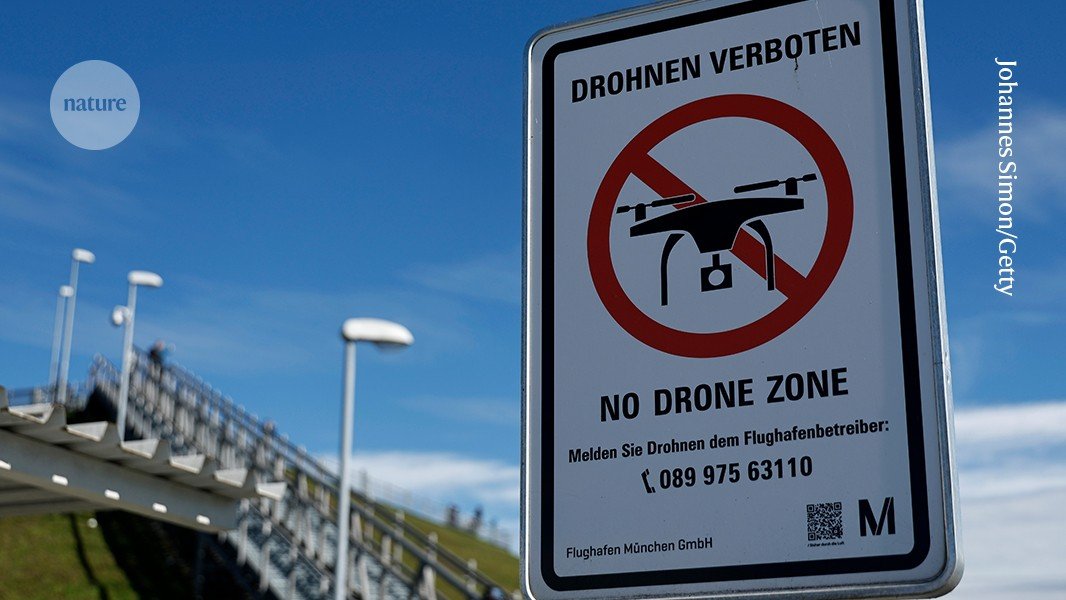
Unidentified drone flights are causing alarm, chaos and uncertainty in European aviation.Credit: Johannes Simon/Getty
In July, the European Commission announced a proposal to nearly double the European Union’s Horizon Europe research-funding budget to €175 billion (US$205 billion) for its next seven-year period, which begins in 2028. But any celebrations did not last long. The commission also confirmed its intention, first mooted earlier this year, to abolish a long-standing rule that restricts Horizon funding to projects with only civilian applications. If the change is implemented, it would be the first time that the EU’s principal research fund (previously known as the Framework Programmes) would allow ‘dual-use’ research — that is, work that could have both civil and military applications — since the programmes began in 1984.
How Europe aims to woo US scientists and protect academic freedom
The Brussels-based commission, one of the EU’s three law-making bodies, also plans to change the maximum length of term served by heads of the European Research Council (ERC), the EU’s widely admired fund for investigator-led research. Until now, the ERC president has served a four-year term, which could be renewed once; the change would cut each of those potential terms in half. Last week, the ERC’s current head, Maria Leptin, had her tenure renewed — but for only two years.
Such changes are characteristic of a growing trend of politicians interfering in the inner workings of research and research-governance processes. This has been evident in the United States of late; in the case of the EU, it is being done in the name of its member states’ national security. Changes are being announced without consultation or, it seems, consideration of the implications. Partly in response, the ERC’s governing body, its Scientific Council, took the unprecedented step of writing to the commission in June to suggest that the ERC be given more independence from the commission and be made into a stand-alone EU agency.
Announcing decisions without consulting those affected marks a departure from the way the EU’s research institutions have typically operated. Abandoning this approach is, to put it charitably, unwise. The commission’s proposals must now be comprehensively scrutinized by the EU’s other law-making institutions — the European Parliament, which is elected by the citizens of member states, and the Council of the European Union, which represents national governments. They, in turn, must be guided by the EU’s networks of scientific advisers.
Will Europe ramp up defence research? War prompts major rethink
Much of Europe is either on or close to a war footing, which is understandably having a big impact on research. Over the past few weeks, unidentified drone flights have led to the closure of some of the region’s main airports, causing chaos, alarm and uncertainty. Along with Russia’s invasion of — and continued war in — Ukraine, these incidents underscore why, after some 80 years of relative peace, the continent’s leaders are making massive investments in defence and security.
National security is often described as the first responsibility of any government. However, this does not mean that politicians should be permitted to interfere in the inner workings of research — an issue that is also evident at the national level. In the United Kingdom, for example, the government has instructed the Alan Turing Institute, the national centre for data science and artificial intelligence, to prioritize defence and security.
A science mega-programme is taking shape in the EU: what it means for researchers
Ekaterina Zaharieva, the European Commissioner for research and innovation, said in July that the division between civil and military applications is often artificial, and that “we cannot miss out on the potential of research and innovation to make Europeans safer”. But there’s a spectrum of fields with little, if any, connection to warfare that are also essential to safety, security and well-being, including environmental science, health and medical science, and social science. If the effect of the EU’s policy change is to squeeze budgets for such research, it is hard to know how gains in one area will be affected by losses elsewhere.
Science has a core role in defence and in warfare. But, as Kurt Deketelaere, secretary-general of the League of European Research Universities, has said, the lack of consultation in the EU’s research policymaking is eroding the already fragile trust between the continent’s leaders and the research community, and it sets an unwelcome precedent — that the research budget can be repurposed any time there is a new political priority. Such meddling is unlikely ever to serve the best interests of science or society as a whole.
