

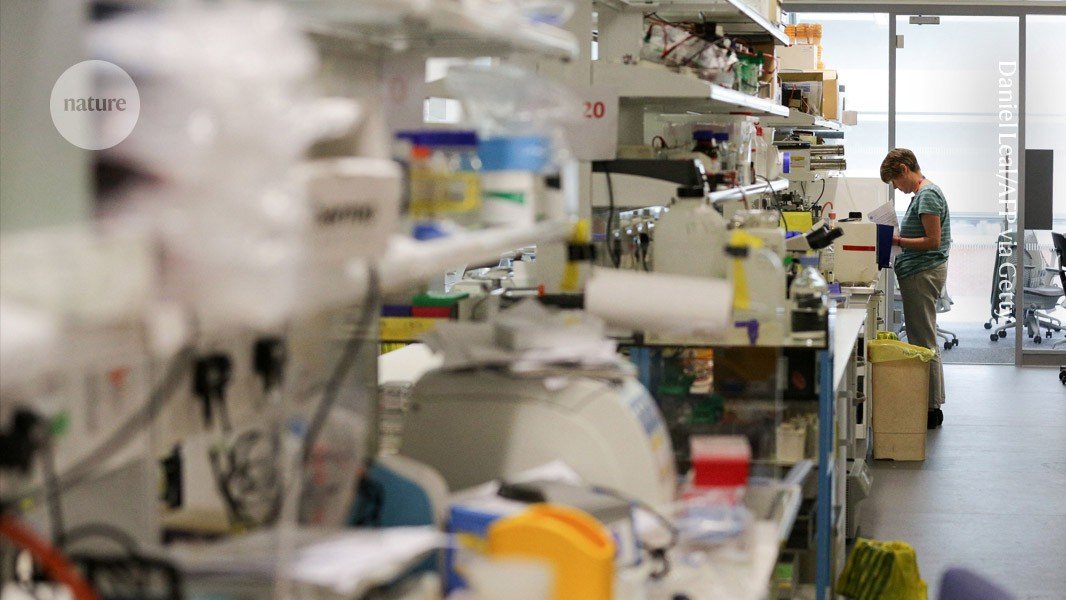
The benefits of doing science can feel abstract, but a new tool can trace how research projects had broad societal impacts on policies, medicines or products.Credit: Daniel Leal/AFP via Getty
Scientific research offers many benefits to society, but how do you trace the impact of specific projects? It’s easy to track which papers result from a grant, but much harder to follow how research has broader societal impacts on policies, medicines or products.
“Those are much more exciting [impacts], and provide greater public good,” says Dashun Wang, director of the Center for Science of Science and Innovation at Northwestern University in Evanston, Illinois.
Wang and his colleagues built a tool called Funding the Frontier, which integrates data on research publications, patents, policy papers and clinical trials, and presents the information in a visually intuitive way. They also combined the tool with a machine-learning-driven predictive algorithm to forecast which studies and fields are likely to lead to the most societal benefits in the future — for example, which grants are most likely to result in a patent. They described the prototype in a paper published on the arXiv preprint server1.
Funding the Frontier includes a mind-boggling amount of data, drawn from four large data sets: the Dimensions, Altmetric and Overton databases, as well as the authors’ own SciSciNet data set. The total collection links 7 million research grants to 140 million scientific publications, 160 million patents, 10.9 million policy documents, 800,000 clinical trials and 5.8 million newsfeeds, all published between 2000 and 2021, with 1.8 billion citation linkages among them. The data can be displayed in several ways, showing the impacts that flowed from a particular study and tracing outcomes back to their sources and all the links between them.
Staša Milojević, who studies the science of science at Indiana University in Bloomington and was not involved in developing the tool, says that it could help to fill an important gap when it comes to translating studies of how science works into useful data. “Many studies in the area of ‘science of science’ have potential science-policy and funding implications,” she says. “However, their practical impact is often limited because they lack the tools that stakeholders can easily use to obtain useful insights.”
The size of the database, and its ability to link disparate strands together, is the biggest advantage, says Milojević. “The sheer amount of data, and the degree of data aggregation associated with FtF [Funding the Frontier], is impressive,” she says. “Even without its predictive aspect, having a tool that allows one to look up PIs [principal investigators] or grants from wide areas of science and evaluate them in terms of their various research metrics normalized for variations over fields and time is extremely useful.”
How to demonstrate the real-world impact of your research
Case studies
Wang expects that many people will be interested in the tool. Funders might use it to investigate their funding portfolio to see which areas have been most productive; university administrators could investigate the footprint of their institution, to identify areas of strength and weakness and help to decide where to invest.
“There’s an infinite amount of questions you could ask,” he says.
The preprint, which is yet to be peer reviewed, includes case studies involving anonymous potential users. One project manager at a large US funding agency used it to examine the broad social impacts of the agency’s grants, which he said he had never been able to see before. He found that their projects had been cites in policy documents in Germany and the United Kingdom and at other intergovernmental organizations. But he also identified a previously unknown gender disparity — namely that, in some fields, female PIs were under-represented — which he planned further investigate.
A second user, who works for a private investment firm specializing in biomedical research, was most interested in the tool’s predictive potential. He found that, in the field of Alzheimer’s research, the biggest clinical impact over the past 20 years came from studies aimed at understanding the disease, but the biggest predicted future impact was concentrated in studies of the social-support systems of people with the disease — suggesting a potential new investment opportunity.
