

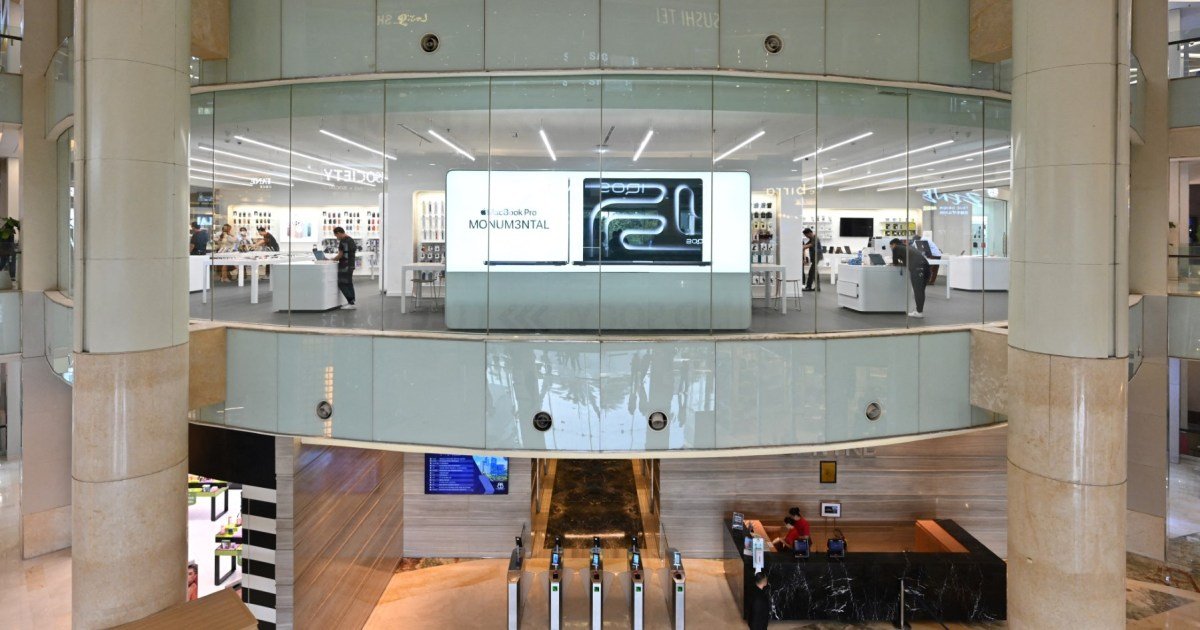
Medan, Indonesia – Delima, a sales representative in Indonesia’s fourth-largest city, used to collapse the moment she got home after spending the whole day on her feet serving customers.
But recently, Delima, who works at a cosmetics store in one of Medan’s upscale malls, has felt like she has “nothing to do”.
Recommended Stories
list of 4 itemsend of list
“The mall is so quiet now, and when customers do come into the store, they have no intention of buying anything. They just use all the free testers, especially perfume, and then leave,” she told Al Jazeera.
Delima’s experience reflects “Rohana” and “Rojali”, the latest buzzwords to sweep Indonesian social media, in action.
“Rohana” and “Rojali”, portmanteaus of the Indonesian for “groups who just ask” and “groups who rarely buy”, have emerged as popular internet slang terms to describe the phenomenon of people who visit malls purely to engage in window shopping.
While it is difficult to put a precise figure on Indonesia’s window shoppers, there are signs that many Indonesians are tightening their belts as they find their rupiah going less far than in the past.
PT Unilever Indonesia, which produces everyday products ranging from ice cream to shampoo and toothpaste, saw its sales decline nearly 4.5 percent in the first half of 2025.
PT Matahari Department Store, which operates a chain of stores selling clothes, household appliances and beauty products, saw a steeper drop of more than 9 percent.
People walk through a connecting bridge to shopping malls in Jakarta, Indonesia, on October 10, 2021 [Adek Berry/AFP]
Tulus Abadi, the chairman of the Indonesian Consumers Foundation, said discussions of “Rohana” and “Rojali” reflect real shifts in people’s material circumstances.
“Transactions at shopping centres are dropping significantly. Sales of private cars and motorcycles are also declining,” he told Al Jazeera.
“This indicates that middle-class consumers are experiencing a decline in purchasing power. Yet, it is the middle class that is the driving force of the economy.”
On paper, Southeast Asia’s largest economy has been in good shape of late. Gross domestic product (GDP) expanded by 5.12 percent year-on-year in the April-June period, according to the Indonesian Bureau of Statistics, the fastest pace in two years and ahead of economists’ forecasts.
Still, economic discontent among Indonesians is not hard to find, erupting most visibly in deadly protests that swept the archipelago in late August.
Thousands of Indonesians took to the streets in cities across the country to protest against budget cuts to education, public works and healthcare, as well as the introduction of a monthly housing allowance for lawmakers worth about $3,000 – almost 10 times Indonesia’s monthly minimum wage.
In a survey published by the ISEAS-Yusof Ishak Institute in Singapore in January, young Indonesians expressed markedly more pessimistic attitudes about the economy and the government than their peers in Thailand, Malaysia, Singapore, the Philippines, and Vietnam.
Whereas an average of 75 percent of respondents expressed optimism about the government’s economic plans across the six countries, only about 58 percent of Indonesian youth felt the same, according to the poll.
About 16 percent of the more than 44 million Indonesians aged 15-24 are out of work, according to government statistics – more than double the rate of neighbouring Thailand and Vietnam.
Government officials have downplayed suggestions that Rohana and Rojali reflect real-life conditions.
Speaking at a news conference in Jakarta last month, Chief Economic Affairs Minister Airlangga Hartarto said spending habits were simply moving online, pointing to rising household consumption among other positive data.
“The narrative around Rojali and Rohana is being blown out of proportion,” Airlangga said.
Airlangga Hartarto, Indonesia’s chief economic affairs minister, speaks during an interview at his office in Jakarta, Indonesia, on August 26, 2025 [Willy Kurniawan/Reuters]
Teguh Yudo Wicaksono, an economics lecturer at Universitas Islam Indonesia, said official economic data painted a complex picture.
While household consumption grew nearly 5 percent in the second quarter, retail sales weakened slightly, though remaining higher than the same period last year, Wicaksono said.
“So, what can we conclude from this indicator? I think there may indeed be a weakening of purchasing power, but this may be occurring in certain segments,” he said.
Wicaksono said while weakened purchasing power could be at play, consumers also appeared to be shifting their spending patterns.
“People are starting to increase spending related to sports, hobbies, and entertainment. Some are spending on services,” he said.
“The proportion of this increase in spending has almost doubled, and this is happening primarily in the lower-middle-class segment. As a result, the portion of spending in other groups has decreased, especially for certain types of goods. This is what we perceive as the Rohana and Rojali phenomenon.”
Abadi of the Indonesian Consumers Foundation said the growing popularity of internet shopping had contributed to the Rohana-Rojali trend.
“The digital economy has rendered malls merely a means of window shopping,” he said.
In an online survey conducted earlier this year by Snapcart, a platform for analysing consumer behaviour based on customer receipts, half of the Indonesian respondents said they viewed online shopping as more practical than visiting brick-and-mortar shopping centres.
Shopee was the most popular platform, used by 90 percent of online shoppers, followed by Tokopedia, Lazada and Alfa Gift, according to the survey.
Indonesian shoppers roam around a mall in Jakarta, Indonesia, on March 14, 2008 [Jewel Samad/AFP]
Dewi Fauna, an admin assistant for an overseas client, said she had begun to embody the Rohana and Rojali phenomenon due to budget concerns and the convenience of e-commerce.
“I only go to the mall to eat in the restaurants and I rarely buy anything, mostly because of the price, and there are not as many options,” she told Al Jazeera.
“I don’t like to look around from one store to another just to find one item. With the same quality, you can get cheaper if you shop online.”
Fauna said she enjoys frequenting malls for the social aspect that they can provide.
“I go with friends or with my husband. I never go alone to the mall because the purpose of going to the mall, for me, is having fun with friends, and chatting while eating,” Fauna said.
“We only eat out once a week and, because I like to explore different foods at the restaurants, I don’t mind spending the money on that to make myself happy,” she added.
