

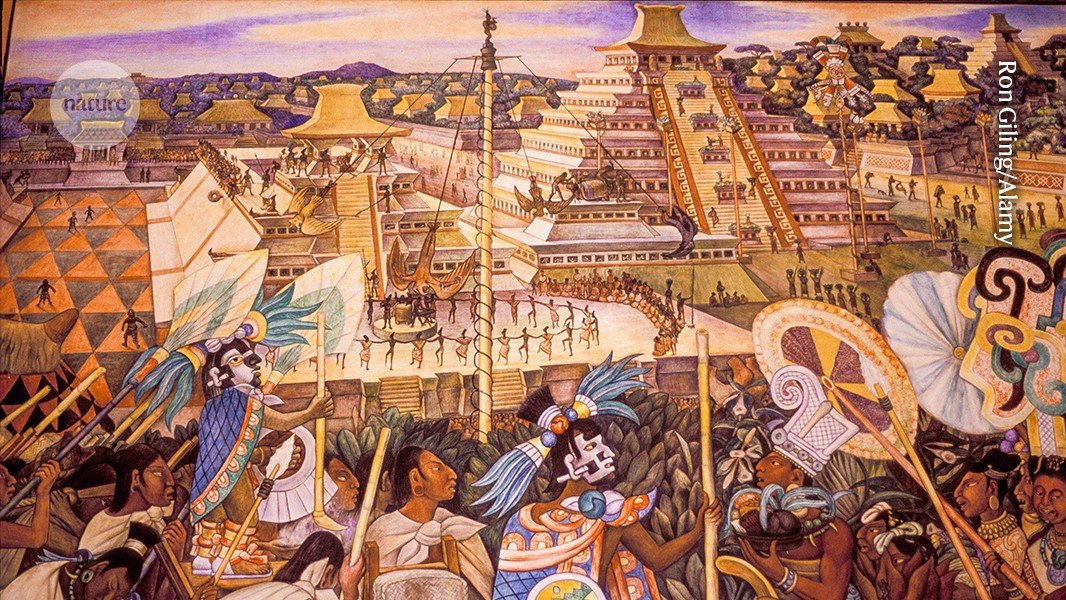
The Great Holocene Transformation: What Complexity Science Tells Us about the Evolution of Complex Societies Peter Turchin Beresta Books (2025)
When Spanish conquistador Hernán Cortés arrived in Mexico in 1519, he found monarchs, cities, roads, markets, schools, astronomers, law courts and much else that also existed in his native Spain. Put another way, two cultural experiments had been running in parallel for 15,000 years, and when they came into contact, each recognized the other’s institutions.
It wasn’t just the civilizations of the Americas and Europe that resembled each other by that time. As biologist-turned-historian Peter Turchin observes in his tenth book, The Great Holocene Transformation, more than half of the world’s population in the sixteenth and seventeenth centuries lived in five or six large societies with political systems that were remarkably structurally similar. His argument is that this was not a coincidence; although every society is unique, they have features in common that make them comparable.
How the world’s largest language family spread — and why others go extinct
This might not seem like a radical statement, but to some scholars it is. They argue that each society’s history is unique and that no meaningful comparison is possible. Others think it is possible in theory, but are uncomfortable with the translation of historical knowledge into binary categories or numbers, saying that it glosses over the inherent difficulty of interpreting the past from the ever-shifting vantage point of the present.
The small army of archaeologists, economists and other social scientists who work with Turchin on that gargantuan task of translation is convinced that this problem is tractable, and that such quantification will reveal patterns in history. The more data you collect, the more clearly the signal will emerge from the noise, they say. Equipped with large databases, powerful computational and analytical tools and artificial intelligence (AI), scholars can find these patterns and even predict how they might shape societies in the future.
In this book, Turchin sets out to answer what he calls “perhaps the biggest question in historical social science”: why, over the past 10,000 years — the epoch known as the Holocene — small collectives of foragers and farmers grew by seven orders of magnitude to become the societies familiar to Cortés and his Aztec adversary, Moctezuma II.
Why Africans should be telling the story of human origins
His answer, depressingly and paradoxically, is war. It was war that made us “ultrasocial”, to use his word, ratcheting up the size and complexity of those collectives until they became the states and empires that existed on the eve of the Industrial Revolution — the point at which his analysis ends. Ultrasociality was the secret of survival in this perpetual arms race, making it the ultimate military technology — or war the ultimate social technology.
He addressed the same question in his 2015 book, Ultrasociety, but that was written for a non-mathematically minded audience. This time, he shows his workings, and he has more data and better tools.
The Great Holocene Transformation is the culmination of more than 20 years’ work, during which he and others built the Seshat database — a storehouse of historical and archaeological information on more than 800 societies around the globe. This and similar databases that have emerged in the past decade form the basis of his cross-cultural and cross-temporal comparisons.
Social benefits
Scientific progress is usually the whittling down of theories to a few, and ultimately to one, through testing them against data. But where the Holocene transformation is concerned, theories have proliferated. The time has come, Turchin writes, “to create a killing field for theories and start retiring them to the cemetery of theories”.
His starting point is that, ten millennia being too short for biological evolution to have driven notable change, the mechanisms that fuelled this societal shift must have been cultural. Among the theories assessed are that agriculture, internal conflict, warfare or external conflict, and religion were the main drivers of societal complexification. Some ideas are dismissed, some are found to be useful but wanting, and the story that emerges, in a nutshell, goes as follows.
A farmer in a tobacco field in Pinar del Rio, Cuba.Credit: David Silverman/Getty
Before the Holocene, cumulative cultural evolution — the capacity of humans to build on the advances of their ancestors — produced technologies that allowed communities to adapt to their environment and increase in size. The threat of war between expanding groups drove the shift to agriculture — because agriculture could sustain more people than foraging could for a given patch of land — and further developments in military technology.
