

As the humanitarian catastrophe in Gaza deepens, world leaders gathering for the UN general assembly face a grave moral and political test – one that has implications for the conduct of war and the supply of humanitarian aid in the decades to come.
The use of humanitarian aid as an instrument of occupation by the Israeli authorities dates back almost 20 years. As a British official, I led a review of the humanitarian situation in Gaza in 2008 when the then government of Israel had just imposed a blockade. I advised UK ministers that this was not in line with international humanitarian principles, that we wouldn’t accept this in other humanitarian contexts, and we should not do so in this case. The UK government ignored my recommendations on securing independent access for humanitarian aid for Gaza.
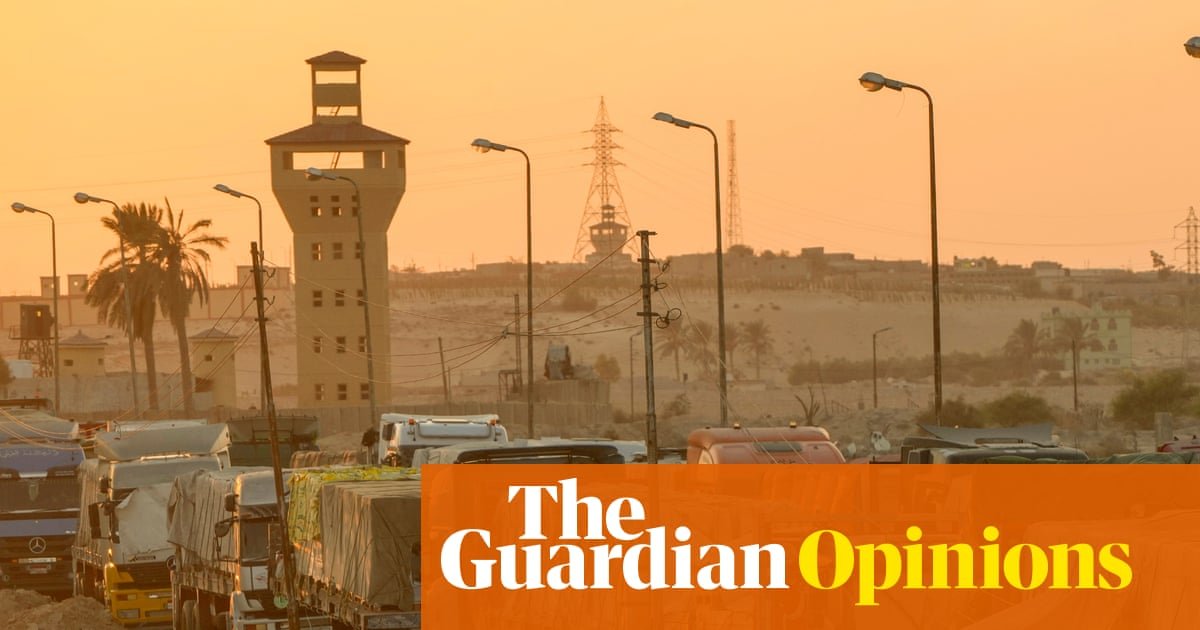
Now that famine has been officially confirmed in Gaza – a first in the Middle East – children are wasting away while truckloads of life-saving aid sit across the border. The international community must act decisively and urgently to break the blockade. Neither airdrops nor a sea route can provide a sustainable solution at scale to address immediate suffering or needs over the coming years, given the level of destruction. All options must be considered now, including a humanitarian lifeline across the Egypt-Gaza border at Rafah, under the mandate of the United Nations or an international “coalition of the willing”. Israel’s restrictions on aid entering Gaza can be challenged and circumvented. It will be politically contentious, but we do have precedents.
In 2014, the UN security council authorised a cross-border humanitarian mechanism for Syria. It allowed UN agencies and their partners to deliver life-saving assistance to millions of Syrians without the consent of the government in Damascus. This mechanism was a lifeline for civilians caught in a brutal conflict. It was grounded in international humanitarian law and the UN’s responsibility to protect civilians when states are unable – or unwilling – to do so. It showed that even in a divided security council, consensus is possible when the humanitarian imperative is clear.
But Syria is not the only example.
In Sudan, during the 1980s famine and civil war, Operation Lifeline Sudan was launched as a collaborative effort between the UN, NGOs and both warring parties. It enabled humanitarian access that allowed aid to reach civilians in both government- and rebel-held areas, despite the absence of a formal peace agreement. It was one of the earliest examples of negotiated cross-border access in a conflict zone.
Following Cyclone Nargis in 2008, international aid was initially blocked by the-then Myanmar government. As the British official overseeing UK humanitarian assistance, I visited Yangon alongside international partners. Intense diplomatic engagement – led by regional countries – established a coordination mechanism involving the Association of Southeast Asian Nations (Asean) and the UN that allowed aid to flow. The lesson: international mechanisms can overcome political barriers when lives are at stake.
The situation in Gaza today is no less urgent.
In December 2023, the UN security council agreed Resolution 2720. It demanded that all parties to the conflict facilitate the use of all routes to Gaza for humanitarian assistance. Now, international efforts remain focused, rightly, on persuading Israel to open border crossings. However, given Israeli intransigence, the prospects of a sustained shift seem bleak. The Rafah crossing between Gaza and Egypt is the only alternative route for humanitarian access that can operate outside Israeli control. Yet, with Israel in control of the Gaza side of the border, access through Rafah is now at a virtual standstill. Aid convoys are stuck. Medical evacuations are denied. Humanitarian efforts to save lives are blocked.
An internationally mandated humanitarian mechanism working in close cooperation with Egypt could change that. It would need international management on both sides of the border. And arrangements to consign emergency supplies to UN and international NGOs on the ground to distribute aid through established humanitarian channels. With upgrades to the infrastructure at the border, it would enable the movement of supplies at scale with transparent oversight. It would demonstrate international resolve to uphold the principles of humanity, neutrality and independence. It would help Palestinians to stay in Gaza with dignity.
Undoubtedly there will be many critics and naysayers, not least those committed to annexing occupied Palestinian territory. In the face of mass suffering and famine, will the international community simply continue to issue statements? The international community and the UN security council have a responsibility to act when civilians are in grave danger. To fail to act is to be complicit in the atrocities that are being committed in Gaza.
skip past newsletter promotion
Sign up to Matters of Opinion
Guardian columnists and writers on what they’ve been debating, thinking about, reading, and more
Privacy Notice: Newsletters may contain information about charities, online ads, and content funded by outside parties. If you do not have an account, we will create a guest account for you on theguardian.com to send you this newsletter. You can complete full registration at any time. For more information about how we use your data see our Privacy Policy. We use Google reCaptcha to protect our website and the Google Privacy Policy and Terms of Service apply.
after newsletter promotion
The people of Gaza are human beings with rights, dignity and urgent needs. The international community meeting at the UN and beyond must summon and act with the same courage it showed in Syria, Sudan, Myanmar and elsewhere.
The time for half-measures and empty declarations is over. More than 2 million people are trapped – under siege and under attack by Israel. Our Save the Children teams report that systematic denial of humanitarian aid is depriving children of food, water, medicine, even nappies and baby formula. Healthcare has collapsed with attacks on hospitals and health workers. Formal education has collapsed with attacks on schools. More than 90% of homes and schools have been damaged or destroyed. More than 20,000 children have been killed.
It is time to create an independent cross-border humanitarian mechanism before more lives are lost. It is time for Lifeline Rafah.
Moazzam Malik is CEO of Save the Children
Do you have an opinion on the issues raised in this article? If you would like to submit a response of up to 300 words by email to be considered for publication in our letters section, please click here.
