

This is an edition of The Atlantic Daily, a newsletter that guides you through the biggest stories of the day, helps you discover new ideas, and recommends the best in culture. Sign up for it here.
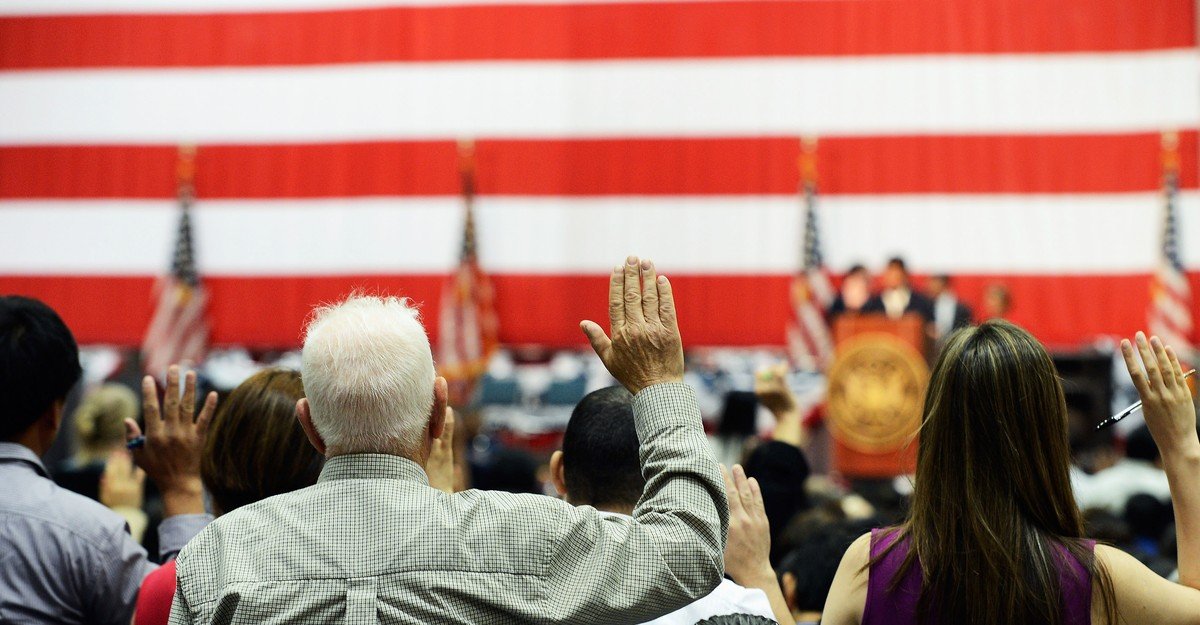
When a person is naturalized as a U.S. citizen, they receive not just a new citizenship but also typically a few other objects: an American flag, a copy of the Declaration of Independence and the Constitution, and a greeting from the president. Of these, the last is the most ephemeral—just a form letter—but it can reveal a great deal about how the writer thinks about the country he leads.
This week, the White House released Donald Trump’s new version of the letter. (In both terms, it took Trump months to get around to replacing his predecessor’s missive.) Although the Trump administration has both cracked down on illegal immigration and sought to curtail legal immigration, the letter is warm and welcoming. Where the letter diverges from those of most past presidents is in its vision of the United States, which Trump sees as founded not on ideas or ideals but on culture and tradition.
For Trump, the nation is less a melting pot where different cultures combine harmoniously than a crucible where foreign notions are burned off and a homogeneous mix emerges.
“America has always welcomed those who embrace our values, assimilate into our society, and pledge allegiance to our country,” he writes. “By taking this oath, you have forged a sacred bond with our Nation, her traditions, her history, her culture, and her values.”
Many philosophers have historically argued that citizenship bestows freedoms but also confers obligations upon those who hold it. Yet Trump’s reframing is more than a nod to those duties. It’s also a move away from a focus on the intellectual underpinnings of the American project, which was an essential message for past presidents, regardless of party.
“In making this journey to America, you have done more than move to a new place. You have become part of an idea,” Joe Biden wrote. Bill Clinton expressed something similar in different terms, writing, “You now share in a great experiment: a nation dedicated to the ideal that all of us are created equal, a nation with profound respect for individual rights.” George W. Bush wrote that “Americans are united across the generations by grand and enduring ideals.” (I am relying in some cases here on copies of the letters posted online by recipients.)
Some presidents have also discussed the importance of democratic engagement. “I ask you to pray for the strength and soul of our nation, and I encourage you to actively participate in shaping its future,” wrote George H. W. Bush. “I encourage you to be involved in your community and to promote the values that guide us as Americans,” Barack Obama implored. Trump, who has demonstrated his skepticism of protest and basic democracy, makes no such suggestions.
Trump’s new letter is also different from the one he sent in his first term, and not only because it is shorter and his signature is an even more Twombly-esque abstraction. Unity has never held much interest for him, but where his first letter had a mention of “mutual kinship and affection,” the new one puts no emphasis on collective bonding. And where Trump used the word nation only once in his first term, he mentions it four times now, capitalized each time. (Neither letter uses the word immigrant, as Obama’s did, much less calls the United States a “nation of immigrants,” as Biden’s did.)
The conceptual shift to nation—a term often connected, outside of the United States, to an ethnic polity—is part of a broader rhetorical change on the right. Vice President J. D. Vance made it most forcefully in his nomination-acceptance speech last summer.
“One of the things that you hear people say sometimes is that America is an idea,” he said. “And to be clear, America was indeed founded on brilliant ideas, like the rule of law and religious liberty. Things written into the fabric of our Constitution and our nation. But America is not just an idea. It is a group of people with a shared history and a common future. It is, in short, a nation.”
The administration’s ongoing attack on free speech and the rule of law make Vance’s acknowledgment—and Trump’s, in the letter—of the principles at the heart of the Constitution ring hollow. Even taken at face value, however, this emphasis on Americans’ common culture is in tension with the idea that all people are created equal, my colleague Adam Serwer wrote after Vance’s speech: “If America is a creedal nation, then anyone can be an American. But if real Americans are those who share a specific history, then some of us are more American than others.”
This is particularly important right now, because the Trump administration is attempting to redefine what that shared history is—for example, by restoring a portrait of the traitor Robert E. Lee at West Point, attempting to install commissars at the Smithsonian, and ordering the bowdlerization of references at national parks to darker parts of the past, including the famous and searing image of a freed slave’s scars from whippings. These steps seem designed to exclude some kinds of people from the shared history, or else force them to acquiesce to a tendentious or partial version.
Trump, as is his nature, depicts citizenship as a kind of deal. “You have pledged your heart to America—and in return, she offers the boundless promise of freedom and opportunity,” he writes. Prospective citizens might reasonably wonder whether his government will hold up its end of that bargain.
Related:
Here are three new stories from The Atlantic:
Today’s News
- The House passed a Republican-led bill to keep the government funded through November 21, but the Senate rejected it along with a Democratic plan, increasing the risk of a government shutdown at the beginning of next month.
- A federal judge dismissed President Donald Trump’s defamation lawsuit against The New York Times, calling the complaint “improper and impermissible” because of its length. Trump’s legal team has 28 days to refile an amended complaint.
- Trump said he had a “productive” call this morning with Chinese leader Xi Jinping, during which they discussed the “approval of the TikTok deal.”
Dispatches
Explore all of our newsletters here.
Evening Read
Illustration by Akshita Chandra / The Atlantic
How to Think, Not What to Think
By Sian Leah Beilock
Across the country, people are questioning the value and role of higher education, and institutions—particularly the elite ones—are experiencing a crisis in public trust. On top of that, tech titans are convinced that AI will break higher education, while many observers lament its corrupting influence and ask whether the “mind-expanding purpose and qualities of a university,” as one historian of education put it recently, are gone forever …
Despite the reforms that our institutions of higher education must embark on to ensure that we are teaching our students how to think—and not what to think—a four-year residential-college experience remains one of the most powerful human environments for cultivating human qualities.
Read the full article.
More From The Atlantic
Culture Break
Warner Bros. Pictures
Watch. One Battle After Another (out Thursday in theaters) is as blisteringly fun as it is daringly political, David Sims writes.
Read. A new book, If Anyone Builds It, Everyone Dies, aims to explain why superintelligent AI would eliminate humanity; the authors, however, fail to make a “case for their claims,” Adam Becker argues.
Play our daily crossword.
Rafaela Jinich contributed to this newsletter.
When you buy a book using a link in this newsletter, we receive a commission. Thank you for supporting The Atlantic.
