

September 16, 2025
3 min read
The Problem with Billionaire Science
Science may need to increasingly rely on wealthy patrons, but privately funded projects don’t always pan out
Scientific American, October 2025
A poster-size version of the front page of the very first issue of this magazine hangs in the lobby of Springer Nature’s New York City office. I walk past it multiple times a day, and one line of text has stuck with me to the point that I keep bringing it up in meetings—so often that I fear my co-workers are getting tired of hearing it.
The line is at the top of the page, right under the words “Scientific American,” declaring the publication’s mission: “The advocate of industry and enterprise, and journal of mechanical and other improvements.” It grabs my attention because it reminds me that the first issue was created in large part to promote manufacturing and trade; it’s pro-business, pro-capitalism, pro-wealth in ways that we don’t see much in modern science journalism or in science as a whole.
Of course, there are some good reasons that in the 180 years since that first issue, science and industry have developed a complicated relationship, just as there are good reasons for some people to have a complicated relationship with capitalism; remember, Scientific American has been around so long that it predates Karl Marx and Friedrich Engels’s The Communist Manifesto by three years.
On supporting science journalism
If you’re enjoying this article, consider supporting our award-winning journalism by subscribing. By purchasing a subscription you are helping to ensure the future of impactful stories about the discoveries and ideas shaping our world today.
During those two centuries, we’ve seen private industry give birth to entirely new areas of science. Edison and Westinghouse pioneered electrical engineering; thanks to IBM and Xerox and AT&T, I have the computer I’m writing this on. And corporate science hasn’t just delivered new gadgets: the industrialization of drug discovery led to advances in pharmaceutical science and biomedicine that have saved countless lives.
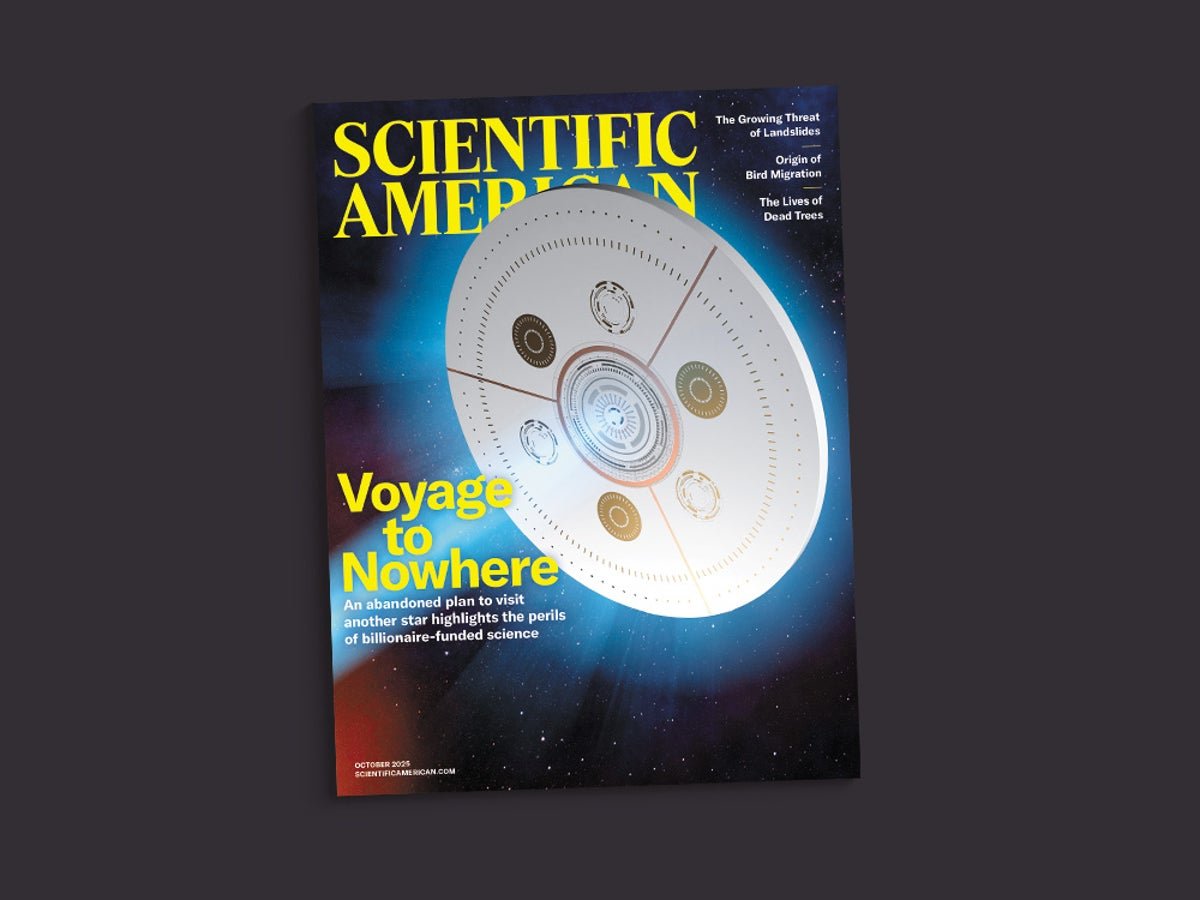
Our cover story in this issue is a very 21st-century tale of how capitalism can help drive creation but doesn’t always result in something quite as good as the invention of the transistor. Back in March 2017, another Scientific American cover story celebrated a project called Breakthrough Starshot, launched by Yuri Milner, a Silicon Valley billionaire who pledged to spend $100 million to send a cloud of tiny ships to Alpha Centauri. More than eight years later science journalist and SciAm contributing editor Sarah Scoles reveals that only a small fraction of that money ever materialized, and the project has effectively been lost in space.
It’s a fascinating look at how billionaire science can go wrong, and I think it’s full of important lessons about what may be one of the best hopes for science in the U.S. over the coming decades. Massive cuts to government funding of research and higher education are going to block off a lot of the traditional, academic paths to innovation, and even if those cuts are eventually reversed, it could take a very long time to rebuild what we’ll have lost in the interim.
It seems to me, then, that a great many researchers are going to have to rely on business—and, yes, billionaires—in a way they haven’t since before World War II. We know billionaire science can work: Milner’s Breakthrough Listen project has already scanned thousands of stars in the most comprehensive search for alien intelligence to date, and Microsoft co-founder Paul Allen’s Allen Institute has made big leaps in bioscience, including the creation of widely used open maps of gene expression in mouse and human brains.
As we enter a new era of slimmed-down, inadequately funded government science, the American scientific community is going to have to figure out how to maintain leadership in research and innovation—or whether that’s even possible. Closer ties to business may be our best bet. We just have to learn how to tell when the money is too good to be true.
I’m curious about your thoughts on our cover story and about your take on billionaire science in general. E-mail us at editors@sciam.com to share your impressions, and visit us at ScientificAmerican.com to remain a part of the conversation.
It’s Time to Stand Up for Science
If you enjoyed this article, I’d like to ask for your support. Scientific American has served as an advocate for science and industry for 180 years, and right now may be the most critical moment in that two-century history.
I’ve been a Scientific American subscriber since I was 12 years old, and it helped shape the way I look at the world. SciAm always educates and delights me, and inspires a sense of awe for our vast, beautiful universe. I hope it does that for you, too.
If you subscribe to Scientific American, you help ensure that our coverage is centered on meaningful research and discovery; that we have the resources to report on the decisions that threaten labs across the U.S.; and that we support both budding and working scientists at a time when the value of science itself too often goes unrecognized.
In return, you get essential news, captivating podcasts, brilliant infographics, can’t-miss newsletters, must-watch videos, challenging games, and the science world’s best writing and reporting. You can even gift someone a subscription.
There has never been a more important time for us to stand up and show why science matters. I hope you’ll support us in that mission.
