

September 16, 2025
3 min read
October 2025: Science History from 50, 100 and 150 Years Ago
Charming quarks; the first Batman signal
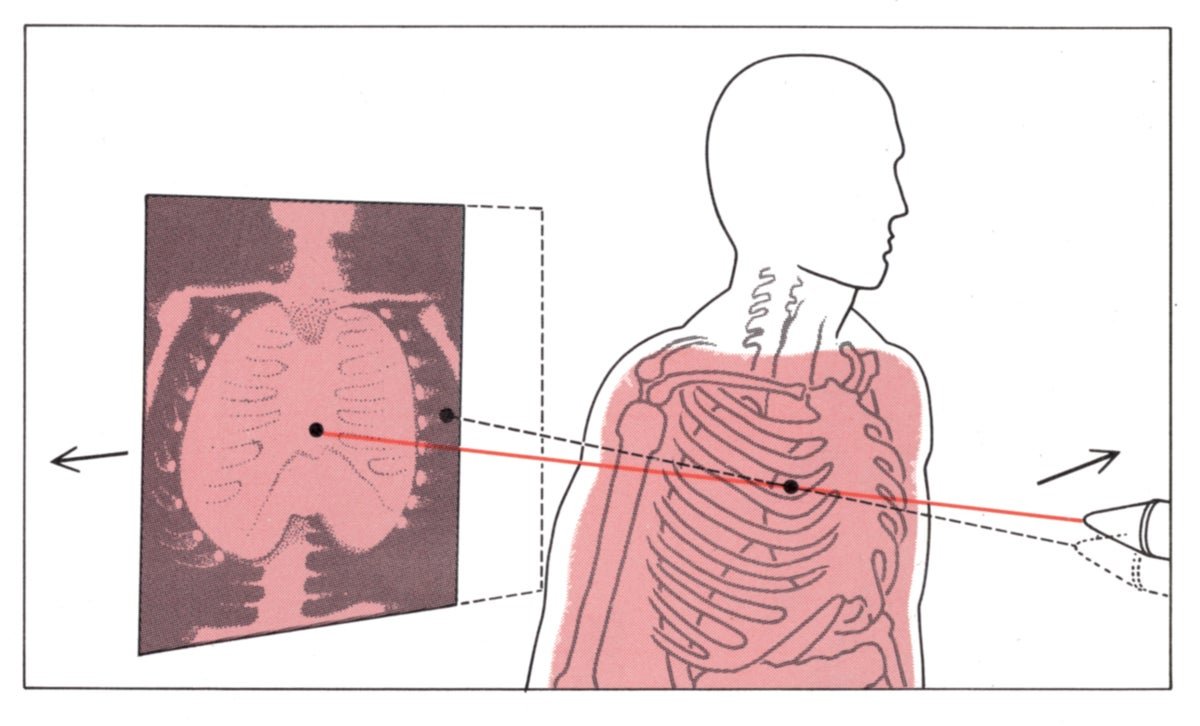
1975, Advent of Tomography: “Medicine is making the internal structures of the body far more accessible by noninvasive procedures. One, called reconstruction from projections, is coming into service. A tomogram is made by having an X-ray source move around a person in one direction, and film in the other direction, and mathematically combining X-ray images made from numerous angles into an image in three dimensions of organs within the body.”
Scientific American, Vol. 233, No. 4; October 1975
1975
Charming Quarks
“When the quark hypothesis was first proposed more than 10 years ago, there were supposed to be three kinds of quark. The revised version of the theory requires 12 kinds. In the whimsical terminology that has evolved, quarks are said to come in four flavors, and each flavor is said to come in three colors. (‘Flavor’ and ‘color’ are, of course, arbitrary labels.) One of the quark flavors is distinguished by the property called charm (another arbitrary term). The concept of charm was suggested in 1964, but until last year it had remained an untested conjecture. Several recent experimental findings, including the discovery last fall of the particles called J or psi, can be interpreted as supporting the charm hypothesis.”
On supporting science journalism
If you’re enjoying this article, consider supporting our award-winning journalism by subscribing. By purchasing a subscription you are helping to ensure the future of impactful stories about the discoveries and ideas shaping our world today.
Cleaner Graffiti
“Graffiti can be regarded as an intolerable nuisance or untrammeled self-expression. From either point of view the need is for clean surfaces; otherwise the public official loses all hope of restoring walls and conveyances to their original condition and the graffito artist runs out of canvas. The National Bureau of Standards puts forward a reasonable solution: Coat the surface in the first place with a special substance from which markings can be removed easily. The investigation turned up three preventive coatings that resist permanent bonding of most of the common types of marking. The three products are generically classified as a urethane, a dimethyl silicone and a styrene acrylonitrile terpolymer. McClure Godette, a chemist who worked on the project, said of them: ‘These coatings cost just slightly more than a coat of paint, and they can be useful in making any future graffiti defacement easier to clean up.’”
1925
Fingerprint Everyone
“Two years ago two bank messengers with a bag containing $43,000 in currency were shot dead. Five bandits dashed into a car and disappeared. Twenty-four hours later the police found a car. On the windshield were the faint prints of a man’s fingers, which coincided with those of a criminal whose record was in police headquarters. Four days later this man and two confederates were arrested in Cleveland. Three of the five men have since been electrocuted. Fingerprint records are of great value in other kinds of problems the police are called upon to solve, including missing persons and persons suffering from aphasia or amnesia. If all infants at birth were fingerprinted, the problem of foundlings would be solved. Fingerprints would be a distinct advantage to innocent citizens. Suppose a person was unjustly accused of a crime. They could prove their innocence by means of their fingerprints. This very thing has happened.”
1875
Patriotic Gallium
“At a recent session of the French Academy of Sciences, M. Wurtz presented a communication from M. Lecoq, announcing the discovery of a new metal analogous and allied to zinc and cadmium, and found in blende or sulphide of zinc in Spain. The existence of the substance was revealed by spectral analysis, two lines appearing which could not be traced to any other element. The new metal has not been reduced from its combinations, so its physical characteristics remain undetermined. It has been obtained, however, in the state of hydrochlorate and sulphate. The discoverer patriotically names the new element gallium.”
Historical accounts say Paul-Émile Lecoq de Boisbaudran derived the term “gallium” from the Latin Gallia, which means “Gaul”—a region once ruled by Julius Caesar that encompassed present-day France.
The First Bat Signal?
“The roof of the Siemens-Halske factory at Berlin was recently the scene of [nighttime] experiments with the electric light, with a crowd in the streets staring with astonishment at a supposed wonderful natural phenomenon up in the clouds. The apparatus was arranged with an enclosed mirror, so that the rays were projected against the clouds, which served as a screen. In front of the mirror the signals were made, and these were repeated, of course on a gigantic scale, in the clouds. The light is to be adopted by the German army for night signaling.”
Perhaps this is where the leaders of Gotham City, in DC Comics, learned to project an emblem of a bat on cloudy night skies to summon superhero Batman to a scene of distress.
It’s Time to Stand Up for Science
If you enjoyed this article, I’d like to ask for your support. Scientific American has served as an advocate for science and industry for 180 years, and right now may be the most critical moment in that two-century history.
I’ve been a Scientific American subscriber since I was 12 years old, and it helped shape the way I look at the world. SciAm always educates and delights me, and inspires a sense of awe for our vast, beautiful universe. I hope it does that for you, too.
If you subscribe to Scientific American, you help ensure that our coverage is centered on meaningful research and discovery; that we have the resources to report on the decisions that threaten labs across the U.S.; and that we support both budding and working scientists at a time when the value of science itself too often goes unrecognized.
In return, you get essential news, captivating podcasts, brilliant infographics, can’t-miss newsletters, must-watch videos, challenging games, and the science world’s best writing and reporting. You can even gift someone a subscription.
There has never been a more important time for us to stand up and show why science matters. I hope you’ll support us in that mission.
