

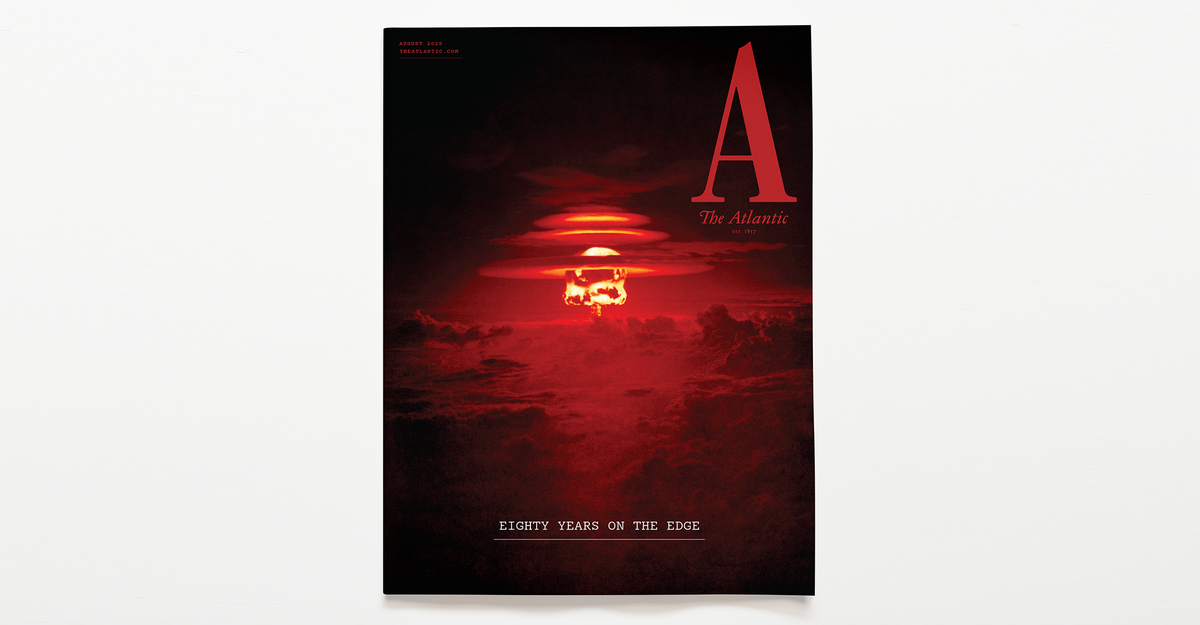
Eighty Years on the Edge
In the August issue, Atlantic contributors examined the past eight decades of life in the Atomic Age.
Explore the October 2025 Issue
Check out more from this issue and find your next story to read.
View More
Thank you for your series of articles on nuclear warfare. I was especially moved by the essays on Japanese internment and Kurt Vonnegut, but all of them led me to wonder why we humans seem so incapable of learning from the past.
Noah Hawley was correct to note that our current age is rife with innovations that are technically sweet but have rarely been subjected to the question Just because we can, should we? I wonder what Vonnegut would say if he were alive today.
Ellen Vliet Cohen
Arlington, Mass.
One question is not answered in The Atlantic’s August issue: What can really be done to rid the world of nuclear weapons? Perhaps it is time that this topic reentered public discussion.
My proposal is that the 186 countries that don’t have nuclear weapons assemble and draft an ultimatum to the countries that do, stating that unless the nuclear-armed states get rid of their weapons, they, the non-nuclear-armed states, will band together to conduct the research and development necessary for each of them to have their own weapons. That’s it. Risky? Yes. But is it riskier than the present situation? Perhaps not. Ross Andersen, in “The New Arms Race,” predicts that the nuclear club may double under existing conditions. Staying on the present course assures us of only one thing: that we will eventually, by intention, misjudgment, human or technological error, or just plain bad luck accomplish our mutual assured destruction. The ultimatum risks nothing more than that.
Red Slider
Sacramento, Calif.
How can I describe the feeling I had when I turned to “The Light of a Man-Made Star” and saw the photographs from Michael Light’s 100 Suns? First among them is a photograph of the Hood test, to which I, as a small child, was exposed. My father, a mineral exploration geologist interested in uranium, had brought my brother, mother, and me to Nevada that summer.
I was young, and my memories of that time are few: lifting my pillow off the floor in the bunkhouse to expose a rattlesnake, the ghostly rise and fall of a player piano’s keys. Years later, many residents of the area contracted cancer from the fallout. Danger, secrecy, and the unnatural—these were the hallmarks of my own private nuclear age.
The following year, in 1958, my father went to work on a feasibility study for Project Chariot, to determine whether the government should use nuclear devices to bomb a harbor into the coast of northwestern Alaska. The project was classified, and he didn’t speak of it until the year I turned 12, when I accidentally discovered a book-length document titled “The Effects of Nuclear Weapons” in our bookcase. The chapter that I most remember was titled “Effects on Personnel.” It contained photographs of hibakusha—Japanese atomic-bomb survivors—with their bodies exposed to display the kimono patterns that had been burned into their backs. I’ve never shaken these images from my mind, or forgotten that those photographed were treated in the text not as victims but as subjects of an experiment.
My father continued to prospect in Alaska for radioactive minerals. The summer before the Cuban missile crisis, he found a large deposit of beryllium, an element crucial to the workings of nuclear weapons; it earned him a write-up in Newsweek and a citation from the Alaska legislature. I grew up to become an English professor, and I taught Kurt Vonnegut’s Cat’s Cradle in a course on nuclear issues that I developed in the early 2000s. Vonnegut’s portrayal of Felix Hoenikker struck close to home.
Alison Sainsbury
Bloomington, Ill.
I read “Damn You All to Hell!,” Tom Nichols’s article discussing films about nuclear war, with interest. He left out an obscure contribution to the genre: In 1964, Rod Serling wrote a TV movie starring Peter Sellers, Carol for Another Christmas, which portrayed a nightmarish future of nuclear destruction. My father was active in groups that urged a nuclear-test-ban treaty. He was so impressed with the movie that he bought a copy, got a projector and a screen, and went around Chicago showing it to anybody who would watch. I was a teenager and it frightened me—it seemed that we were all doomed to die in nuclear war. The movie remains worth a watch today.
Judith Jacobson
Baltimore, Md.
I appreciated “Damn You All to Hell!” and could relate to Tom Nichols’s anecdote about teaching today’s students about nuclear war. After 23 years on active duty in the Army, I also went into academia, teaching courses in political science and intelligence studies. When I first taught a class on homeland security, I shared videos of “duck and cover” drills and received similarly incredulous reactions from my students, who after 9/11 were living with the threat of terrorism—not nuclear war. At one of the colleges where I taught, I had a colleague who owned a home with a fallout shelter constructed in the 1960s. I took students to see it so they could imagine what it would have been like to actually live there. It wasn’t until I showed them the 1999 movie Blast From the Past, however, that they fully grasped what a fallout shelter would have to look like for a family to survive a nuclear war.
Richard Kilroy
Charlottesville, Va.
Eleven years ago, I visited Manzanar with my wife, never having known that such a place existed. We were told that the word manzanar means “apple orchard” in Spanish, because the land where the internment site stood had originally been an apple orchard. Now, we discovered, it was a national historic site. Trying to imagine life in the prison camp was impossible. We couldn’t visualize how families had been ripped from their homes and crammed into barracks surrounded by guard towers and barbed wire. Our visit ended in Manzanar’s cemetery, which people still visit to see the graves of their ancestors. What we did not hear or see were the firsthand stories of the people who lived there. Andrew Aoyama’s “The Expatriate,” about Joseph Kurihara, was an article we needed to read, even 11 years later.
Richard Grove
Philadelphia, Pa.
I appreciated Jeffrey Goldberg’s article, “Nuclear Roulette,” which quotes me in its last sentence: “Most of all, we forget the rule articulated by the mathematician and cryptologist Martin Hellman: that the only way to survive Russian roulette is to stop playing.”
Society neglects the nuclear threat at its peril. If we would honestly face that threat—and others, such as climate change—they could transform into opportunities to finally build the more peaceful, cooperative world we have dreamed of for ages, but thought ourselves incapable of achieving. To quote a paper I wrote some years ago, “Technology has given a new, global meaning to the Biblical injunction: ‘I have set before you life and death, blessing and curse; therefore choose life that you and your descendants may live.’ ”
Martin E. Hellman
Stanford, Calif.
Behind the Cover
In this month’s cover story, “How Originalism Killed the Constitution,” Jill Lepore considers why the process of constitutional amendment has all but vanished from American politics. The Framers designed the Constitution to be adaptable, Lepore argues, but a conservative legal philosophy has undermined attempts to change it. For our cover design, the calligraphers Sean Freeman and Eve Steben of There Is Studio wrote out the headline and subheadline using fountain pens and traditional brushes, their tapered strokes evoking the lettering of the Constitution’s preamble.
— Liz Hart, Art Director
Corrections
“The New Arms Race” (August) stated that Japan’s centrifuge program reprocesses nuclear waste into plutonium. In fact, this process occurs in separate waste-reprocessing plants. “The Judgments of Muriel Spark” (September) stated that T. S. Eliot converted to Catholicism. In fact, he converted to Anglo-Catholicism.
This article appears in the October 2025 print edition with the headline “The Commons.” When you buy a book using a link on this page, we receive a commission. Thank you for supporting The Atlantic.
