

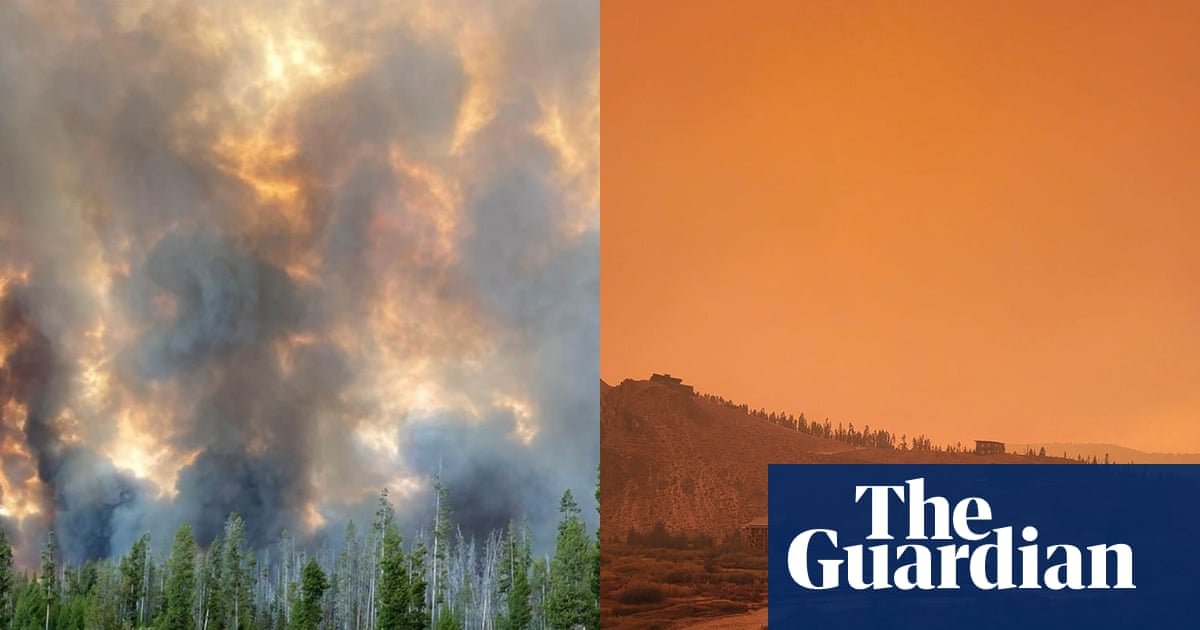
During a 2024 wildfire season described as “unprecedented”, the tiny central Idaho town of Stanley and nearby Redfish Lake Lodge narrowly missed incineration by two fires: the Bench Lake and then the Wapiti blazes.
It took heroic firefighting efforts and favorable turns in weather conditions for the town – a mountain mecca for tourists from around the world – to survive without the loss of a single life or home.
The manager of the Redfish Lake Lodge, Jeff Clegg, along with a handful of Stanley residents, have since told the story of how their community survived the wildfire. While their dramatic accounts offer rare glimpses revisiting an episode from more than a year ago, their perspectives offer insights that are relevant as ever as wildfires continue raging across the US west, leaving an increasing number of communities at risk of burning down – or coming dangerously close.
The deadly January wildfires in southern California and 2023 fires in Hawaii demonstrated the extreme consequence of fires hitting densely populated areas. More recently, lightning sparked dozens of wildfires in California’s Sierra Nevada foothills, devastating a 19th-century settlement founded by Chinese miners. Firefighters in the state were also racing to protect a historic grove of ancient sequoia trees in the Sierra national forest as the lightning-caused blazed dubbed the Garnet fire spread through Fresno county.
And the trend of bigger, hotter and faster fires as demonstrated by those blazes is by no means isolated to the US.
A recent analysis by World Weather Attribution found that the hot, dry and windy conditions fueling wildfires in Spain this past summer are 40 times more likely to recur due to the climate crisis, spurred primarily by human activities emitting greenhouse gases.
Canada set records in 2023 for its worst fire season and has been experiencing its second-worst fire season in recorded history. And globally, 2025 is on track to become the second or third hottest year on record, behind 2024 and 2023.
Those who survived the dual fire threats confronting the population of about 120 in Stanley, Idaho, in July 2024 recall how the US in theory was relatively well-positioned when the first of those blazes – the Bench Lake fire – occurred. It was earlier that season, when more firefighting resources were available. Nonetheless, it still came within feet of burning down Clegg’s Redfish Lake Lodge.
The US as a whole was at its highest fire-preparedness level – five – when the Wapiti fire erupted. Numerous other fires in the same region depleted fire resources to the point where there were not enough to prevent the Wapiti blaze from exploding in size and ultimately bringing the town of Stanley to the brink.
As of 4 September, the US was at a preparedness level of three, having been downgraded from a so-called PL4.
“We need to think differently about how secure we are,” Stanley mayor Steve Botti, an experienced firefighter himself, remarked.
Rough and unforgiving
As ash and burning embers rained down from the smoke-choked sky, there was a moment when the whole world shifted, Clegg recalled.
Elite “hotshot” firefighting crews had his family’s log cabin resort surrounded by a protective perimeter of hoses and sprinklers, soaking every structure and inch of defensible ground.
A massive scooper plane gulped water from the adjacent Redfish Lake, dumping it on to the Bench Lake fire as it advanced hot, loud and fast toward the lodge.
We need to think differently about how secure we are Steve Botti, mayor of Stanley, Idaho
The thunderous roar of the fire was punctured by popping noises as bone-dry trees burst into flames and others crashed to the ground.
But then, rather suddenly in the middle of that fateful mid-July afternoon, the smoke cleared and the sun appeared.
The wind died down and the wildfire quieted, settling back into the drainage just over the ridge from where Clegg, his wife, his son and a few other employees had stayed to defend the family’s legacy and livelihood.
Clegg’s eyes later welled up with tears as he sat at a lakeside picnic table reliving the day Redfish was saved.
Whether attributed to the success of the strategic fire-suppression tactics by firefighters, a lucky turn in the weather or to his wife’s desperate call for prayer on social media – what happened that afternoon was nothing short of a miracle, Clegg described.
In the preceding days, the hotshot crews conducted a “back burn” across the ridge next to the lodge – using torches to intentionally set dry wooded fuel in the path of the fire ablaze.
The objective was to keep the fire from reaching the resort by slowing the beast and ideally stopping it, or at least changing its momentum and direction.
Clegg was told by the team’s commander if the back burn worked as intended and weather conditions cooperated – the lodge could be saved.
But with any change in wind direction or speed, there was an equal possibility all could be lost.
Nestled in the forests of Idaho’s breathtaking Sawtooth mountains, named for their jagged peaks, the terrain around Redfish Lake Lodge is rough and unforgiving.
The first helicopter responding to the fire crashed into one of the nearby Bench Lakes after the pilot snagged a submerged log while trying to fill his bucket. The pilot swam to shore and survived without serious injury.
Despite (or because of) its remote location and epic scenery, when the Redfish Lake Lodge, built in 1929, opens reservations in January for peak summer season, every bed is booked within about 20 minutes.
Many of the bookings come from families who make the pilgrimage to the same cabins over the same dates every summer, and have done so for generations.
It is revered not just by Idahoans but by hundreds of thousands of annual visitors from across the nation and the globe.
But it wasn’t the memory of fear of losing something beloved by so many that made Clegg’s throat tighten as he reflected on those most harrowing days.
It was the memory of how small he had felt against the power of wildfire and the gratitude he felt toward the dauntless firefighters.
It was also the memory of the people who answered his wife’s call for prayer on that fateful day and the surrounding community who offered support.
Clegg chokes up when he talks about the hundreds of contributors to an online fundraising effort, which allowed him to pay his employees during the full two weeks of closure.
The Bench Lake fire – ignited by back country campers on 11 July 2024 – happened during the peak of the peak summer season, Clegg said, when the family business earns the income critical to sustaining the rest of the year when the resort is closed, buried under snow in frigid temperatures.
However, while the two-week closure delivered Redfish Lake Lodge a massive economic hit, little did Clegg know the worst – in terms of lost income – was yet to come.
The Bench Lake fire would end up having a smaller economic impact on Clegg’s business than the next fire – the Wapiti fire – ignited by lightning on 24 July about 20 miles (32km) away and across the peaks of the Sawtooths.
‘Perfect storm’
The Wapiti fire unfolded under “unprecedented” conditions, as Boise national forest supervisor Brant Petersen recalled.
The natural fuels available in the region for fire – including beetle-ravaged pines – set records for low moisture content. July set records for hot temperatures and lack of rain.
The drought conditions were unprecedented, Petersen said. So were the number of fires and unpredictable manner in which many of them exploded.
There’s no turning back. The wildfire risk is not going to suddenly improveKathryn Grohusky, Sawtooth Society
“I’ve said the word ‘unprecedented’ thousands of times,” Petersen said. “It’s been an incredible fire season.”
The Wapiti fire, ultimately ballooning to nearly 130,000 acres (52,600 hectares), burned during the country’s preparedness level 5 – when the number and size of fires burning across the US north-west vastly outweighed available resources.
That fire grew unexpectedly and exponentially in late August and early September.
From the streets of Stanley, Botti, the mayor, described watching an approaching 200ft wall of flames as he worked with officials on evacuation plans.
But the town itself never came under mandatory evacuation orders.
Thanks to increased firefighting resources and a favorable turn in the weather in mid-September, the town was spared without a single home lost, including in surrounding neighborhoods.
Nonetheless, the summer tourist hotspot took a massive hit, economically.
Botti said many of Stanley’s businesses make 90% of their income between June and September.
Russell Clark, a volunteer firefighter who owns the Mountain Village Resort in Stanley, said he makes 70% of his annual income during June, July, August and September.
He is one of the few businesses that stays open year-round. Yet his business was still down by more than 50% after the threat from the Wapiti fire had subsided.
In the immediate aftermath of the blaze, Clark expressed frustration about what he viewed as poor forest management before the blaze, inconsistent messaging from the federal teams then struggling to contain the fire, and the virtual closure of the town.
Highway 21 – Stanley’s artery to visitors traveling from Boise – was closed for almost two months.
It was also hard for Clark to understand why the fire – ultimately costing the federal government about $80m to battle – wasn’t extinguished when it was still small.
Petersen said he understands frustration from residents. But he has no complaints about decisions made that prioritize firefighter safety. In addition, the Wapiti fire was just one of 15 fires started by lightning virtually at the same time in the same region, he said. As he put it: “There were fires growing all around us.”
Petersen described a series of days when the fire response team was unable to get the resources needed to control the fire – either due to unsafe conditions for firefighters or because requests for additional resources were denied or diverted to either blazes, including aerial support.
Much of the fire also burned in remote mountain terrain, where blazes are an essential part of the natural ecosystem, Petersen acknowledged. Forests, perhaps paradoxically to the uninitiated, need fire to regenerate.
He pointed to prescribed burning and other work under way in his region to foster more “good” fire – and mitigate “bad” fire.
But as fires grow increasingly larger and more destructive, they are increasingly burning closer to human-built infrastructure – and doing more permanent damage to land and vegetation.
For Stanley and Redfish Lake Lodge, “this was a near miss”, said Kathryn Grohusky, executive director of the non-profit Sawtooth Society. “And it will help us be stronger ahead of the next big wildfire that comes through.”
Grohusky said the key question looking ahead is: “How do we thrive in a fire-prone climate? And what do we have to do as individuals and communities to work together in order to thrive?”
The answers for many communities, for now, are few. “There’s no turning back,” Grohusky continued. “The wildfire risk is not going to suddenly improve.”
“No one can argue” that fires across the west are getting larger, more intense and more frequent, Petersen remarked: “That’s a fact.”
He also noted more people moving into fire-prone areas, adding to the urgency of the questions Grohusky posed.
“It’s a perfect storm of conditions,” Petersen said.
