

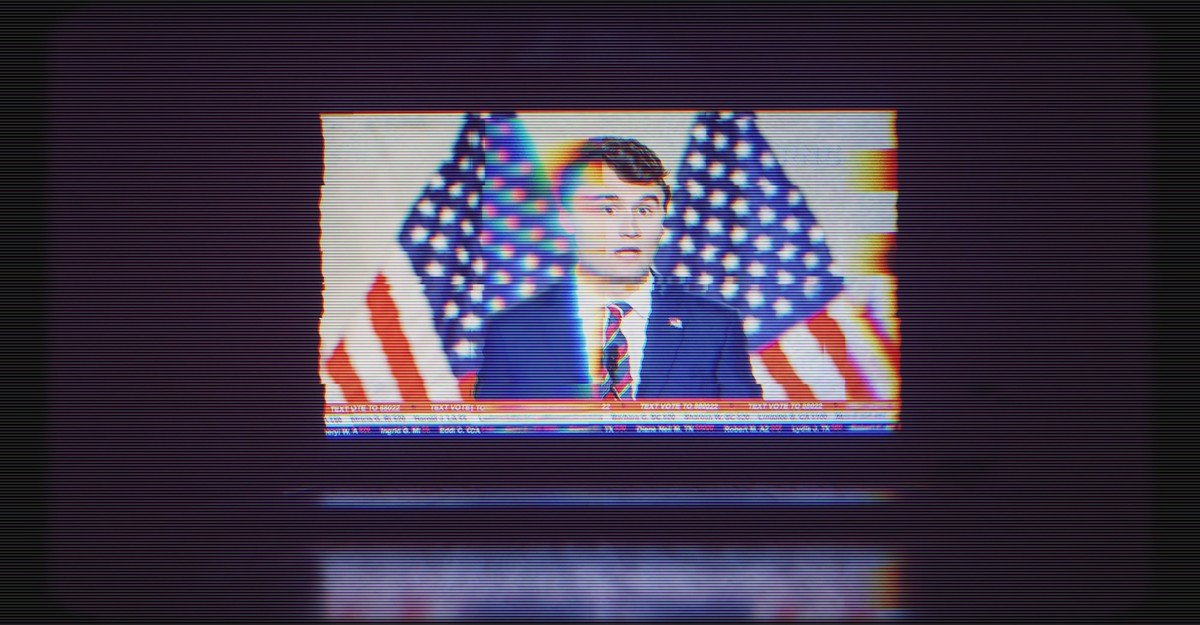
Arguably the most remarkable aspect of the aftermath of the right-wing activist Charlie Kirk’s assassination is how irrelevant its actual perpetrator was to the immediate discourse. I saw the finger-pointing online even before I saw the news that Kirk had been shot. At that point, there was hardly any information about the incident—let alone details about the shooter or a motive. Yet there was plenty of blame to go around: Elon Musk posted on X that “the Left is the party of murder,” even before Kirk’s shocking death had been confirmed. Others blamed the shooting on the media, NGOs, and billionaire Democrat fundraisers.
This is the algorithmic internet at work. It abhors an information vacuum and, in the absence of facts or credible information, gaps are quickly filled with rage bait, conspiracy theorizing, doomerism, and vitriol.
If one thing has united the discourse in the past 48 hours, it has been a desire for certainty—a drive to know exactly why Kirk was killed. He was a political figure, of course, which makes his horrific death inherently an act of political violence. But understanding Kirk’s assassination through politics alone may not be enough. After the alleged assassin was apprehended, late last night, the online meaning-making machine went back into overdrive. This morning, I watched as people dredged up what appeared to be his mother’s Facebook page, posting photos from 2017 of a person who looks like the alleged shooter supposedly dressed up like Donald Trump for Halloween. Other photos from the same Facebook page appear to show children at a county fair, and one is wearing an NRA hat. “They were a pro-gun family,” one account that posts on both X and Bluesky wrote, alongside a screenshot of the Facebook post, implying that the killer may have been a Republican. None of this seems to have been verified before it was posted.
Another account claimed that it had found a donation from the shooter to the Trump Make America Great Again Committee. A separate post from a journalist claimed to debunk this. On 4chan’s “politically incorrect” message board, anonymous posters feuded over the killer’s ideology. “So… not trans, huh? And a white person? Male? Interesting. Who’d have thought it?” one wrote. Another poster suggested, with no evidence, that the shooter may have been a Groyper, the term for followers of the white nationalist Nick Fuentes, who had publicly feuded with Kirk. Others, of course, speculated about what the assassination might have to do with Jeffrey Epstein. Many of the right-wing accounts who’d been clamoring for civil war just hours earlier seemed not to know what to make of the news—Representative Nancy Mace, who’d previously speculated that the shooter was transgender, posted on X that the shooter was a “lost individual” and she offered to pray for him. As of this writing, the public still knows very little about the shooter—there are no charges, just speculation.
Watching all this play out, you can feel a jockeying of sorts; interested parties are trying to label or disavow the shooter, or otherwise pin a label onto him. This, too, is the algorithmic internet at work: a justification machine where facts and news aren’t so much presented and reported as they are cataloged and then rearranged to fit preset narratives.
What we know of the killer’s ideology, beyond what can be interpreted from his alleged mother’s Facebook posts, comes from the crime scene. The details offered by Utah’s governor at a press conference this morning suggest that the situation may be complex in the way that many highly visible shootings now are. According to Utah’s governor, the fired bullet casing found on the scene had been inscribed with the phrase “Notices bulges OwO whats this?”—a niche online reference to flirting within the furry community that is now mostly just used trollishly. Unfired cases were also inscribed with hyper-online references, including a series of arrows that, as the gaming publication Polygon pointed out, match the input required to drop a bomb in a popular game called Helldivers 2. Another bullet casing was engraved with the trollish phrase “If you read this you are gay lmao.” The bullet casings are less of a sign of a political affiliation and much more a signal that the shooter was very online. One old Facebook post that’s made the rounds purportedly shows the alleged shooter dressed up in 2018 as an obscure meme that gained popularity in the 2010s on 4chan, Reddit, and Twitter.
This dynamic—a young shooter who seems to have no barriers between fringe online life and the real world—has become an alarming meme unto itself. Just last week, I wrote about the mass shooting at the Annunciation Catholic Church in Minneapolis; the shooter there was also extremely online and apparently affiliated with a number of groups that defy normal political ideologies. These groups are better thought of as fandoms—a hybrid threat network of disaffected people that can include Columbine obsessives, neo-Nazis, child groomers, and trolls. They perform for one another through acts of violence and cheer their community on to commit murder. Though these groups might adopt far-right aesthetics, the truth is that their ideology is defined by a selfish kind of nihilism. To them, murder is the ultimate act of trolling, and they want to be remembered for it.
From the little we know, Kirk’s assassin seems to differ some from this profile. He appeared to have intentionally carried out a targeted assassination rather than attempting a mass shooting—both are horrific, but they are different. And he did not take his life in the hopes of becoming a “saint” online, as many mass shooters do. But the bullet casings suggest a desire to reach an audience—and to troll the media and law enforcement tasked with trying to find a motive.
This leaves the broader discourse around Kirk’s assassination in an awkward position, deprived of the certainty that so many crave. The killer’s motive is not clear yet, nor is the full political and cultural impact of Kirk’s death. And yet, as this and so many other shootings have demonstrated, none of this matters to individuals who are using the tragedy to get attention for themselves online.
I get the sense that, for many, the most unnerving outcome might be if the shooter does not fall neatly into an ideological framework. Perhaps this is part of why the unknowns will not stop interested parties from trying to categorize him. They will not stop the Trump administration from suggesting, as the White House adviser Stephen Miller did on X yesterday, that there is a sickness among the administration’s ideological enemies that must be purged from the country. The unknowns will not stop those who see the assassination as an overt act of left-versus-right violence from feeling like the country is on the brink of a civil war. The livestreams, vigilante investigators, extremists sending death threats, and conspiracist threads will continue their work. And Kirk’s organization, Turning Point USA, will continue to sell $35 memorial T-shirts with an illustration of Kirk and a Bible verse on them.
The shooters who fall into this mold implicitly understand these internet dynamics. They seek an audience, but they are also acting out to get the world—especially the online world—to respond. “If you read this you are gay lmao” is a trolly, nihilistic thing to inscribe on a bullet casing, but the point is for people to see it, for people like me to write it down so that people like you can read it and feel something, be it shock, outrage, confusion, or sadness. The shooters may not have a coherent ideology, or even be particularly politically motivated per se, but they seem to know the ecosystem they are dropping their horrific acts of violence into.
For some shooters, online communities—with all their irony-poisoning, shitposting, and feuding—are more real, or at least more meaningful, than physical ones. With their senseless violence, these killers are bringing a part of that networked, online chaos to tangible, life-and-death reality. They know that their violence will be flattened, picked apart, argued over, and, crucially, amplified by the justification machine. In this way, they will get what they’re after. The violence will continue.
There are many overlapping problems at work here: a gun-violence and firearm epidemic; worsening political polarization; social and cultural issues such as loneliness, alienation, and a growing distrust of elites; and disdain for one’s fellow citizens. There is so much anger right now, plenty of it justified. A young father was murdered on a college campus. Few public or private spaces seem to be safe from the specter of a mass shooter. Institutions that once functioned for the benefit of the public are now sclerotic, having been partly dismantled, or seem indifferent to suffering. The economy operates like a casino, and there’s a feeling that traditional pathways to prosperity are gone. People are being rounded up off the streets without due process. The list goes on.
Every minute of every day, all of these thoughts and feelings are uploaded into platforms that are owned by billionaires or massive technology companies and built for viral advertising and the collection of individual data. The internet is not a monolith. For every community of mass-shooter fandoms, there is another that is silly, joyous, productive, or totally harmless. But it is hard not to notice that, in the aggregate, something poisonous is in the architecture of its platforms and the way that our technologies demand not just our attention, but our most heightened emotions. This is not an environment for good-faith politics. These platforms are governed by algorithms that tend to prioritize engagement above all else, amplifying the loudest, most shameless users because these voices will draw in other voices. This attention is worth good money, both to posters who can harness it, as well as the tech companies. Kirk knew this and was quite successful at playing this game, using social media to spread invective, troll his political opponents, polarize his audience, and grow his movement.
The public has no understanding of how the algorithms really work—they’re company secrets—so participants are constantly shadowboxing the machine, turning conversation into a constant A/B test to see what catches on. Even many of the people who broadly understand this situation feel compelled to have conversations in these spaces—the very same outlets that help incubate and perpetuate unthinkable violence.
When Kirk’s death was announced, I felt sick—primarily because the act itself was so cowardly and brutal and autoplaying on my timelines with every refresh. But I also knew this could only accelerate the kind of physical violence and hateful rhetoric that got us here. And I knew what would happen next: Kirk’s death would set off a chain of the highest-stakes conversations—about gun violence, mental illness, political polarization, online snuff films, fascism, free speech, the right to assemble, the Second Amendment, transgender rights, Nazis, the Civil War, the very state of our democracy, and more. And the dialogue would happen on platforms that goad each of us into being the worst versions of ourselves; that prioritize in-group performance over listening; that reward outrage and outrageousness; that collapse context; that exist to privilege conflict over resolution. To continue to conduct our discourse in these spaces suggests, however tacitly, a desire for them not to resolve.
