

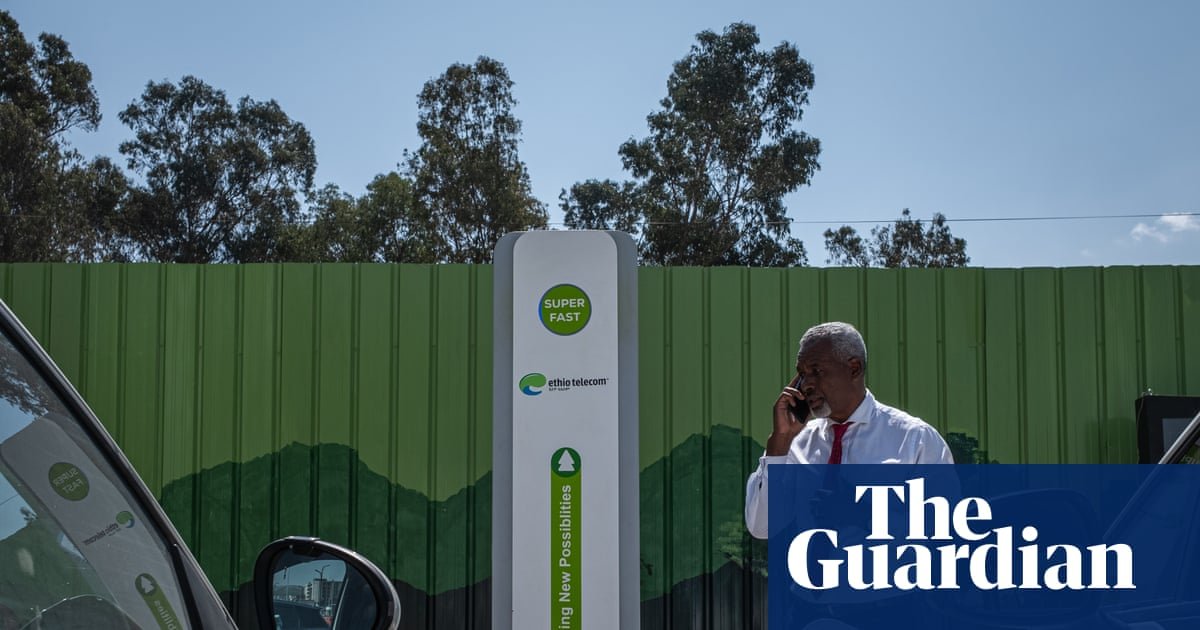
When Deghareg Bekele, an architect in his early 30s, bought an Volkswagen electric car this year, he was a little sceptical. Not only is his home town, the Ethiopian capital, Addis Ababa, prone to persistent power cuts, he also doubted the quality of his new vehicle.
Four months on, Deghareg is pleased with his purchase since he no longer has to endure long lines at the petrol pump, caused by Ethiopia’s chronic fuel shortages.
“I’d have to wait two to three hours, even if I got there in the early morning, and they often run out of petrol before it’s your turn,” he says. “Having an EV saves me lots of time. I have no regrets.”
Architect Deghareg Bekele at an EV charging station in Addis Ababa. Photograph: Fred Harter
Until recently, electric vehicles were almost unheard of in Ethiopia. But last year it became the first country to ban imports of combustion engine vehicles. Now, EVs are a common sight in the capital. The most prevalent brand is China’s BYD, which recently overtook Tesla as the world’s largest EV maker, although western vehicles are also popular.
Roughly 115,000 EVs now ply Ethiopia’s roads, out of a total of 1.5m cars in the country, according to the transport ministry. It wants to increase the number to 500,000 by 2030.
Ethiopia is an unlikely proponent of the transition to EVs. Roughly half of its 126 million people have no access to electricity, only 20% of households have access to it for at least 23 hours a day and only a third of households have access through the grid. Power cuts mean many factories are not fully operational.
These shortages will be alleviated to an extent following the opening of the Ethiopian Grand Renaissance Dam earlier this month, 14 years after construction began. With a maximum capacity of 5,150 megawatts, it will double Ethiopia’s current electricity output – 97% of which already comes from hydropower.
But problems remain with the national grid, which is prone to outages and will cost billions of dollars to expand to rural communities currently cut off from power.
“We have massive potential in renewables,” says Bareo Hassen, state minister for transport. He says the decision to ban imports of diesel and petrol vehicles is part of Ethiopia’s push to promote green policies and reduce the pollution that chokes the capital during rush hour.
The Grand Ethiopian Renaissance Dam on the Blue Nile River in Guba, north-west Ethiopia, which came online this month. Photograph: Anadolu/Anadolu Agency/Getty Images
But the main motivation is economic, however. Ethiopia spends roughly $4.5bn (£3.3bn) a year importing fuel – a huge amount in a country where foreign currency is scarce and poverty is widespread. “It is one of our main expenditures,” says Bareo.
By contrast, Ethiopia’s hydropower is cheap as well as green. This has helped to win over doubtful drivers in Addis Ababa, who have seen pump prices more than double in the past three years.
Firew Tilahun, a taxi driver, estimates he used to spend 20,000 Ethiopian birr (£105) a month on fuel, a significant chunk of his earnings. Now he spends less than 3,000 birr a month recharging his Chinese EV.
skip past newsletter promotion
Sign up to Global Dispatch
Get a different world view with a roundup of the best news, features and pictures, curated by our global development team
Privacy Notice: Newsletters may contain information about charities, online ads, and content funded by outside parties. If you do not have an account, we will create a guest account for you on theguardian.com to send you this newsletter. You can complete full registration at any time. For more information about how we use your data see our Privacy Policy. We use Google reCaptcha to protect our website and the Google Privacy Policy and Terms of Service apply.
after newsletter promotion
We wanted to create a local production capacity to create local skills and job opportunitiesBareo Hassen, transport minister
“I have no plan to change back,” he says as he tops up his battery at a new charging station in Addis Ababa. “Sometimes we have power cuts, but we manage.”
To encourage the take-up of EVs, Ethiopia has granted them sweeping tax exemptions. They are still hugely expensive, with a BYD model costing roughly 2.2m Ethiopian birr (£11,000) in a country where doctors earn £60 a month on average. But combustion engine cars also fetch sky-high prices, the result of import levies of 200% in place before their ban, which wildly distorted the secondhand vehicle market.
Ethiopia is also encouraging local production, but for now the scale is small. One of the main sites is run by Belayneh Kinde Group, an industrial conglomerate with a site on the western outskirts of Addis Ababa, where mechanics are assembling 150 Chinese minibuses in a large hangar.
Electric vehicles are assembled at a plant on the outskirts of Addis Ababa. Photograph: Fred Harter
“Our focus shouldn’t just be on importation,” says Bareo. “We wanted to create a local production capacity to create local skills and job opportunities for our citizens.”
The abrupt transition to EVs has been uneven, however. Drivers complain they were given little time to prepare. Ethiopia only has just over 100 charging stations out of a target of more than 2,300, compared with 21,600 in London. Almost all of them are in Addis Ababa. This rules out road trips to the countryside, where power cuts are particularly frequent. It also makes owning an EV hugely impractical outside the capital.
Lema Wakgari charging his electric car. He says there needs to be more charging stations. Photograph: Fred Harter
At another charging station in Addis Ababa, Lema Wakgari, a coffee export manager, says he’s “really happy” with his BYD, but laments that he cannot drive to Hawassa, a popular lakeside resort a 177-mile (285km) drive south from Addis Ababa, without running the risk of getting stranded.
“They need to build more charging stations – it’s a must,” he says. “Even in Addis there aren’t many available. No electric vehicles are driving outside the city right now. This car can go 420km. After that, what are you going to do?”
There are also no plans to bring in electric versions of the heavy lorries that bring a large proportion of Ethiopia’s imports from the port in neighbouring Djibouti. As the fleet begins to dwindle from wear and tear, the economy may feel the effects.
The chief executive of a large ride-hailing company in Addis Ababa says most of his drivers are sceptical about the durability of the vehicle’s batteries and how their value will hold up. But he has been won over after buying one himself and hopes the country’s EV infrastructure will catch up to meet demand.
“When this policy was introduced, I thought it would be a spectacular failure because we don’t have good power infrastructure, we have a lot of power outages and not many charging stations,” he says.
“Now, I’m cautiously optimistic.”
