

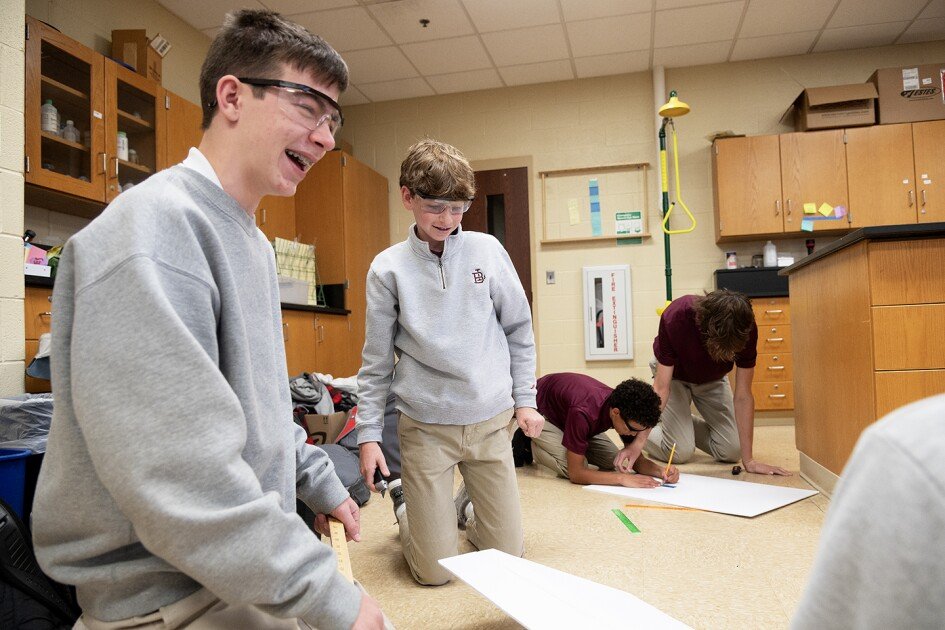
Science is usually one of the more hands-on subjects in middle school: Students design research questions, draw diagrams, and conduct experiments.
But the country’s 8th graders are less likely to do those kinds of activities in science class now than their peers five years ago, according to findings from the 2024 National Assessment of Educational Progress.
The test’s results in 8th grade science, released Tuesday, show a four-point drop in average student scores, erasing the progress that students had made since 2009. Scores fell for students across the board—those performing at the highest and lowest levels—and in all three tested content areas: physical science, life science, and earth and space science.
At the same time, classroom environments have changed.
In addition to testing students on their science content knowledge, the assessment also surveys students and their teachers about the lessons they do, the resources they have, and their attitudes toward the subject. The findings offer a rare, nationally representative glimpse into the state of middle school science education across the country.
Read on for three data points that show how 8th grade science instruction has changed since 2019.
1. Students are participating in less ‘inquiry-related’ learning.
Eighth graders were asked how often they did a series of activities that involved scientific inquiry—tasks that asked them to use statistics or equations to analyze data, engage in scientific arguments, or do hands-on activities like experiments or modeling.
Participating in scientific inquiry was correlated with higher NAEP science scores.
But the percentage of students who said they did these activities “often” or “always” decreased on average, from 17% in 2019 to 14% in 2024.
Inquiry is a core component of the Next Generation Science Standards, first released in 2013 and since adopted by 20 states and the District of Columbia. The standards say that students should learn science and engineering practices, along with core content, so they can learn to investigate problems and design solutions the way that working scientists do.
Still, analyses of the curriculum market have found that high-quality materials to meet this new teaching framework are still hard to find, especially at the elementary level.
And finding time for scientific inquiry—or even science at all—may have been especially challenging for teachers during pandemic-era school closures.
Students who were in 8th grade in the spring of 2024 were in elementary school during the 2019-20 and 2020-21 school years. Science is already marginalized in early grades, often crowded out by the tested subjects of reading and math. During COVID-era closures, the subject might have become even less of a priority. Science teachers reported struggling to teach scientific investigations and hands-on learning through online platforms.
The 2024 science scores suggest a need for more “hands-on, collaborative learning,” said Christine Cunningham, the senior vice president of STEM learning at the Museum of Science in Boston, and a member of the National Assessment Governing Board, the organization that sets policy for NAEP.
“The NAEP scores are proof positive that we cannot keep doing science instruction in the same old way,” she said in a statement on Tuesday.
2. Science teachers have fewer textbooks, and more screens, at their disposal.
NAEP also surveys students’ science teachers, asking them about the availability of texts and materials.
In 2024, 17% of 8th graders had teachers who said they had no access to science textbooks, compared with 10% in 2019. A quarter of 8th graders had teachers who said they had no access to science magazines and books, compared with 18% in 2019.
At the same time, computer access went up. The percentage of 8th graders whose teachers said computers were largely available for educator use rose, from 77% in 2019 to 83% in 2024.
These shifts may reflect the broader national expansion of screens in classrooms, accelerated by the pandemic. Most students in the United States now use at least one school-issued digital learning device, according to a 2021 survey from the EdWeek Research Center.
3. Fewer students say they like science.
Students’ attitudes toward science took a big hit over the past five years. In 2019, 38% of 8th graders had a high level of interest and enjoyment in the subject, compared with 28% in 2024.
While 72% of 8th graders in 2019 agreed “quite a bit” or “exactly” that it was important to do well on their science assignments, only 63% said the same in 2024. The percentage of students who said they thought science would help them outside of school fell as well, from 46% in 2019 to 38% in 2024.
How teachers introduce and explain science topics might have an effect on students’ interest, other research shows.
Almost half of teenage students in a recent EdWeek Research Center survey said having teachers who explain things in an understandable way would have a major impact on their motivation in STEM.
This was the top response students chose, above hands-on projects, solving real-world problems, or even having a teacher they liked.
