

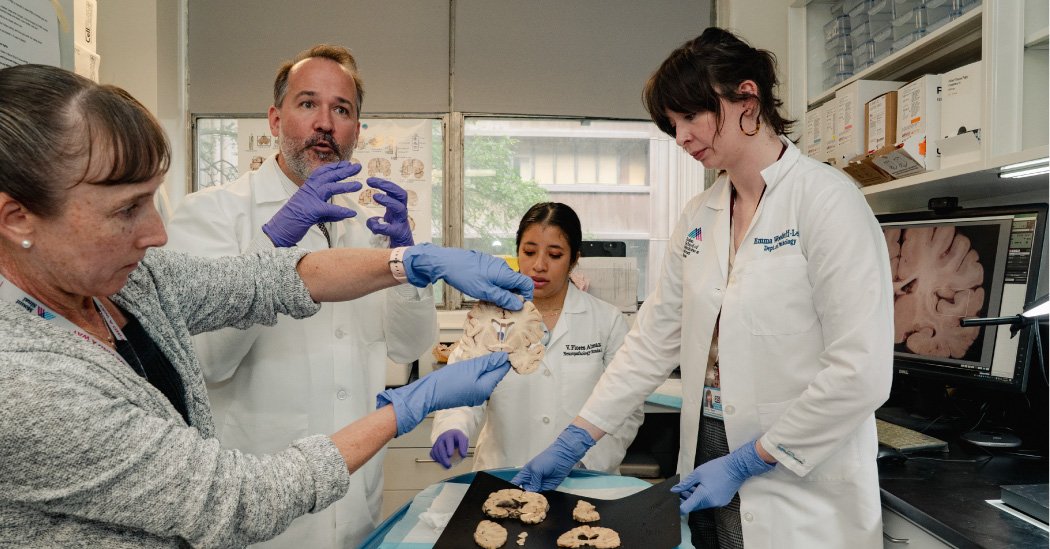
Examining a brain at the Neuropathology Brain Bank at Mount Sinai Medical Center in Manhattan.
In July, a gunman in Midtown Manhattan left a note that referred to chronic traumatic encephalopathy, or C.T.E., a brain disease that can be diagnosed only after death.
“Study my brain please,” the note said.
The New York City medical examiner’s office is examining the shooter’s brain, a process that can take weeks, or months. A visit to the Neuropathology Brain Bank at Mount Sinai in New York City reveals the many steps required to prepare brain tissue for analysis and diagnosis.
Step 1 · Remove
Calvin Keys, morgue director.
Once or twice a week, the autopsy suite in the basement of Mount Sinai receives a body for brain donation. A coordinator works with families to obtain permission and with funeral homes to retrieve the brain quickly, ideally within 24 hours of death.
Parkinson’s disease, Alzheimer’s disease, strokes and normal aging all leave visible changes in brain tissue. Some changes are visible with the naked eye, while others require detailed examination with a microscope or a high-resolution scan.
Posters throughout the brain bank say, “Every brain tells a story.” But first you need the brain.
An oscillating saw and other instruments used in the procedure.
Stephanie McQuillan, clinical research manager, coordinates brain donations.
The process takes an hour. A technician makes an incision at the back of the head and lifts the scalp to expose the skull. An oscillating saw cuts through the bone, and a scalpel severs the few internal connections that hold the brain in place.
The brain is removed intact, the incision is sealed and the body is returned to the funeral home. “Our job is to make sure the brain is removed in a way that the family can have an open casket,” said Calvin Keys, the hospital’s morgue director.
The fresh brain is weighed — the first piece of scientific data to be collected — and then placed in an Igloo cooler lined with a biohazard bag and rolled to the cutting room.
Step 2 · Breadloaf
A brain on a cutting surface behind Victoria Flores Almazan and Taylor Hardy, research associates, and Emma Thorn, the brain bank manager.
The cutting room handles two types of brain tissue: fresh tissue and tissue that has been stabilized and fixed with formalin, a preservative.
“I have a comparison about the texture,” said Emma Thorn, the brain bank manager. “I’d say a fresh brain is similar to flan, and a fixed brain is similar to a deli ham.”
A fresh brain is typically separated into its two lobes, or hemispheres. One half is parceled into smaller pieces and frozen for future study, and the other half is submerged in formalin and fixed, a process that can take two or three weeks as the solution penetrates the tissue. Fixing a whole brain takes longer, about a month.
Cutting into the base of a fixed brain.
Breadloafing a fixed brain into thin, consistent slabs.
Fresh brain tissue is too mushy to cut cleanly, but fixed tissue is firm enough to be sliced into thin slabs, a process known as breadloafing. Smooth cuts with a long, single-edged razor help prevent marks and ridges on the slabs. Once a blade starts to snag, it’s replaced.
Cleaning a thin slab of brain tissue.
Each slab of tissue is labeled, inspected and cleaned in preparation for the next step.
Step 3 · Section
A poster highlights 40 numbered regions of brain tissue that are cut out for further analysis.
After the brain tissue has been sliced into thin slabs, the brain bank removes 40 small sections for further processing.
Cutting a section of brain tissue from a slab.
Placing sections into numbered cassettes.
A razor blade cuts clean sections of tissue to fit inside numbered plastic cassettes. When all 40 sections have been removed, they are transported across the hall to be processed and embedded in wax.
Step 4 · Freeze
A frozen parcel of fresh brain tissue.
A different process is used for fresh brain tissue. Regions of interest are parceled into small pouches and then flash-frozen between metal plates lying on dry ice.
The goal is to process and freeze the fresh brain within two hours of removal from the donor’s body, to minimize deterioration.
Parcels of tissue on dry ice.
Freezing damages cells but preserves the tissue’s chemistry. Researchers around the country request frozen tissue for molecular and biochemical testing.
For long-term storage, the brain bank keeps fresh tissue in freezers at minus 80 degrees Celsius (minus 112 degrees Fahrenheit). Samples of fixed tissue must undergo further steps to make them stable at room temperature.
Step 5 · Process
Removing a tray of cassettes from the tissue processor.
The small cassettes of fixed brain tissue are carried across the hall from the cutting room and placed into a tissue processor for about 24 hours. The processor uses a series of chemicals and substances, including ethyl alcohol and paraffin wax, to remove water and further stabilize the tissue.
Step 6 · Embed
Embedding a section of processed brain tissue in wax.
After a day of processing, the 40 sections of brain tissue are firm and stable at room temperature. Each section is moved to a metal dish, covered with melted wax and allowed to harden into a solid block.
Leveling the tissue in the liquid wax.
A finished block of brain tissue in hardened wax.
The blocks can now be stored at room temperature, or moved back across the hall to be shaved into thin slices for analysis.
Embedding a section of brain tissue in paraffin wax.
Step 7 · Slice
Shaving thin slides from blocks of brain tissue.
To make a diagnosis, a doctor needs slides.
Each block of brain tissue is soaked in cold water to firm up the wax, and then inserted into a microtome, a machine that makes precise cuts measured in microns, or millionths of a meter. (A human hair is about 100 microns thick.)
“Right now the blades are made in Japan — very, very sharp,” said Valeriy Borukhov, the histotechnician operating the device.
Slicing a block of tissue into shavings that are six microns thick.
A ribbon of wax containing several tissue shavings.
Floating the ribbon on a tray of water.
Capturing a tissue shaving on a slide.
In an elegant dance, the block bobs against a fixed blade, shaving a continuous ribbon of wax and tissue. The ribbon is floated in a tray of water, separated into individual pieces and then captured on glass slides dipped in the water.
Cutting, floating and separating slides of brain tissue.
The pale, translucent slides are then carried across the hall to be stained.
Step 8 · Stain
Dr. Claudia De Sanctis, histology manager, prepares a machine to stain tissue cut by Mr. Borukhov, at left.
The “octopus,” a hulking gray staining machine with 30 arms for 30 slides, sits in a corner of the histology room.
The device contains vials of solutions, and each inserted slide has a printed code that specifies which chemicals to use. The machine runs for three to 12 hours, depending on the stains required, and produces up to 30 finished slides.
A slide ready for staining.
A tray with different stained slides.
Different stains are used to highlight specific components of the brain tissue. Sometimes multiple runs are required to make a diagnosis, with new slides stained based on the outcome of a previous run.
Loading chemicals and a slide into the staining machine.
The stained slides are cleaned, sealed under glass and sent for analysis. “Only when we look under the microscope can we make a definitive diagnosis” of C.T.E., said Dr. John Crary, founding director of the brain bank.
Physical microscopes are still used for quick turnarounds or to examine older slides that haven’t yet been scanned, but new slides are run through high-resolution scanners. “The microscope hasn’t gone away, it’s just not on my desk anymore,” said Dr. Crary.
Step 9 · Scan
Loading slides into a high-resolution scanner.
Stacks of stained slides are loaded into a half-million dollar Leica scanner.
The resulting scans are magnified up to 400 times, with file sizes measured in gigabytes. A single scan might contain “10 to 100 times more data than an M.R.I.,” according to Dr. Crary.
Step 10 · Diagnose
Dr. Crary compares a pair of scanned slides.
After several weeks of processing, the brain tissue is ready for analysis.
To interpret the slides and search for evidence of C.T.E., a pathologist must be aware of the full spectrum of brain disorders.
Dr. Crary examines a stained section of cerebellum.
“We’re not studying one disease. We’re studying everything that can possibly go wrong,” said Dr. Crary. “There’s hemorrhages and strokes, all kinds of vascular changes. There are tumors, infections, developmental disorders, hypoxia, metabolic changes. And all of these things can all be happening simultaneously.”
Tangled Proteins
Dr. Crary often begins by looking at the hippocampus, a seahorse-shaped structure involved with memory formation. He describes it as “almost a fingerprint for different diseases,” which if present, affect different parts of its complex structure.
Like rows of tiny staples, tau proteins help support and stabilize the structure of neurons in the brain. But abnormal tau can clump together in a tangled net of protein, killing the neuron and leading to cognitive decline.
Below, sections of hippocampi from two brains are stained to highlight tangles of tau. Most brains develop abnormal tau in specific areas of the hippocampus as they age. But a brain with severe C.T.E. might eventually develop dense bands of abnormal tau across the whole structure.
Tangles of tau, stained brown, in the hippocampus of an aging brain.
The same area in a brain with severe C.T.E.
Pressure Points
C.T.E. is a mechanical injury, where mild but repetitive impacts stretch and tear the delicate fibers that connect brain cells. This physical damage tends to be amplified at natural weak points in the brain’s geometry.
One weak point is along the depths of the sulci, the furrows and grooves in the brain’s rippled surface.
A stained section of brain from a 68-year-old man who had C.T.E.
Abnormal tau, stained brown, is visible around the base of the sulci, or grooves in his brain.
“I think of it as like a Kit Kat bar,” said Dr. Crary. If you apply pressure to a grooved chocolate bar, “it breaks at that little sulcus because that’s the weakest point.” He added, “So this is exactly what’s happening in the brain. This is a pressure point.”
A Diagnostic Bull’s-Eye
Impacts can also damage soft brain tissue surrounding more rigid blood vessels.
Dr. Crary compared this effect to another food. “Imagine the brain is a bowl of Jell-O.” The soft gelatin doesn’t tear when you shake the bowl, he explained, but if a straw is embedded inside, the shaking gelatin can shear and tear where it touches the rigid sides of the straw.
Abnormal tau, stained brown, around the cross section of a blood vessel.
Abnormal tau in neurons around two blood vessels.
In a similar way, abnormal tau can accumulate in damaged tissue around blood vessels in the brain, leaving a “bull’s-eye” pattern on a slide that is the definitive evidence needed to diagnose C.T.E.
But interpreting tau is a delicate art. Pathologists must “read the tea leaves” and judge whether the bull’s-eye’s tangles are in neurons, which count toward a C.T.E. diagnosis, and not in other types of brain cells, which do not.
In general, according to Dr. Crary, abnormal tau in “C.T.E. is going to be patchy and Alzheimer’s disease is going to be diffuse, and normal aging is going to be localized to very specific structures.”
Dr. Jamie Walker, co-director of the brain bank, is focused on finding a biomarker that could differentiate these types of abnormal tangles in living patients.
Future Steps
Researchers at the brain bank are working to train artificial intelligence to make objective judgments about scanned slides and reduce human bias in making diagnoses. And they hope that A.I. models will identify patterns across thousands of slides that are too subtle for their human trainers to detect.
“Basically you have a giant pile of hay and one needle in it, and you tell the algorithm to find that needle,” said Dr. Kurt Farrell, an assistant professor of pathology who develops machine learning models at the brain bank.
A collection of atypical brain slabs. Dr. Crary points at a brain with a dark stain from a severe hemorrhage.
A brain that had Alzheimer’s disease shows enlarged cavities, or ventricles.
In a 2023 paper, an A.I. model developed at Mount Sinai was trained to predict a brain’s age based on images of the hippocampus. The estimates were typically within five years — more accurate than pathologists. Unpublished results also suggest signs of accelerated aging in C.T.E. brains, which an A.I. model estimated were roughly 10 years older than their chronological ages.
And while C.T.E. can be definitively diagnosed only posthumously, future tests may be able to diagnose the disease while a person is alive.
