

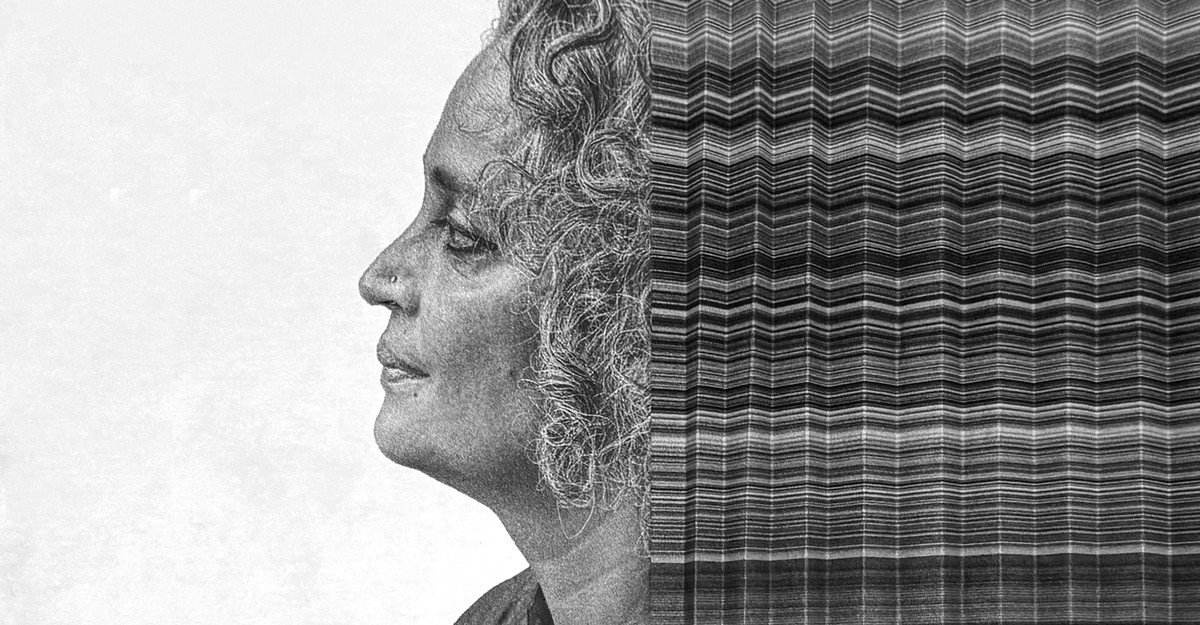
In the spring of 1997, Arundhati Roy’s debut novel, The God of Small Things, became an international sensation, marking a watershed moment in a new wave of Indian writing in English. That June, The New Yorker immortalized the boom in a group portrait celebrating the 50th anniversary of India’s independence: Salman Rushdie (still in hiding, at the time) stood at the center, flanked by Vikram Seth, Amitav Ghosh, Anita Desai, and Rohinton Mistry, among others. A younger generation was represented by Kiran Desai, Vikram Chandra, Amit Chaudhuri, and—caught in the middle of a laugh—a beaming Roy.
Who could resist her? The God of Small Things brimmed with inventive language, eccentric characters, and the lush landscape of her native Kerala. The novel won the Booker Prize, and many in India held Roy up as a model of the country’s new, triumphalist incarnation, with its roaring economy and rising Hindu nationalism, exemplified later in the slogan “India Shining.” (I remember her face gracing billboards along Indian highways at the time.)
But then Roy made a pivot, or what seemed like a pivot: She turned to writing critical, crusading essays about caste, class, religious violence, and the politics of power. Forsaking fiction, she focused on the marginalized and victimized, “the refugees of India’s shining,” as she put it in a 2010 essay. Hers was a risky act, a shift of not just genres but also loyalties. India had championed her on the world stage, and she responded by critiquing it, urgently and stridently, from within.
At the turn of the millennium, the nation’s leaders and one of its most lauded writers diverged radically: India’s politics lurched rightward, with the ascent of the Hindu-nationalist Bharatiya Janata Party and, later, the autocratic Prime Minister Narendra Modi; Roy, meanwhile, attacked imperialism and globalization from the left. Since then, their fates have been bound together in a left-right struggle that has come to define the turbulent 21st century globally. In 2023, Indian officials moved to prosecute Roy for comments that she’d made in 2010 about Kashmir; last year, the government approved charges under a broad anti-terrorism law, which Modi’s government has routinely used to silence its critics.
To dissidents, she has been seen as a hero putting her life on the line; to Modi’s supporters, as a dangerous subversive who is anti-national and anti-Hindu. She became more of a player in national politics—a litmus test of one’s own beliefs—than an observer. She was not a novelist bemoaning the human condition and its injustices, but a political thinker taking strong and sometimes unpopular positions. Yet the backlash, as she now sees it, was also freeing.
“It liberated me and set me walking,” Roy writes in her raw, unsparing new memoir, Mother Mary Comes to Me. “For years after that I wandered through forests and river valleys, villages and border towns, to try to better understand my country. As I traveled, I wrote. That was the beginning of my restless, unruly life as a seditious traitor-writer.”
Defying the expectations put on a successful debut novelist—fleeing the “gilded cage” of literary adulation, as she puts it—may have been her latest escape in what Roy depicts as a lifetime full of them. She seems to have learned from an early age that there is no safety in keeping still—that the best thing to do is to keep moving.
Roy’s instinct for flight had roots, she explains, in a childhood ruled by a dynamic but suffocating mother. Mary Roy, who raised Arundhati and her brother alone, founded a progressive school in the state of Kerala and encouraged local children, especially girls, to challenge conservative norms. (“She gave them wings, she set them free,” Roy writes.) Mary was a cultlike figure among her colleagues and a scandalous eccentric within her “tiny, insular Syrian Christian society,” a leader whose successful fight to establish inheritance rights for Christian women turned her into a “national feminist icon.”
But to the younger Roy, Mary was a monster, too, a tempest of “clawing, lashing fury” who berated Arundhati constantly and called her daughter a millstone around her neck. Chronically ill and asthmatic, Mary leaned on her daughter for support. “I tried to breathe for her,” Arundhati writes, with the kind of mythopoetic flair that infuses her fiction. “I became her lungs. Her body. I attached myself to her in ways she wasn’t aware of. I became one of her valiant organs, a secret operative, breathing my life into hers.”
Roy describes her first escape, at the age of 16: She leaves home and sets off to study architecture in Delhi. She throws herself into a reckless, vagabond student life. She eventually moves into a rooftop garret in a run-down part of the city, barely making ends meet. She stops using her first name, Susanna, and abandons architecture for screen writing, all the while nurturing the dream of writing fiction. But first, she explains, she must find her own way of describing her multilingual world to herself. “I knew that if I could describe my river, if I could describe the rain, if I could describe feeling in a way that you could see it, smell it, touch it,” she writes, “then I would consider myself a writer.”
By the time Roy completed the first draft of The God of Small Things, she had settled into a stable domestic life with her partner, Pradip. When he read the draft, Pradip immediately knew nothing in their world would be the same, including their relationship. The overwhelming success of the book and the resulting media glare opened a divide between them. Political changes had an even greater impact when a right-wing coalition came to power in 1998 and radically altered the country as she knew it. Roy chafed at the stifling comforts of their safe, privileged existence in the face of what she recalls sensing as the beginning of an “ideological coup.”
Once again, she found a way to flee—moving out on her own and separating from Pradip. “As my personal life turned to rubble and I risked coming undone, the outside world smashed in,” she writes. “In a strange way, over the next several years, it was politics—and anger—that held me together.”
Roy’s nonfiction quickly made her a darling of the international left. Her voice in the essays is sly and irreverent, knowing and persuasive—all qualities that endeared her to readers, despite her often excessively Manichean tone. In the memoir, she recalls asking herself: “Could I write about irrigation, agriculture, displacement, and drainage the way I wrote about love and death, or about characters in a novel?”
In a flurry of essays, Roy skewered India’s official justifications for a string of nuclear tests, decried government corruption and Hindu nationalism, and attacked a series of major dam projects. She frequently participated in protests for the grassroots movements that she supported. After Roy joined activists fighting against the construction of a dam on the Narmada River, she was convicted of contempt of court for challenging the supreme court’s order to renew construction.
Soon, Roy broadened her political critique to include commentary on United States policy, and her polemical essays became as recognizable (and as controversial) as her fiction. In “The Algebra of Infinite Justice,” published three weeks after the attacks of September 11, 2001, Roy called the act “unconscionable” but questioned President George W. Bush’s assertion that the perpetrators “hate our freedoms.” She argued that Osama bin Laden had been, in essence, “invented” by the CIA’s actions in Afghanistan decades before, and she warned her readers about the dangers of the open-ended War on Terror. Critics called her “anti-American.”
Even as her political writing provoked responses, she felt the pull of fiction. As she traveled through Central India with Maoist guerrillas in 2010, made-up characters began to consume her consciousness. She writes that this resurgent impulse “felt like a benediction.” But it would evolve, too, becoming more boisterous and overtly topical. The Ministry of Utmost Happiness, published in 2017, 20 years after her debut novel, moves between a Delhi graveyard where a community of outsiders gather—“a place where derelicts, vagrants, and those who have fallen out of India’s strict grid of caste, religion, gender, and ethnicity are buried”—and the embattled territory of Kashmir. Once again, she wrote about India’s contested region despite government pressure.
What to make, finally, of Roy’s trajectory, and the dichotomy of her elaborately woven novels and activist essays? The critic John Berger, a mentor and friend, was one of the few who saw the intrinsic connection between the author’s two modes. “Your fiction and non-fiction,” she remembers him writing to her, “they walk you around the world like your two legs.”
Roy herself makes the case that her worldview stems from the feeling of dread—“the cold moth on my heart”—that she knew as the wounded, ever-vigilant daughter of Mary Roy. That is what she sees as having shaped her and driven her out into the world—restless, rebellious, wary of authority and confinement. Roy adds that after her mother died, in 2022, she felt “unanchored.” The great magnetic force of her world was gone, and she didn’t know where to turn. Now 63, still living in the country that once celebrated her but now stifles dissent, she knows there are no easy escapes.
When you buy a book using a link on this page, we receive a commission. Thank you for supporting The Atlantic.
