

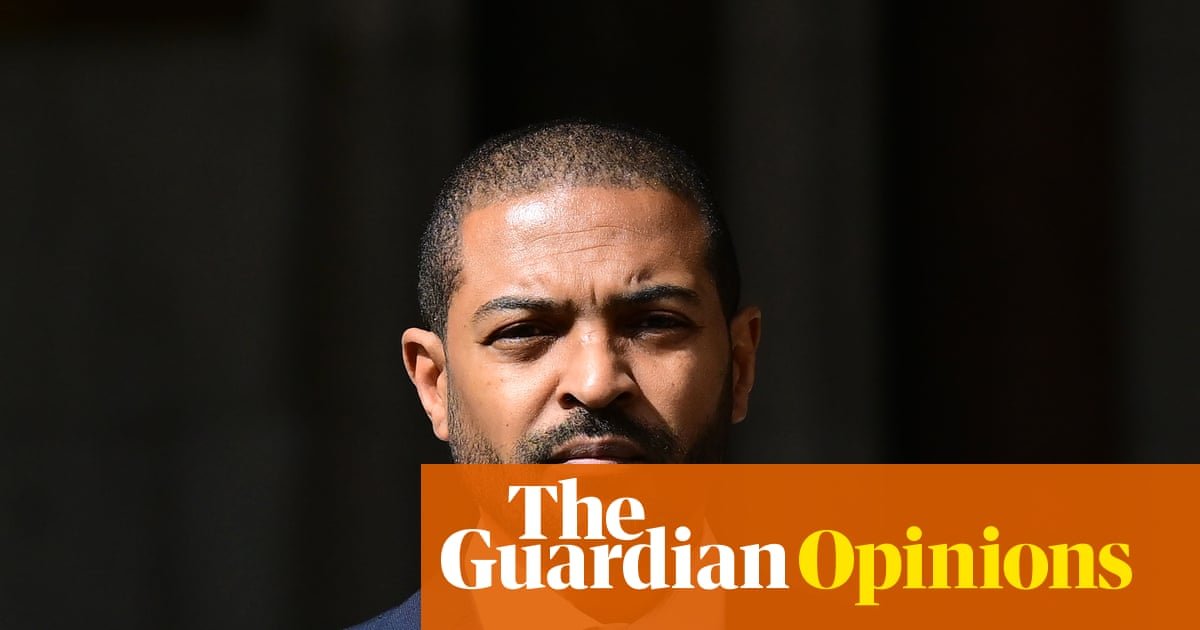
The high court’s ruling in favour of the Guardian struck a powerful blow for the free press and for holding those accused of sexual misconduct to account. While across the globe, we have seen the courtroom as the venue of choice to push back against the legacy of the #MeToo movement, this victory sent a clear signal that the voices of those affected have lost none of their power, impact or poignancy.
Noel Clarke is an actor, screenwriter, producer and director who is best known for the Hood trilogy, as well as acting in Doctor Who. In 2022, he sued the Guardian for its reporting based on the testimony of 20 women who accused him of “sexual harassment, unwanted touching or groping, sexually inappropriate behaviour and comments on set, professional misconduct, taking and sharing sexually explicit pictures and videos without consent, and bullying between 2004 and 2019”.
Clarke claimed that the Guardian had defamed him and breached his data protection rights. More than two years later, on 22 August 2025, the high court disagreed, stating that: “The Guardian has succeeded in establishing both truth and public interest defences to the libel claim.” As the data protection claim had been withdrawn, the judge dismissed the claim against the Guardian. Clarke’s defeat was emphatic, but we cannot let that cloud the damage that has already been done.
Embedded within Clarke’s legal action against the Guardian is another threat, one that cannot be overlooked if we value public interest reporting.
Prior to the commencement of the trial, Clarke lodged an amended application to add a new cause of action for “conspiracy to injure by unlawful means” against an expanded list of defendants. Both lawful and unlawful means conspiracy are defined by two or more people coming together with an intention to injure the claimant and whose acts result in loss and damage. So in Clarke’s presentation of the case, the articles and podcast episode were not standalone pieces of “shoddy” journalism, they were part of a coordinated effort to “to impede his receipt of a Bafta award” and to pervert the course of justice “by attempting to procure his prosecution.” Clarke’s legal representative stated this more succinctly: “the defamation was … the mere instrument”.
The high court judgment stated “Clarke’s case that there is an unlawful means conspiracy against him … lacked any proper foundation”, but the status of the amended application, which has yet to be tested in court, is unclear. Yet in some ways the damage may have already been done. Alleging a conspiracy between journalists, sources and those the claimant believes to be sources poisons the roots that sustain public interest journalism. You can kill a story by threatening a journalist or media outlet. You can also achieve the same goal by making sure no source or witness dares to come forward, with the costs, turmoil and unpredictability of mounting a defence in court enough to encourage silence. Time will only tell if others are watching and taking notes.
This is the first time, to my knowledge, this tort has been used against public interest journalism. It is not, however, the first time it has been used to stifle acts of public participation. In 2024, Shell used the tort as the primary charge against Greenpeace. While the parties settled the action, according to Doughty Street Chambers, “[t]he claim raised legal issues regarding the limits of the tort of unlawful means conspiracy and its relationship with the freedoms of expression and assembly”.
Strategic lawsuits against public participation (Slapps) and other abusive legal actions are seldom designed to succeed in court – the process is the punishment. Every minute of distracted focus or every pound put towards a legal defence is something redirected away from the target’s work. How can journalists dig into a subject or cultivate a source if they are expected to prepare for lengthy and unpredictable court proceedings?
The more distracting, intensive, intrusive and costly this process is, the more likely a litigation target is to hold up their hands and step away, giving the claimant whatever they are demanding. If Clarke had turned his sights on a blogger, social media user or a smaller media outlet, let alone one of the Guardian’s sources individually, we may not have had a court hearing, let alone a victory.
The Guardian is not alone. Journalists, including freelancers, as well as environmental campaigners, sexual violence survivors, local Facebook group users, academics and members of the public have been forced to defend their public interest speech and navigate the alien world of the British court system. With legal aid out of reach for the vast majority, many have no choice but to self-censor or consider defending themselves.
skip past newsletter promotion
Sign up to Matters of Opinion
Guardian columnists and writers on what they’ve been debating, thinking about, reading, and more
Privacy Notice: Newsletters may contain information about charities, online ads, and content funded by outside parties. If you do not have an account, we will create a guest account for you on theguardian.com to send you this newsletter. You can complete full registration at any time. For more information about how we use your data see our Privacy Policy. We use Google reCaptcha to protect our website and the Google Privacy Policy and Terms of Service apply.
after newsletter promotion
The UK Anti-SLAPP Coalition, which I co-chair, has long called for a change in the law to support and empower courts and judges to throw out abusive legal actions before they can do damage. But last year’s general election wiped out all progress, except narrow and flawed protections for reporting on economic crime. As the current government has deprioritised progress against a universal anti-Slapp law, we all remain vulnerable. Abuse of the UK’s defamation law earned London the moniker “a town named sue”, but those seeking to avoid scrutiny are no longer restricted to this one cause of action alone.
The British legal system is malleable enough to establish a wide range of laws that can be used to target protected speech. If one is reformed to prevent such abuse, claimants can just look elsewhere, whether that means malicious falsehood, data protection, privacy, harassment or trespass, to name but a few. Further to this, we have seen how claimants learn from each other. Tactics that may have failed in one action could take on new life in another. Dust it off, make a few tweaks, learn from where the other party failed – and then you are good to go.
Without robust protections for journalism and free speech, namely a universal anti-Slapp law, the legal landscape will continue to be skewed in favour of those with something to hide. Journalists are often the canary in the coalmine for threats such as these. Here’s hoping we pay attention to the warnings.
Nik Williams is a policy and campaigns officer at Index on Censorship
Sign up for our new weekly newsletter Matters of Opinion, where our columnists and writers will reflect on what they’ve been debating, thinking about, reading and more
Do you have an opinion on the issues raised in this article? If you would like to submit a response of up to 300 words by email to be considered for publication in our letters section, please click here.
