

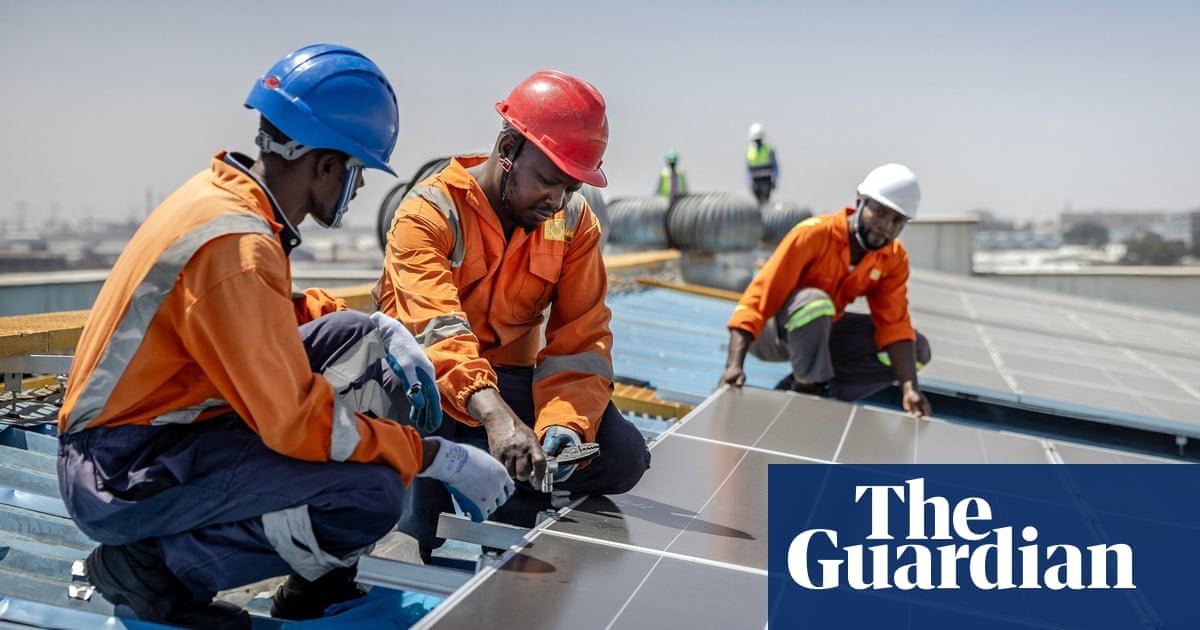
The first signs of a takeoff of Africa’s green economy are raising hopes that a transformation of the continent’s fortunes may be under way, driven by solar power and an increase in low-carbon investment.
African leaders are meeting this week in Addis Ababa, Ethiopia, for the Africa Climate Summit, a precursor to the global UN Cop30 in November. They will call for an increase in support from rich countries for Africa’s green resurgence, without which they will warn it could be fragile and spread unevenly.
Richard Muyungi, the climate envoy and adviser to the president of Tanzania, said: “Africa is ready to be part of [the global fight to stave off climate breakdown] provided we are supported with finance, technology and capacity-building.
A delegate at the summit. Africa is responsible for only 4% of global greenhouse gas emissions but bears the brunt of climate breakdown. Photograph: Luis Tato/AFP/Getty Images
“There has been an increase of investments in some areas but Africa still needs a lot of financing to be able to be part of the global solution, and to address the challenges we are facing.”
Green energy is booming in Africa, with 20 countries breaking records for imports of solar panels in the 12 months to June. According to the thinktank Ember, imports of photovoltaic equipment from China rose by 60% over the past year, from 9MW in 2024 to 15MW of capacity, with a tripling of imports to countries outside South Africa.
Though the increase is impressive, it is from a low base. Africa, which boasts the greatest potential for solar power, has lagged far behind other countries in installations. Only 4% of global solar generation last year was in Africa, and in 2023, the International Energy Agency reported that Belgium had as many solar panels as the entire continent.
The Redstone solar thermal power plant in Northern Cape, one of South Africa’s biggest renewable energy facilities. Photograph: Xinhua/Rex/Shutterstock
“There is a glimmer of light [in the increased investment] but this is still quite meagre compared to other continents in the global south,” Muyungi said.
Last year’s imported panels would add about 5% to current electricity generation capacity in 16 countries, according to Ember, but the need remains vast. About 600 million people in Africa lack access to electricity, and about a billion have only firewood or dirty fuels for cooking. Women and girls are worst affected.
Melaku Yirga, the regional director for Africa at Mercy Corps, a humanitarian organisation, said: “Renewable energy is not only Africa’s greatest opportunity, it is also an urgent necessity. Renewable power enables everything from irrigation and food storage to early-warning systems, healthcare and livelihoods.”
People reading by a makeshift fire at an informal settlement in Nairobi, Kenya. Photograph: Anadolu/Getty Images
While recent increases in renewable energy investment were welcome, Yirga said the public sector and overseas aid were still vital.
“Africa has no shortage of ambition in renewable energy, but without stronger international finance and the right incentives, the private sector will remain on the sidelines and adaptation goals will go unmet,” he said.
“Private sector financing must be met with public commitments, and funding must also be long-term and reliable – short grants rarely achieve full impact, as meaningful engagement with governments and communities takes time and requires significant upfront investment.”
The leaders of Djibouti, Ethiopia and Kenya join a photocall at the summit. Photograph: Tiksa Negeri/Reuters
Reductions in overseas aid from rich countries are causing consternation among African governments, many of which are blighted by record debt burdens, exacerbated by the aftermath of the Covid-19 pandemic and recent interest rate rises.
Macky Sall, the former president of Senegal, said: “The drop in official development assistance fundamentally changes the climate calculus. Where does that leave Africa, if we can no longer count on our partners’ promises?
“The costs of the climate crisis have fallen most heavily on Africa. We are not the cause. We are not only footing the largest bill – we are also seeing the cheques to stem the damage cancelled.”
skip past newsletter promotion
Nesrine Malik and Jason Okundaye deliver your weekly dose of Black life and culture from around the world
Privacy Notice: Newsletters may contain information about charities, online ads, and content funded by outside parties. If you do not have an account, we will create a guest account for you on theguardian.com to send you this newsletter. You can complete full registration at any time. For more information about how we use your data see our Privacy Policy. We use Google reCaptcha to protect our website and the Google Privacy Policy and Terms of Service apply.
after newsletter promotion
A shepherd watches livestock near a solar thermal plant close to Upington, South Africa. Photograph: Themba Hadebe/AP
Private sector companies will put cash into renewable energy, but few will help Africa adapt to the impacts of the climate crisis, which are already being felt in the form of droughts, floods and crop failures. Investment to build resilience – such as water storage systems, better infrastructure and new farming techniques – is lacking.
A report published at the summit on Monday showed that while Africa needed at least $70bn a year to adapt to the effects of the climate crisis, and possibly much more, only $15bn was provided in adaptation finance to the continent in 2023.
Without urgent action to address that vast financing gap, Africa’s future costs from climate impacts will balloon, wiping out a fifth of GDP by 2050.
Delegates walk past a poster at the summit in Addis Ababa. Photograph: Luis Tato/AFP/Getty Images
Patrick Verkooijen, the chief executive of the Global Center on Adaptation thinktank, says rich countries must increase their finance for adaptation in Africa, which is responsible for only 4% of global greenhouse gas emissions while bearing the brunt of climate breakdown.
“Europe [and other countries] will shoot themselves in the foot if they defund ODA [official development assistance],” he said. “African leaders will see it as a stab in the back.”
While Africa is behind in climate adaptation, its riches are increasingly sought after by China and the rest of the rich world.
Africa has some of the biggest deposits of “critical minerals” – elements vital to building renewable energy components. Cobalt, lithium, copper, nickel, rare earths and other minerals are abundant in parts of Africa, which has spurred a global scramble for the resources.
An artisanal miner descends into a pit in Kolwezi, the Democratic Republic of the Congo. Photograph: The Washington Post/Getty Images
Human rights abuses have soared in some mining areas, with child labour and the exploitation of adult workers, particularly women, in places such as the Democratic Republic of the Congo. Africa’s under-resourced public sector is struggling to contain the damage and ensure resource extraction is done responsibly, without causing environmental devastation and in a way that benefits local people.
Africa also abounds in gas, with reserves of the fossil fuel that have scarcely been tapped in some countries. Muyungi insisted they must be allowed to exploit those resources, despite the impact on the climate crisis. “We do not envisage anything to stop us using gas – we need it for our development,” he said.
For rich countries to tackle the climate crisis, Africa’s assistance will be essential. If global north governments fail to address the continent’s needs, they will feel the impact. Roughly 60% of Africa’s population is under 25, a “youthquake” that could spur development or, if poorly handled, will be felt around the world.
Abay Yimere, a scholar at the Climate Policy Lab at Tufts University in the US, said: “If the climate crisis is not tackled in Africa, that will be a problem for migration. If we do not provide them with jobs, and adapt to climate change, the impact will be huge and not controllable. The global north should look at this from their own national perspectives and see where their interest lies.”
