

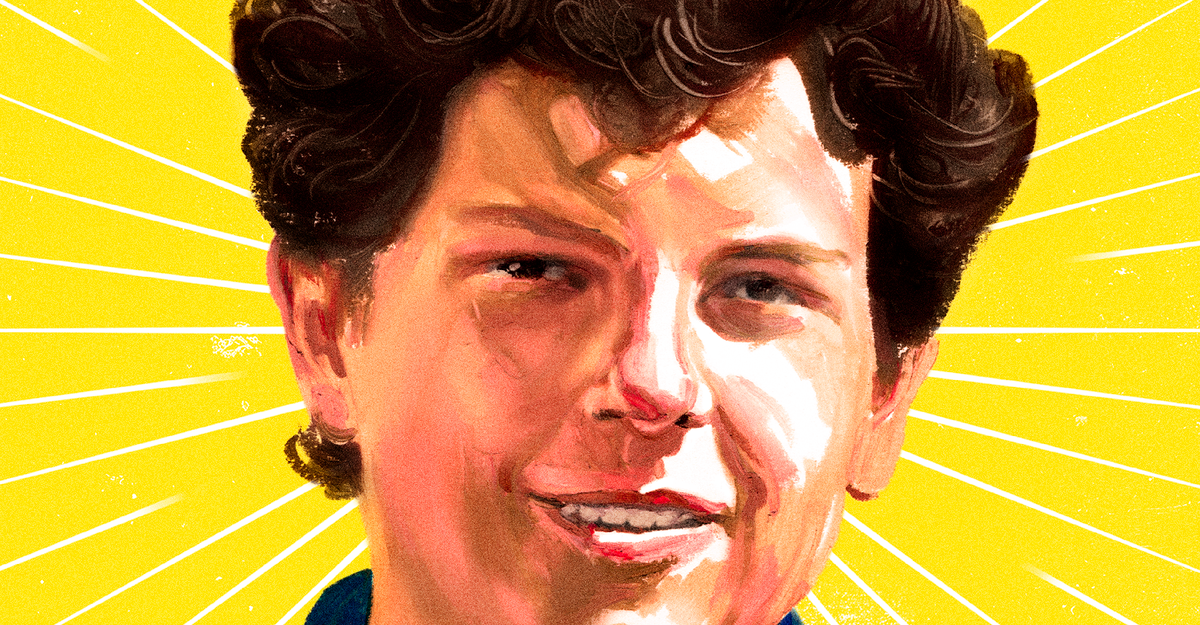
Visit the Church of Santa Maria Maggiore in the Italian town of Assisi, and you’ll encounter the life-size cutout of a teen boy: the soon-to-be Saint Carlo Acutis. His real body, encased in wax, lies nearby in a brightly tiled coffin with a glass panel in the center. He’s dressed as you might expect a kid his age would be, in jeans, a zip-up jacket, and Nikes. Stone panels behind the coffin depict scenes from his life with some symbolic flourishes. In one, the logos of Facebook, Google, and other internet companies float around him.
Acutis, who is scheduled to be canonized on September 7, is unusual among saints. Born in London in 1991 and raised in Italy, he grew up with the internet—playing video games, making websites—and died at age 15, of leukemia. He’s the first prospective saint to be entombed in branded gear. He’s also the first Millennial.
The Catholic Church has embraced Acutis’s identity as an ordinary teen and internet user. “The digital world can expose you to the risk of self-absorption, isolation and empty pleasure,” Pope Francis wrote in Christus Vivit, a 2019 letter to young Catholics. “But don’t forget that there are young people even there who show creativity and even genius.” He pointed to Acutis as one example. Pope Leo also called on Acutis’s legacy in a homily at the Jubilee of Young People this summer. Vatican representatives and news outlets have described Acutis as “a computer genius,” a “tech-savvy teen,” and “a child of the Web and the digital age.” As the rector of the shrine where Acutis’s remains lie said in 2022, “His ‘normality’ attracts and is an example for many.”
Yet there’s another way to see Acutis. Sure, he played video games, but he limited himself to one hour a week—not exactly typical kid behavior. He used his computer skills not to hang out in chat rooms or make goofy websites but to help his local parish and the Vatican with web design. He was apparently so fascinated by Eucharistic miracles—stories about the bread that believers take at Communion transforming into human heart tissue or starting to bleed—that he created an in-person exhibit and accompanying website about them. A movie about his life describes him as a “teenage mystic,” a term that harkens back to figures such as Hildegard of Bingen, a 12th-century abbess known for her trancelike visions. According to his mother, even before his leukemia diagnosis Acutis said he knew he would die young. Timothy P. O’Malley, a theologian at the University of Notre Dame, said in a 2024 lecture, “Carlo was weird.” And recognizing that, O’Malley suggested, is the key to “unlocking his holiness.”
To a certain extent, the tension in Acutis’s story—“He’s just like us!” but also, not like us—is part of any sainthood campaign. But the diverging understandings of Acutis also speak to an urgent question for the Church, about how to reconcile certain of the faith’s teachings with advances in science and technology. Some of the faithful resolve this conflict by rejecting the faith’s more otherworldly elements; most Catholics in the United States, for example, don’t believe in transubstantiation, which asserts that Communion bread and wine become the body and blood of Christ. Meanwhile, many of the most devout believers continue to embrace rituals that can seem out of place in the modern world. Still others fall somewhere in between.
Acutis has inspired devotion from both of these corners of the faith—even when they seem to clash. He represents a Church at an uncertain juncture: a contemporary, technologically fluent teenager who was also deeply interested in stories about bread turning into flesh.
Compared with other recent saints, Acutis has had a singular level of posthumous fame. One Facebook group honoring him has more than 320,000 members. More than 1 million people are reported to have visited the shrine in person last year; even more have seen its livestream. In one TikTok video, a girl films herself crying as she visits his tomb. In another, she writes that Acutis “changed my life forever.” A supposed lock of his hair sold online for 2,000 euros this year; the Catholic Church denounced the sale, but that hasn’t stopped more unverified relics from popping up. A Chicago parish has been named after him.
Acutis is set to become a saint fewer than 20 years after his death, light speed for a Church that once mandated candidates wait five decades before their cases could be considered. Such velocity isn’t unheard of, Carlo Nardella, a sociology professor at the University of Milan, told me—but the exceptions are generally prominent figures such as Mother Teresa and Pope John Paul II, not ordinary people like Acutis.
The success of the campaign to canonize Acutis seems to be the result of two forces: a concerted effort by his family—a wealthy and powerful one—to share his story, and the usefulness of his identity to the Church. After Acutis died, in 2006, his mother, Antonia Salzano, who works for a Vatican organization that promotes research on martyrs, devoted herself to giving talks and speaking with journalists about him and all the miracles she believed him responsible for. She also sent his exhibit on Eucharistic miracles to more than 500 parishes, the Catholic News Agency reporter Courtney Mares wrote in her book, Blessed Carlo Acutis: A Saint in Sneakers. By 2007, an official in Milan tasked with presenting cases for sainthood said Acutis was worth looking into. In 2011, a group of priests and loved ones formed an association to advocate for his cause, and by 2013, the inquiry into his life had officially begun.
Church leaders ultimately decide who becomes a saint. But campaigns for sainthood thrive on devotion from laypeople. A would-be saint needs to be proved responsible for two miracles, which happens only when enough people know about and pray to the candidate. A new population began to learn about Acutis when, in 2010, the Brazilian priest Marcelo Tenório heard of him from his godson and spread his story around the country. Tenório held services in his honor, mailed pamphlets to parishes, and befriended Salzano, who gave him a relic of Acutis’s to exhibit. In 2013, a young boy with a malformed pancreas touched that relic at a church in São Sebastião, Brazil, and prayed that he would stop vomiting. According to the boy’s family, he was eating normally when he got home that day.
In 2020, after the Church recognized the miracle, Acutis was beatified. Last year, the Church recognized a second miracle for Acutis, when a Costa Rican university student who was studying in Italy and suffering from severe head trauma said she was healed unexpectedly after her mother visited Acutis’s tomb. It was official: Acutis would become a saint.
Acutis’s story is a convenient one for the Church right now. His canonization is happening at a time when the Catholic population in the U.S. is rapidly aging. Catholicism “needs young people who are a good example of how to be devout,” Massimo Faggioli, a professor of historical theology at Villanova University, told me, “without being anti-modern, anti-society, anti-world.” Acutis fits neatly in that niche.
The people I spoke with who work with young Catholics told me that seeing oneself in a saint can draw believers in. Katherine Dugan, a professor studying contemporary Catholicism at Springfield College, in Massachusetts, said that the highly religious students she has researched “love a saint that’s married. They love talking about lay saints, saints that do normal things that they can relate to.” Kathleen Sprows Cummings, an American studies and history professor at Notre Dame and the author of A Saint of Our Own, told me, “My students are fascinated by him.” She continued, “They were talking about, like, ‘He’s wearing Nike sneakers.’ They just thought this was just the greatest thing.”
Any relatable characteristic could lure in the faithful, but, for the Church, the internet is a point of particular interest. The Vatican is certainly not against the online world; the Catholic Church was an early adopter of the internet, creating an official website in 1995. But some officials do seem wary of it. At a recent address to Catholic influencers, Pope Leo urged attendees to focus less on their follower count and more on their message. Heidi A. Campbell, a Texas A&M professor who studies technology and religion, told me, “The Catholic Church is very pro using this technology as long as it’s affirming their values.” Acutis’s digital restraint seemed to achieve this balance: The official decree recognizing his heroic virtues—an early hurdle on the path to sainthood—cites his computer use as a model.
Acutis’s devotion to the Eucharist seems to be another helpful point. “He was an average, simple, spontaneous, likable young man,” Cardinal Agostino Vallini said in a 2020 homily. He also highlighted Acutis’s attendance at daily Mass and the time he spent in Eucharistic adoration. As an ordinary teenager who also revered Communion, Acutis offers Vatican officials a way to show how belief in the practice can coexist with contemporary life.
But not all Catholics are looking for ordinariness in their religious figures. Many devout young people in the U.S. tend to desire an “intentionally countercultural, more evangelistic Catholicism,” Katherine Schmidt, a religious-studies professor at Molloy University, told me. Molly Worthen, a religious-history professor at the University of North Carolina at Chapel Hill, said that around the world, plenty of believers have a “hunger for evidence of God’s presence” that is not satisfied by “modern rationalistic approaches to the universe.” She added: “The future of Christianity is highly supernaturalist.” Acutis appeals to this cohort too.
The push and pull between adapting to the world and standing apart from it is core not just to Acutis’s life but also to the history of Catholicism. Over the years, many in the Church have felt that it needs to change to avoid extinction. Worthen told me that in the 16th and 17th centuries, this impulse led the Vatican to tighten up the scientific rigor of its miracle-vetting process in response to reports of levitating saints. More recently, Church officials have discouraged the faithful from worshipping in Latin. At the same time, Schmidt told me, many other Catholics think that “if we don’t get really clear on what it is we believe and offer something substantive to people, then we’re gonna die.”
One unique feature of the Catholic Church, Worthen told me, has been its ability “more than maybe any other religious institution in the modern world” to keep all of those diverging beliefs “under one tent.” One day, devotees may decide whether Acutis was weird or relatable. Or they may not. For now, his story may be best for the Church if it’s left unresolved.
