

When the chief executive of the Financial Times suggested at a media conference this summer that rival publishers might consider a “Nato for news” alliance to strengthen negotiations with artificial intelligence companies there was a ripple of chuckles from attendees.
Yet Jon Slade’s revelation that his website had seen a “pretty sudden and sustained” decline of 25% to 30% in traffic to its articles from readers arriving via internet search engines quickly made clear the serious nature of the threat the AI revolution poses.
Queries typed into sites such as Google, which accounts for more than 90% of the search market, have been central to online journalism since its inception, with news providers optimising headlines and content to ensure a top ranking and revenue-raising clicks.
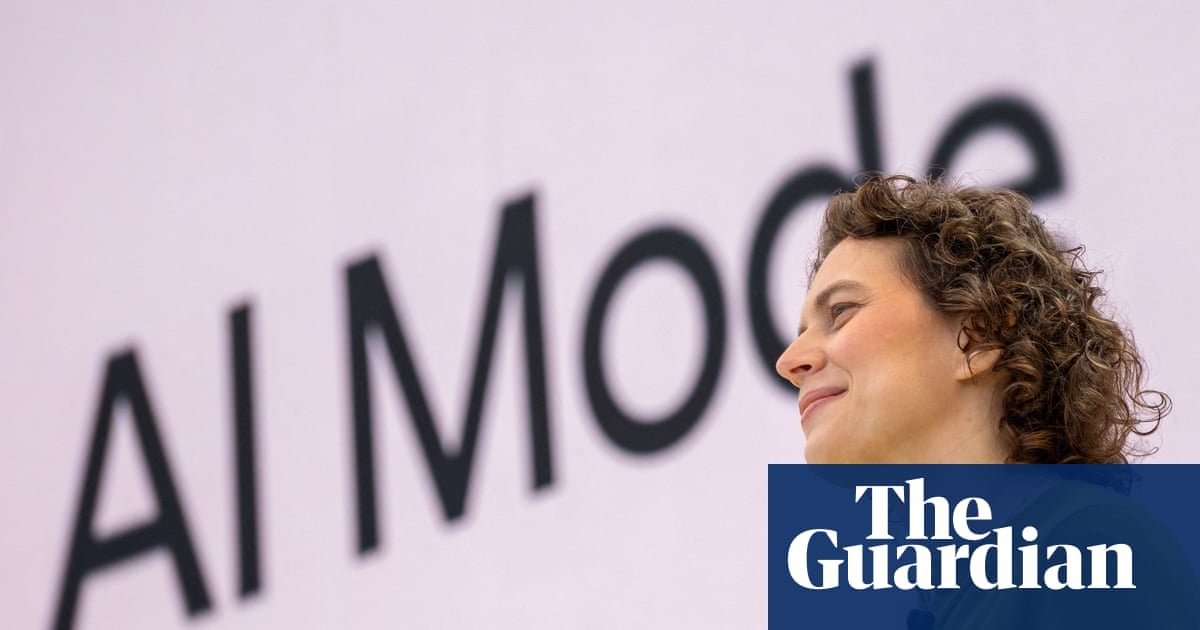
But now Google’s AI Overviews, which sit at the top of the results page and summarise responses and often negate the need to follow links to content, as well as its recently launched AI Mode tab that answers queries in a chatbot format, have prompted fears of a “Google zero” future where traffic referrals dry up.
“This is the single biggest change to search I have seen in decades,” says one senior editorial tech executive. “Google has always felt like it would always be there for publishers. Now the one constant in digital publishing is undergoing a transformation that may completely change the landscape.”
Last week, the owner of the Daily Mail revealed in its submission to the Competition and Markets Authority’s consultation on Google’s search services that AI Overviews have fuelled a drop in click-through traffic to its sites by as much as 89%.
DMG Media and other leading news organisations, including Guardian Media Group and the magazine trade body the Periodical Publishers Association (PPA), have urged the competition watchdog to make Google more transparent and provide traffic statistics from AI Overview and AI Mode to publishers as part of its investigation into the tech firm’s search dominance.
Publishers – already under financial pressure from soaring costs, falling advertising revenues, the decline of print and the wider trend of readers turning away from news – argue that they are effectively being forced by Google to either accept deals, including on how content is used in AI Overview and AI Mode, or “drop out of all search results”, according to several sources.
On top of the threat to funding, there are concerns about AI’s impact on accuracy. While Google has improved the quality of its overviews since earlier iterations advised users to eat rocks and add glue to pizza, problems with “hallucinations” – where AI presents incorrect or fabricated information as fact – remain, as do issues with in-built bias, when a computer rather than a human decides how to summarise sources.
Google Discover has replaced search as the main source of traffic click-throughs to content. Photograph: Samuel Gibbs/The Guardian
In January, Apple promised to update an AI feature that issued untrue summaries of BBC news alerts, stamped with the corporation’s logo, on its latest iPhones; alerts incorrectly claimed that the man accused of killing a US insurance boss had shot himself and that tennis star Rafael Nadal had come out as gay.
In a blogpost last month, Liz Reid, Google’s head of search, said the introduction of AI in search was “driving more queries and quality clicks”.
“This data is in contrast to third-party reports that inaccurately suggest dramatic declines in aggregate traffic,” she said. “[These reports] are often based on flawed methodologies, isolated examples, or traffic changes that occurred prior to the rollout of AI features in search.”
However, she also said that while overall traffic to all websites is “relatively stable” she admitted that the “vast” web means that user trends are shifting traffic to different sites “resulting in decreased traffic to some sites and increased traffic to others”.
In recent years, Google Discover, which feeds users articles and videos tailored to them based on their past online activity, has replaced search as the main source of click-throughs to content.
However, David Buttle, founder of the consultancy DJB Strategies, says the service, which is also tied to publishers’ overall search deals, does not deliver the quality traffic that most publishers need to drive their long-term strategies.
“Google Discover is of zero product importance to Google at all,” he says. “It allows Google to funnel more traffic to publishers as traffic from search declines … Publishers have no choice but to agree or lose their organic search. It also tends to reward clickbaity type content. It pulls in the opposite direction to the kind of relationship publishers want.”
Meanwhile, publishers are fighting a wider battle with AI companies seeking to plunder their content to train their large language models.
The creative industry is intensively lobbying the government to ensure that proposed legislation does not allow AI firms to use copyright-protected work without permission, a move that would stop the “value being scraped” out of the £125bn sector.
skip past newsletter promotion
Sign up to Business Today
Get set for the working day – we’ll point you to all the business news and analysis you need every morning
Privacy Notice: Newsletters may contain information about charities, online ads, and content funded by outside parties. If you do not have an account, we will create a guest account for you on theguardian.com to send you this newsletter. You can complete full registration at any time. For more information about how we use your data see our Privacy Policy. We use Google reCaptcha to protect our website and the Google Privacy Policy and Terms of Service apply.
after newsletter promotion
The Make It Fair campaign in February focused on the threat to the creative industries from generative AI. Photograph: Geoffrey Swaine/Rex
Some publishers have struck bilateral licensing deals with AI companies – such as the FT, the German media group Axel Springer, the Guardian and the Nordic publisher Schibsted with the ChatGPT maker OpenAI – while others such as the BBC have taken action against AI companies alleging copyright theft.
“It is a two-pronged attack on publishers, a sort of pincer movement,” says Chris Duncan, a former News UK and Bauer Media senior executive who now runs a media consultancy, Seedelta. “Content is disappearing into AI products without serious remuneration, while AI summaries are being integrated into products so there is no need to click through, effectively taking money from both ends. It is an existential crisis.”
While publishers are pursuing action on multiple fronts – from dealmaking and legal action to regulatory lobbying – they are also implementing AI tools into newsrooms and creating their own query-answering tools. The Washington Post and the FT have launched their own AI-powered chatbots, Climate Answers and Ask FT, that source results only from their own content.
Christoph Zimmer, chief product officer at Germany’s Der Spiegel, says that while its traffic is currently stable he expects referrals from all platforms to decline.
“This is a continuation of a longstanding trend,” he says. “However, this affects brands that have not focused on building direct relationships and subscriptions in recent years even more strongly. Instead, they have relied on reach on platforms and sometimes generic content.
“What has always been true remains true – a focus on quality and distinct content, and having a human in charge rather than just in the loop.”
One publishing industry executive says the battle to strike deals to help train AI models to aggregate and summarise stories is rapidly being superseded by advances that are seeing models interpret live news.
“The first focus has been on licensing deals for training AI, to ‘speak English’, but that is becoming less important over time,” says the executive. “It is becoming about delivering the news, and for that you need accurate live sources. That is a potentially really lucrative market which publishers are thinking about negotiating next.”
Saj Merali, chief executive of the PPA, says a fair balance needs to be struck between a tech-driven change in consumers’ digital habits and the fair value of trusted news.
“What doesn’t seem to be at the heart of this is what consumers need,” she says. “AI needs trustworthy content. There is a shift in how consumers want to see information, but they have to have faith in what they are reading.
“The industry has been very resilient through quite major digital and technological changes, but it is really important we make sure there is a route to sustain models. At the moment the AI and tech community are showing no signs of supporting publisher revenue.”
