
Close Menu

    Subscribe to Updates

    Get the latest creative news from FooBar about art, design and business.

    What's Hot

    Ann Barrett obituary | Cancer

    Prosecutors to ‘fast-track’ hate crime cases in England and Wales after spate of attacks | Hate crime

    Two million airline seats cut amid soaring jet fuel prices | Airline industry

    Facebook X (Twitter) Instagram
    Facebook X (Twitter) YouTube LinkedIn
    Naija Global News |
    Tuesday, May 5
    • Business
    • Health
    • Politics
    • Science
    • Sports
    • Education
    • Social Issues
    • Technology
    • More
      • Crime & Justice
      • Environment
      • Entertainment
    Naija Global News |
    You are at:Home»Science»Ultrasound ‘helmet’ could treat Parkinson’s non-invasively, study shows | Medical research
    Science

    Ultrasound ‘helmet’ could treat Parkinson’s non-invasively, study shows | Medical research

    onlyplanz_80y6mtBy onlyplanz_80y6mtSeptember 5, 2025003 Mins Read
    Share Facebook Twitter Pinterest LinkedIn Tumblr Email
    Ultrasound ‘helmet’ could treat Parkinson’s non-invasively, study shows | Medical research
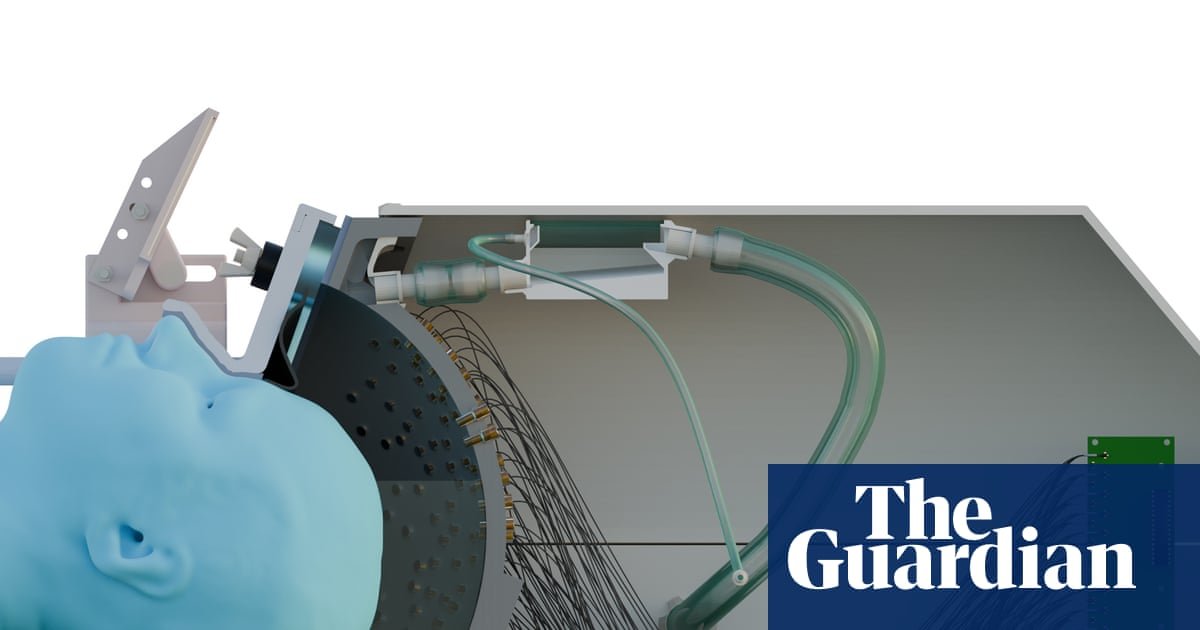
    Cross-section of the water-filled ultrasound helmet showing the ultrasound sources that transmit focused waves into the brain. Photograph: Morgan Roberts
    Share
    Facebook Twitter LinkedIn Pinterest Email

    An ultrasound “helmet” offers potential new ways for treating neurological conditions without surgery or other invasive procedures, a study has shown.

    The device can target brain regions 1,000 times smaller than ultrasound can, and could replace existing approaches such as deep brain stimulation (DBS) in treating Parkinson’s disease. It also holds potential for conditions such as depression, Tourette syndrome, chronic pain, Alzheimer’s and addiction.

    Unlike DBS, which requires a highly invasive procedure in which electrodes are implanted deep in the brain to deliver electrical pulses, using ultrasound sends mechanical pulses into the brain.

    But no one had managed to create an approach capable of delivering them precisely enough to make a meaningful impact until now.

    A study published in Nature Communications introduces a breakthrough system that can hit brain regions 30 times smaller than previous deep-brain ultrasound devices could.

    “It is a head helmet with 256 sources that fits inside an MRI scanner,” said the author and participant Ioana Grigoras, of Oxford University. “It is chunky and claustrophobic putting it on the head at first, but then you get comfortable.”

    The new head helmet fits inside an MRI scanner. Photograph: Bradley Treeby/Study Authors

    Current DBS methods used on Parkinson’s patients use hard metal frames that are screwed into the head to hold them down.

    To test the system, the researchers applied it to seven volunteers, directing ultrasound waves to a tiny region the size of a grain of rice in the lateral geniculate nucleus (LGN), the key pathway for visual information that comes from the eyes to the brain.

    “The waves reached their target with remarkable accuracy,” the senior author Prof Charlotte Stagg of Oxford University said. “That alone was extraordinary, and no one has done it before.”

    Follow-up experiments showed that modulating the LGN produced lasting effects in the visual cortex, reducing its activity. “The equivalent in patients with Parkinson’s would be targeting a motor control region and seeing tremors disappear,” she added.

    An independent expert and neuroscience professor, Elsa Fouragnan, of Plymouth University, said this proof of concept “represents a fundamental neuroscience milestone that opens the way for clinical translation”. Calling it a remarkable achievement, she offered her “heartfelt congratulations to the authors”.

    The work took place over a decade, with interdisciplinary teams from University College London (UCL) and Oxford University working together to create the helmet and integrate it with the MRI scanner.

    Stagg said: “When we started the project, I was pregnant with my daughter. She is now 12. Hopefully, we will see the first clinical applications before she is at the university.”

    The team is already on the way to test the system on brain areas linked with Parkinson’s, schizophrenia, stroke recovery, pain, depression and other conditions.

    The helmet itself is one of a kind. The core team that built it, the UCL academics Elly Martin and Brad Treeby, emphasise the importance of working with patients to design it to be more comfortable and applicable to many conditions.

    “I created a company to focus specifically on the building of the helmet,” said Treeby. It currently needs an MRI scan to navigate it, but with the help of AI, it could be programmed to work on its own, allowing patients to use it in their own home.

    Martin says further studies are needed, “but our long-term goal is to refine the system into a practical clinical tool, one that could sit alongside or even replace invasive brain implants in the future”.

    Helmet Medical noninvasively Parkinsons research shows study Treat Ultrasound
    Share. Facebook Twitter Pinterest LinkedIn Tumblr Email
    Previous ArticleHealthy living, science and an army of doctors: Putin’s pursuit of longevity | Vladimir Putin
    Next Article What It Costs to Be a Sorority Girl
    onlyplanz_80y6mt
    • Website

    Related Posts

    Single dose of magic mushroom psychedelic can cause anatomical brain changes, study finds | Neuroscience

    May 5, 2026

    One in three HR leaders face opposition to inclusion schemes, study finds | Prisons and probation

    May 3, 2026

    Swearing banned by one in five councils in England and Wales, report on ‘busybody’ fines shows | Local government

    April 29, 2026
    Add A Comment
    Leave A Reply Cancel Reply

    Top Posts

    Watch Lady Gaga’s Perform ‘Vanish Into You’ on ‘Colbert’

    September 9, 20251 Views

    Advertisers flock to Fox seeking an ‘audience of one’ — Donald Trump

    July 13, 20251 Views

    A Setback for Maine’s Free Community College Program

    June 19, 20251 Views
    Stay In Touch
    • Facebook
    • YouTube
    • TikTok
    • WhatsApp
    • Twitter
    • Instagram
    Latest Reviews

    At Chile’s Vera Rubin Observatory, Earth’s Largest Camera Surveys the Sky

    By onlyplanz_80y6mtJune 19, 2025

    SpaceX Starship Explodes Before Test Fire

    By onlyplanz_80y6mtJune 19, 2025

    How the L.A. Port got hit by Trump’s Tariffs

    By onlyplanz_80y6mtJune 19, 2025

    Subscribe to Updates

    Get the latest tech news from FooBar about tech, design and biz.

    Most Popular

    Watch Lady Gaga’s Perform ‘Vanish Into You’ on ‘Colbert’

    September 9, 20251 Views

    Advertisers flock to Fox seeking an ‘audience of one’ — Donald Trump

    July 13, 20251 Views

    A Setback for Maine’s Free Community College Program

    June 19, 20251 Views
    Our Picks

    Ann Barrett obituary | Cancer

    Prosecutors to ‘fast-track’ hate crime cases in England and Wales after spate of attacks | Hate crime

    Two million airline seats cut amid soaring jet fuel prices | Airline industry

    Recent Posts
    • Ann Barrett obituary | Cancer
    • Prosecutors to ‘fast-track’ hate crime cases in England and Wales after spate of attacks | Hate crime
    • Two million airline seats cut amid soaring jet fuel prices | Airline industry
    • U.S. and Iran Make Competing Claims Over Strait of Hormuz
    • Single dose of magic mushroom psychedelic can cause anatomical brain changes, study finds | Neuroscience
    © 2026 naijaglobalnews. Designed by Pro.
    • About Us
    • Disclaimer
    • Get In Touch
    • Privacy Policy
    • Terms and Conditions

    Type above and press Enter to search. Press Esc to cancel.