

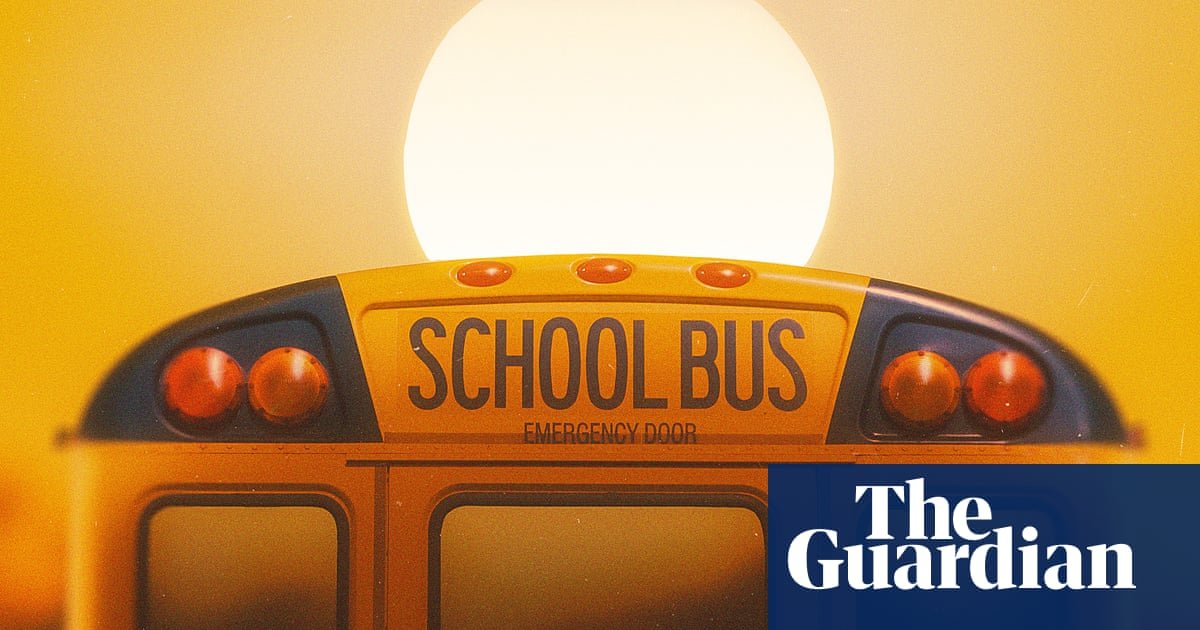
As schools are returning to session following one of the hottest summers ever recorded, districts are faced with a new problem: how to handle increasingly extreme heatwaves, both in and outside the classroom.
Unbearably hot days are no longer just a summer problem. In the US districts from the north-east to the mountain west to the deep south are shortening days, delaying openings, and reworking calendars as temperatures spike during August and September, the typical back-to-school months.
A handful of potential methods for protecting students from extreme temperatures have been put forward, including modernizing HVAC systems, creating more shade on playgrounds, swapping their blacktop surfaces for grass and, perhaps most provocatively, reworking school calendars. There’s even some talk of replacing summer vacation with a spring or fall break, if schools can be kept cool enough, when homes for some students may be hotter.
School schedules are already beginning to shift. New York City recently urged schools to move end-of-year activities indoors during a June 2025 heatwave. Philadelphia dismissed students early at more than 60 campuses during late August 2024 because buildings lacked adequate cooling.
Detroit also cut days short in the first week of the 2024–25 school year as heat indices climbed. In Colorado’s Poudre school district, most schools announced two-hour early releases for 14 and 15 August due to high temperatures. In June, the notoriously cold state of Alaska had their first statewide heat advisory.
As the climate crisis is already shaping the way we discuss the future of education in the US, rearranging the calendar has become one tactic for school districts to tackle the issue.
“It’s definitely one technique that you could take to address the extreme temperature events, and especially since we’re already seeing school get postponed and the days canceled or moved around,” said Grace Wickerson, the senior manager of the climate and health team at the Federation of American Scientists.
“But even with some of the major legislation of the last administration, the climate risk to schools is still a major gap in our strategy around climate action,” said Wickerson. “And so I think this definitely needs to be a part of the conversation of what things we need to do differently in the age of extreme heat.”
Last summer, 22 organizations, including the Federation of American Scientists, sent a letter to the US Department of Education urging them to take swift action to protect students from the increasingly hot weather.
The Center for Green Schools at the US Green Building Council is another name on the letter. The center is a non-profit known for the Leadership in Energy and Environmental Design (Leed) rating system, a framework for designing climate-ready buildings that has so far been adopted by more than 5,000 US schools.
The average number of days hitting 87 degrees is increasing every year, and we estimate it will reach 120 days a year sometime in the 2030sAndra Yeghoian, Ten Strands
Though Leed has become a popular strategy for schools to prepare against hotter temperatures, the policy aspect can be difficult to navigate due to a lack of governmental guidelines.
“The main issue is we have very little data about school buildings across the country because they’re all managed locally,” said Anisa Heming, the director of the Center for Green Schools. “There’s no data collection on the federal level, and in most states actually there’s no data collection, so we have very little data on the buildings themselves.
“And then there’s no real threshold established for when a school has actually done a good job on being heat-resilient,” she added. “So we have a bunch of strategies that schools can adopt, but we don’t have a real sense of if we’ve done enough because there’s no standard to follow.”
Most American schools were built for a cooler climate that no longer exists. A Government Accountability Office survey from 2020 estimated that 41% of districts needed to update or replace HVAC systems in at least half of their schools, about 36,000 buildings.
Despite a need and emphasis on air conditioning, it’s not the only thing a school would need to be heat-resilient. Decreasing black pavement on playgrounds and increasing shade through planting trees are also common requirements.
Green Schoolyards America, a non-profit aiming to create greener schoolyards, and Ten Strands, a California-based non-profit working to increase environmental literacy, recently collaborated on a tree canopy project to measure the amount of trees across the state’s schools.
Climate experts recommend that urban areas, including school districts, have at least 30% tree canopy coverage. The study found that California schools had only a median of 6.4% tree canopy coverage, with less than half of the existing amount being accessible to children during their school day.
“The average number of days hitting 87 degrees is increasing every year, and we estimate it will reach 120 days a year sometime in the 2030s,” said Andra Yeghoian, chief information officer of Ten Strands.
“Some people look at that and they’re like: ‘87, that’s just a nice day.’ And well, it’s a nice day if you are in air conditioning. But if you’re in a community that doesn’t have air conditioning, and you’re in a building trying to learn, that’s not a nice day,” Yeghoian added. “And if you’re going out to the playground and you have no shade and it’s just a blacktop, 87 degrees is actually more like 100 degrees.”
The health stakes of rising temperatures are real, with children being especially vulnerable during heatwaves. Federal heat guidance lists children among the demographics at highest risk during extreme heat, and public health agencies advise schools to limit exertion, ensure hydration and adjust activities as temperatures rise.
Data collected by UndauntedK12, another non-profit advocating for more heat-resistant facilities and a cosigner of the letter, suggests that more than 1,000 schools were affected by extreme heat during the 2024-2025 school year.
A thermometer reading 100F outside a high school in Columbia, South Carolina, on 24 June. Photograph: Sam Wolfe/Bloomberg/Getty Images
“We see these headlines all the time now. It feels like every summer and even in the fall, schools are closing early,” said Kristen Hengtgen, the program director at UndauntedK12. “After-school activities are being canceled. We can see that so many of our schools are underprepared for extreme heat.”
The hotter temperatures also contribute to higher rates of school absences, particularly for Black, Hispanic and lower-income students. Because children from low-income households are more likely to be enrolled in schools with inadequate air conditioning, these children often opt to stay home during the hottest days rather than take the risk of being stuck in a sweltering classroom.
“One of my biggest concerns is that many kids who lack AC in their schools also don’t have it at home,” said Hengtgen. “I’m especially thinking of kids who may attend schools that are in low-income communities. We wouldn’t want them to be spending more of the hottest days in a hot home.”
You can’t satisfactorily, in any way, shape or form, actually teach if it’s above 90 degrees in a classroom, never mind learnJames Skoufis, New York state senator
But just a year prior, it wasn’t only local non-profits spearheading ways to combat the increasing heat. The National Integrated Heat Health Information System (NIHHIS) was a collaboration of 29 federal health agencies established during the Obama administration to consolidate heat expertise.
In early summer 2025, the Trump administration purged many of these experts, leaving the NIHHS severely understaffed.
But there has been some progress on the state level. New York recently became the first state to pass legislation establishing guidelines for extreme heat conditions in school buildings. The law, which takes effect on 1 September, sets 88F (31C) as the maximum temperature for occupied spaces in school buildings. It also requires that schools take action, such as relocating students, when temperatures reach 82F.
“For as long as people could remember here in New York, we had a minimum classroom and school building temperature of 65 degrees,” state senator James Skoufis, who championed the legislation, said in a recent presentation with the Center for American Progress. “But until this bill passed, we did not have a maximum temperature.”
He added: “You can’t satisfactorily, in any way, shape or form, actually teach if it’s above 90 degrees in a classroom, never mind learn.”
But one glaring problem still persists; even if schools across the country are successfully modified to be heat-resilient, most children are not in classrooms during the summer months. And summer vacation, the prime time for children to play outside without the stress of academia, is quickly becoming intolerable for outdoor play.
So it raises the question: is it safer to keep kids in adequately cooled schools during extreme heat, or let them stay home to mitigate risk of heat exposure? And, as blasphemous as it might be to suggest, could there be a future where summer vacation becomes fall or spring vacation as a way to keep kids in air-conditioned classrooms during summer?
“It’s definitely a needed conversation,” said Wickerson. “I’m not quite sure right now that we’re ready to have school in July, just because they’re not built for that operationally. But if there was a concerted effort to increase the cooling capabilities of these buildings, they probably would be some of the safer places for kids to go in the summer months.”
Yeghoian also agrees that she could picture that future, but adds that simply moving the summer break wouldn’t do much to change the reality of kids needing year-round outdoor play.
“What would be most ideal is children should have a balance of learning inside and learning outside, playing indoors and playing outdoors,” said Yeghoian, emphasizing the need for greener educational institutions.
“If people are making the assumption that kids should only play outside during the summer, then yes, you’d have to really readjust the school calendar,” she said. “But our goal for the future should be that kids will have access to outdoor play every single day.”
