

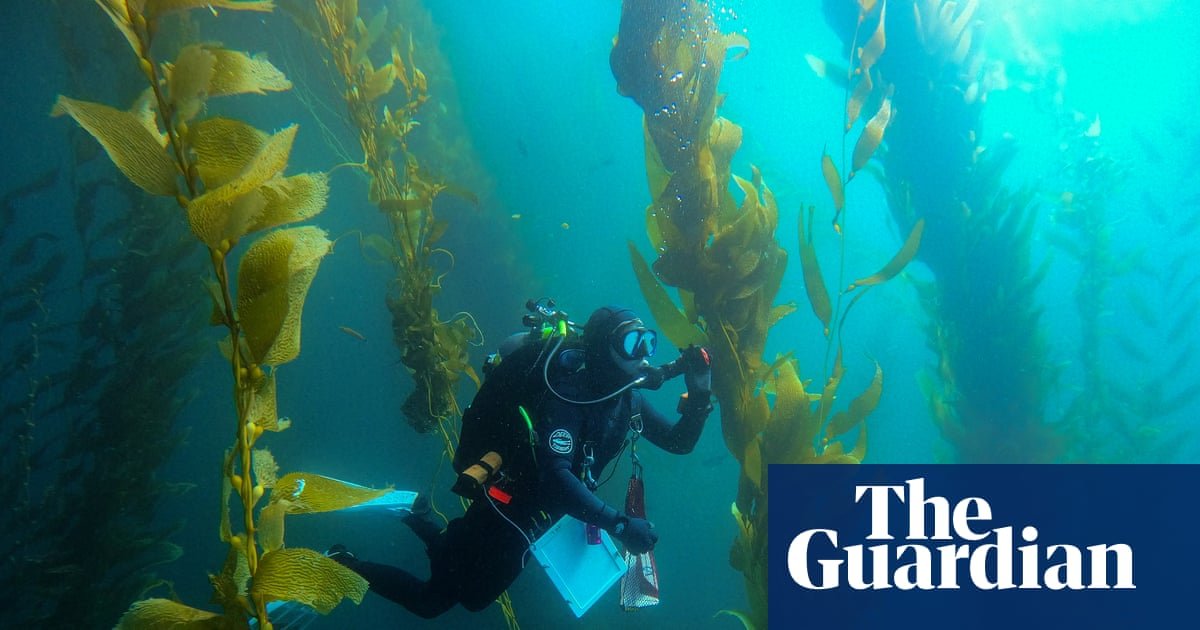
On an overcast Tuesday in July, divers Mitch Johnson and Sean Taylor shimmy into their wetsuits on the back of the R/V Xenarcha, a 28ft boat floating off the coast of Rancho Palos Verdes, south of Los Angeles. Behind them, the clear waters of the Pacific are dotted with a forest of army-green strands, waving like mermaid hair underwater.
We are here to survey the giant Pacific kelp, a species that once thrived in these ice cold waters. But over the past two decades, a combination of warm ocean temperatures, pollution, overfishing and the proliferation of hungry sea urchins that devour the kelp has led to a 80% decline in the forest along the southern California coast.
In recent years, scientists have staged a comeback – mounting one of the largest and most successful kelp restoration projects in the world. To do so, they’ve recruited an army of hammer-wielding divers to smash and clean up the voracious urchins. Today’s trip is a chance to see that success up close.
video of kelp underwater A kelp forest in Santa Monica Bay.
Seen from the boat’s edge, the kelp fronds are so thick and sturdy at places that they form mats at the ocean’s surface, sturdy enough for egrets and herons to perch on while they poked at the fish beneath. These waters host a multitude of species, from bright orange garibaldi fish and white sharks that silently cruise the coastline to blue whales which sail through the deep channel a few miles to our east.
Divers like Johnson and Taylor have a variety of tools at their disposal. Some days, they pick up rock hammers – like an underwater version of the seven dwarves – and dive to crack open the ravenous purple urchins that destroy the baby kelp. But today, they are armed only with a tape and a camera to survey the status of this gigantic concealed forest.
Gear on, the divers give a thumbs-up to Tom Ford, chief executive officer of the Bay Foundation, a non-profit dedicated to restoring Santa Monica Bay and its coastal waters, who is piloting the boat. With a small splash, they disappear into the water. Ford and I wait, with the quiet slapping of waves on the side of the Xenarcha, to see what they find.
Sean Taylor, a diver with the Bay Foundation, working on the restoration project. Photograph: Courtesy of the Bay Foundation
Led by the Bay Foundation, divers in the Santa Monica Bay have spent 15,575 hours underwater over the past 13 years. To bring the kelp back, they focus on minimizing the impact of one voracious eater: the purple urchin. The effort has been successful, smashing 5.8 million purple urchins and clearing 80.7 acres (32.7 hectares, the size of 61 football fields), and allowing the kelp to return.
But with the results contained far offshore and underwater, has anyone noticed? Ford wonders the same thing. “We call it the forgotten forest,” he says.
Cathedrals in the sea
The fast-growing kelp ecosystems are known as the “sequoias of the sea” for good reason: they store large amounts of carbon, create habitat for more than 800 marine species and blunt the powerful force of storm waves. Technically, they are a macro-algae, and can grow as much as 2ft each day, reaching 100ft from reef bed to surface.
For those lucky enough to see the kelp from under the waves, it can feel like a fairytale – a forest, but instead of walking through it, you’re flying underwater.
Ford still remembers the first time he dived into the forest as a scuba diver. The sunlight looked like tongues of flame rippling through the blades from underwater, and the shafts of light peeked through the small holes in the canopy. “It looked like a cathedral, with light shooting through the stained glass,” he says. “And sometimes you float down through this and there’s thousands of fish of all sorts of colors just flitting around everywhere. It’s like flying through an unimaginably dense forest of life.”
a diver hammering urchins underwater A diver with the Bay Foundation working on the restoration project.
But for a time, these glorious environments were at risk of disappearing. When the Bay Foundation started working in these waters in 2012, the sea bed looked like carpets of purple – blanketed in endemic golf ball-sized spiky urchins.
It was a symptom of an ecosystem gone haywire, with multiple overlapping injuries: sea otters, which eat urchins as a staple of their diet, were almost wiped out by hunters in the 19th century. Then, from the 1940s to the 1970s, a large amount of DDT was discharged from a chemical plant into the sea off Palos Verdes. Sediment from landslides also buried the reefs in silt, preventing anything from growing. More recently, the local sea stars, which eat the urchins, were hit with a wasting disease, and turned to goo. All that was left was urchins, which eat kelp at an incredible rate, and scratched the reef bed so much that any kelp spores still circulating couldn’t grab a foothold.
Ford and the Bay Foundation did multiple tests to determine the optimal amount of urchins per square meter: two. Meanwhile, some areas of the barrens had 70-80 urchins per meter. Since they didn’t have much to eat, they were basically empty zombie urchins – hungry, empty of their meat, just hanging on and preventing kelp from growing. There was a lot to do.
The Bay Foundation applied for grants from the state and federal authorities and started hiring divers, gathering 75 volunteers, and even working with commercial fishers to help out. Ford points out that the team was not smashing the healthy urchins that people depend on for their livelihood. “We were paying the fishermen to put back the forest, and then they could then go back in and fish from there again,” he says.
That’s the case with Terry Herzik, a longtime red sea urchin fisher, who started working with the foundation in 2012, spending nine hours a day smashing urchins instead of collecting them for sale. “No one has more hours down there clearing urchins than Terry,” says Ford, gesturing to Herzik’s boat, the Sun Spot, which is anchored nearby. “We could not have achieved this without him.”
Before urchin mitigation (left), and after (right). Photograph: Courtesy of the Bay Foundation
Slowly, methodically, divers ventured down out and smashed urchins week after week, clearing the plots. Hitting an urchin with a foot-long rock hammer gives “a satisfying crunch”, Johnson says. He is quick to point out that this is manual labor, just underwater (and while wearing a cumbersome scuba suit).
The divers talk about their job almost as if they are part of a construction crew – it’s repetitive work, but fulfilling, like filling potholes in the ocean. “You just tap, tap, and sometimes you have to reach into crevices to get the urchins out,” says Taylor. “Your forearms get super tired.”
But the real benefit is seeing how quickly the kelp returns when the urchins are under control – in some cases within a matter of months. That’s because the microscopic single-celled kelp spores are wafting in the water column all the time – much like seeds of a plant carried by the wind – waiting for the right conditions to attach to the reef and start growing.
Johnson remembers one spot along the coast that he worked on. “Within three months, the kelp came back,” he says. “I’ve never seen a kelp forest that dense – and it was insane to see how quickly it returned.”
With a little kelp from my friends
Taylor and Johnson, who both work for the Bay Foundation, resurface and haul themselves on to the back of the boat. Shaking the sea water out of their hair, they describe what they saw in the survey area: tons of fish, a small shark and a forest of green.
“There’s still a lot of kelp,” Johnson tells Ford, but it’s not all good news. “There’s still a pocket where the urchins are expanding out.” It’s still a mystery why some areas stay restored with kelp, while others return to barrens.
The boat moves on to another point on the coast, where the divers descend again. Here, the kelp forest is so thick that it forms a mat keeping the boat in place.
“I don’t know if we need to anchor,” Ford says. “I’ll just let the algae hold me.”
a close-up video of kelp Kelp off the coast of Rancho Palos Verdes, California.
Ford and I lift up a kelp frond from the edge of the boat. It’s slippery, rubbery and slightly slimy. On the top, I can see a colony of bryozoans – tiny filter-feeding invertebrates that live on the surface of the kelp. Teensy shrimp and snails also gather on the fronds: evidence of its importance as a habitat for so many creatures. I run my fingers along the blades that are just starting to differentiate and grow the bulbs that keep the structure afloat. Even as a parent to fast-growing children, it’s hard to imagine the speed at which this algae moves – always upward, always out. “Everything flows from the kelp.” Ford says.
The project could be a model for other parts of the world where kelp is struggling. In Tasmania and South Korea, efforts are under way to save kelp. California’s Santa Barbara channel is also a target for future restoration work.
With blobs of warmer oceans in a climate-changed future, kelp may still be at risk – but there are hopeful signs. The sites that have been restored remain mostly intact. The foundation’s research shows that California spiny lobster have returned to the area, and fish such as kelp bass and sheepshead are more abundant now than before restoration work started. The kelp also improves water quality, absorbing excess nutrients, and keeps sediments in place in a similar way that trees hold the land from sliding after rains. And the improvements even benefited the valuable red sea urchins – in sites where the kelp has been restored, red sea urchin gonads (the prized parts, also known as uni) weigh 168% more.
While the effect of the urchins has been devastating, Ford points out that kelp has always faced challenges: from powerful waves that rip out the strands from the seabed, to summertime temperatures that kill off the nutrients needed to grow. That has made the kelp super-resilient – and ready to pounce at any opportunity to regrow. “Part of the reason why we see such a rapid response to the restoration is because the system has evolved to respond rapidly to beneficial conditions,” he says.
Perhaps the kelp will have a fairytale future after all – one that helps the planet, the people and the coastline into the next century.
