

When I was a teenager, I was—shockingly, I know—deeply nerdy. At a science-fiction convention, I bought a button that read, “186,282 miles/second: Not just a good idea, it’s the law.”
It was poking fun at a highway speed limit slogan from the time; the speed listed is the velocity of light (forgive me, this was also long before I personally went metric). The joke is that the speed of light really is a cosmic law; to the best of our understanding, nothing can travel faster than light.
Generations of Star Trek notwithstanding, this restriction isn’t just some engineering limit, like the way the speed of sound used to be unsurpassable for airplanes (the phrase “sound barrier” was popular in sci-fi movies when I was a kid). The speed of light is the ultimate physical speed limit, a parameter woven into the fabric of the universe itself. The rules governing the way space behaves, the way time behaves, rely on nothing being able to get from point A to point B faster than a photon. It’s the law.
On supporting science journalism
If you’re enjoying this article, consider supporting our award-winning journalism by subscribing. By purchasing a subscription you are helping to ensure the future of impactful stories about the discoveries and ideas shaping our world today.
So you can imagine the bafflement of astronomers in 1901 when they saw material in space moving faster than light—apparently.
That year a star in the constellation of Perseus blazed brilliantly into view; astronomers dubbed it GK Persei. Ironically called a nova—short for nova stella, or new star—it’s actually what occurs when a dead white dwarf star accumulates enough matter on its surface that the material catastrophically fuses. This creates an immensely powerful explosion that blasts away matter at very high speeds.
The nova got very bright and was observed by many astronomers at the time. One, German researcher Jacobus Kapteyn, noticed that the star was surrounded by glowing material that appeared to be expanding. Measuring that expansion, he found it was moving faster than light!
This was still a few years before Albert Einstein would publish his special theory of relativity, which established that nothing can travel faster than light. But even so, at the time, such rapid motion was unheard of. Kapteyn was quick to realize that it might be an illusion, though. He was correct. And in fact, today’s far better telescopes and cameras commonly see seemingly superluminal motion. But how?
The simplest analogy is one a lot of schoolkids will understand: if you take a pair of open scissors and close them, the cutting edge where the two blades meet seems to move very rapidly. Its speed depends on what the angle between the blades is and how fast you close them. Think of it this way: if the blades are nearly parallel, that point can move incredibly rapidly down the lengths of the blades as they close. If the blades are exactly parallel, the point will move infinitely fast! That’s certainly faster than light speed.
The solution to this paradox lies in the fact that the point where we see the blades intersect isn’t a physical thing; it’s just a location in space. Nothing is actually physically moving faster than light; it just appears to be.
What astronomers were seeing in those first years of the 20th century was a light echo: the light from the nova reflected off intervening interstellar dust. As I described in an earlier The Universe column, this is much like a sound echo in that there’s a delay between seeing the event and seeing the echo. The volume of space we can see lit up is, oddly, shaped like a paraboloid, a thimble shape, with the central axis passing through Earth’s line of sight, the illuminating object and the vertex on the opposite side of the object. Over time that paraboloid widens, lighting up material as it passes through.
Now imagine a streamer of gas that is almost but not quite parallel to the surface of that paraboloid. The part of that streamer nearer the nova gets lit up first, but the part farther away is lit up quite rapidly after—similar to the scissors blades being nearly parallel. The wave of light we see illuminating the streamer will move along its length very rapidly, and if the geometry is just so, we will see it looking as if it’s being lit by a wave of light moving faster than light. The closer the streamer is to being parallel to the surface of the paraboloid, the faster the wave appears to move.
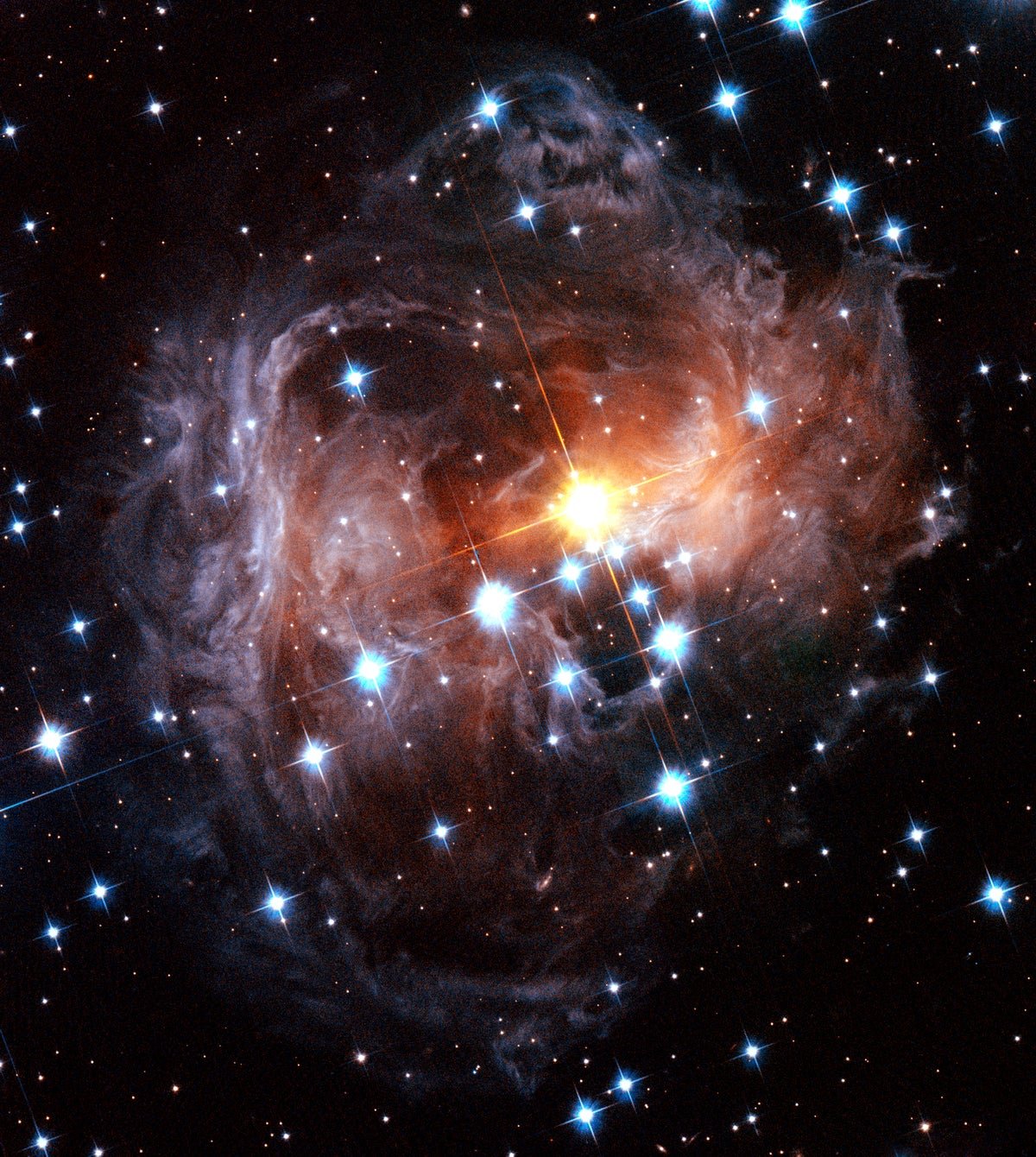
As I noted in that earlier column, the fantastically shaped material around the star V838 Monocerotis was lit up by the light echo from the star. This effect also mimicked faster-than-light travel.
There’s another way to get apparent superluminal motion as well, and again geometry and the finite speed of light are the keys.
In the late 1960s astronomers started to make extremely high-resolution observations of distant galaxies called quasars. Powered by matter falling into supermassive black holes, these objects can blast blobs of gas away from the galaxy at speeds approaching that of light.
If the material is aimed more or less toward Earth, we get a funny illusion. Let’s say a blob is suddenly blasted away. A year later the light it emitted when it formed is one light-year away from the black hole. But the blob itself is hot on its heels, moving only a bit slower and still emitting light. Because of that motion, the light it emits a year later might be detected by us just a few weeks after the initial burst of light; it’s like we’re seeing the events unfold at many times their actual speed, watching sped-up footage with time greatly compressed. If the angle is just right, we see that blob moving on the sky away from the black hole much faster than its actual motion through space would imply, and it could appear to be traveling at many times the speed of light.
This sort of motion is common in galaxies sporting active central supermassive black holes, like the one in the nearby elliptical galaxy M87. Astronomers have measured motion in M87’s ejecta as rapid as six times the speed of light, and it’s all illusory.
In a way, that’s too bad. I wish superluminal travel through space really were possible; there are a lot of astronomical phenomena I’d like to see in person. Because of that, it sometimes feels like the cosmos is mocking us by appearing to break the law.
But by studying this phenomenon, we can learn more about the material surrounding energetic events and black holes, the way it behaves, and, in some cases, the way it was created. If we’re going to anthropomorphize the cosmos, we can say that it isn’t teasing us—it’s helping us learn. And as we’ve discovered, the universe is not violating the law so much as, well, warping it.
