

August 29, 2025
3 min read
How Humans Became Upright: Key Changes to Our Pelvis Found
Genetic and anatomical data reveal how the human pelvis acquired its unique shape, enabling our ancestors to walk on two legs
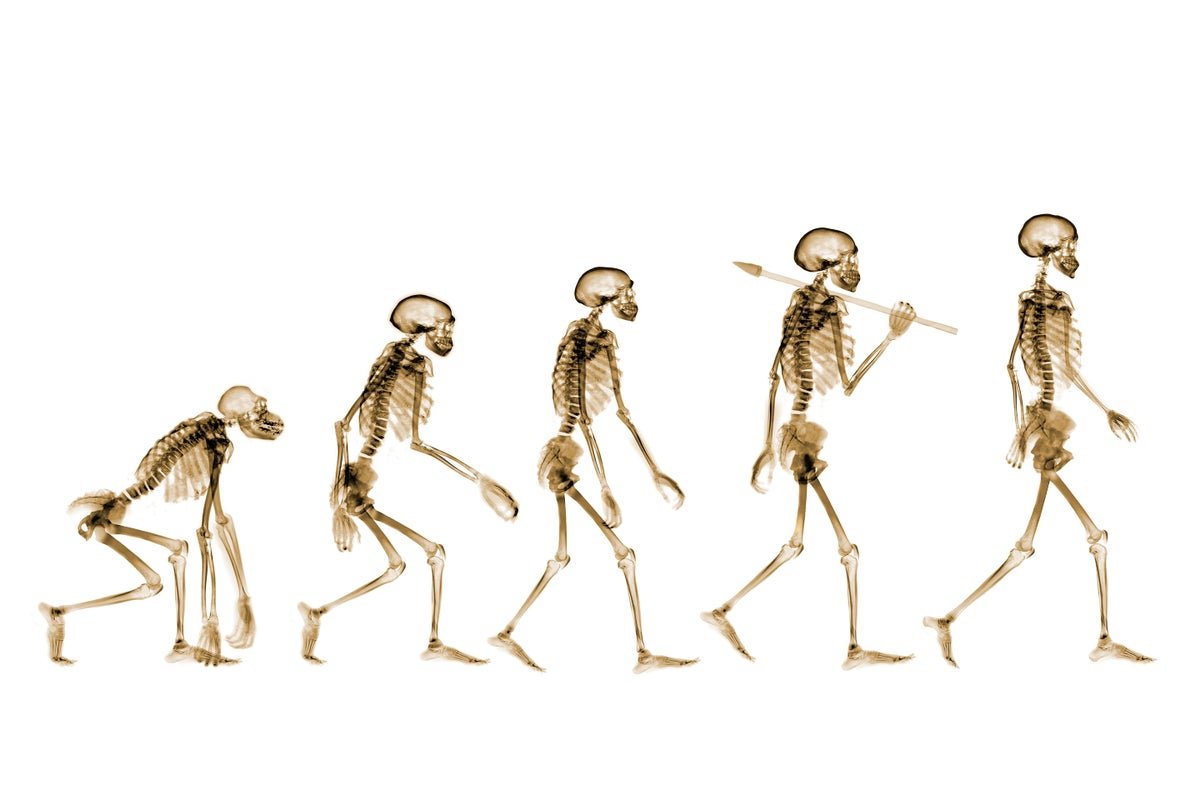
Humans have been walking on two legs for millions of years.
Nick Veasey/Science Source
All vertebrate species have a pelvis, but there is only one that uses it for upright, two-legged walking. The evolution of the human pelvis, and our two-legged gait, dates back 5 million years, but the precise evolutionary process that allowed this to happen has remained a mystery.
Now, researchers have mapped the key structural changes in the pelvis that enabled early humans to first walk on two legs and accommodate giving birth to a big-brained baby. The study, published in Nature on 27 August, compared the embryonic development of the pelvis between humans and other mammals. They found two key evolutionary steps during embryonic development — related to the growth of cartilage and bone in the pelvis — which put humans on a separate evolutionary path from other apes.
“Everything from the base of our skull to the tips of our toes has been changed in modern humans in order to facilitate bipedalism,” says Tracy Kivell, a palaeoanthropologist at the Max Planck Institute for Evolutionary Anthropology in Leipzig, Germany.
On supporting science journalism
If you’re enjoying this article, consider supporting our award-winning journalism by subscribing. By purchasing a subscription you are helping to ensure the future of impactful stories about the discoveries and ideas shaping our world today.
Kivell says the study offers a new understanding of how some of those changes came about, not just in living humans, but also in fossils from ancient hominins such as Denisovans. “I think it’s exciting in terms of moving forward this area of functional genomics,” she says.
Two small steps for evolution
As modern humans evolved, our pelvises developed the wide, bowl-like shape needed to allow upright, two-legged walking — but it is unclear exactly how that happened. “The human pelvis is dramatically different than what you see in chimpanzees and gorillas, so we wanted to set out to try and understand what’s happening there,” says study co-author Terence Capellini, a developmental geneticist at Harvard University in Cambridge, Massachusetts.
To investigate, the researchers studied anatomical, histological and genomic changes in samples of human pelvis from different stages of development. They then compared human pelvic development with the process in mouse embryos and other primate species, including gibbons and chimpanzees.
The researchers focussed their analysis the formation of the ilium; one of the pelvic bones that supports internal organs and anchors the gluteal muscles to stabilise walking. The team collected samples of primate embryos from museums, where they had been preserved in some cases for hundreds of years. “These museum collections are exceptionally precious; they were collected in the last hundred to two hundred years,” says Capellini.
The analysis identified two key steps in the development of the human ilium which enabled its characteristic shape and therefore its ability to support bipedalism.
The first step occurs during early development of the ilium cartilage. Early bone development begins as a vertical rod of cartilage, 7 weeks after gestation. This process is similar in non-human primates. But what happens next sets the human pelvis apart from other primates — in humans, the ilium cartilage rotates 90 degrees shortly after its formation. This ultimately makes the pelvis short and broad.
The second step unique to humans occurs later in development, at 24 weeks after gestation, when the ilium cartilage ‘ossifies’ and is replaced by bone cells. In humans, some of these bone cells form much later than in other primates, which allows the cartilage cells to maintain the shape of the pelvis while it grows.
Together, these developmental quirks help to create a pelvis with the perfect shape for bipedalism.
Bipedalism genes?
As well as pinpointing differences between the formation of the pelvis in human and non-human embryos, the researchers identified a series of genetic factors that control how the pelvis develops. They found found five different genes that were involved in creating the molecular signals for cartilage growth and bone formation in the ilium.
“I was impressed with how much work it was, they really did some incredible things”, says Daniel Schmitt, a biological anthropologist at Duke University in Durham, North Carolina. “It reveals mechanisms that allow changes in [bone] shape that we never knew anything about before, and we can now consider those mechanisms all throughout the body.”
Kivell says the study left her wondering whether DNA from fossilized hominins could help to explain how different genes impact how the human skeleton grows. “I’m curious when [other bone structures] evolved.”
This article is reproduced with permission and was first published on August, 27 2025.
It’s Time to Stand Up for Science
If you enjoyed this article, I’d like to ask for your support. Scientific American has served as an advocate for science and industry for 180 years, and right now may be the most critical moment in that two-century history.
I’ve been a Scientific American subscriber since I was 12 years old, and it helped shape the way I look at the world. SciAm always educates and delights me, and inspires a sense of awe for our vast, beautiful universe. I hope it does that for you, too.
If you subscribe to Scientific American, you help ensure that our coverage is centered on meaningful research and discovery; that we have the resources to report on the decisions that threaten labs across the U.S.; and that we support both budding and working scientists at a time when the value of science itself too often goes unrecognized.
In return, you get essential news, captivating podcasts, brilliant infographics, can’t-miss newsletters, must-watch videos, challenging games, and the science world’s best writing and reporting. You can even gift someone a subscription.
There has never been a more important time for us to stand up and show why science matters. I hope you’ll support us in that mission.
