

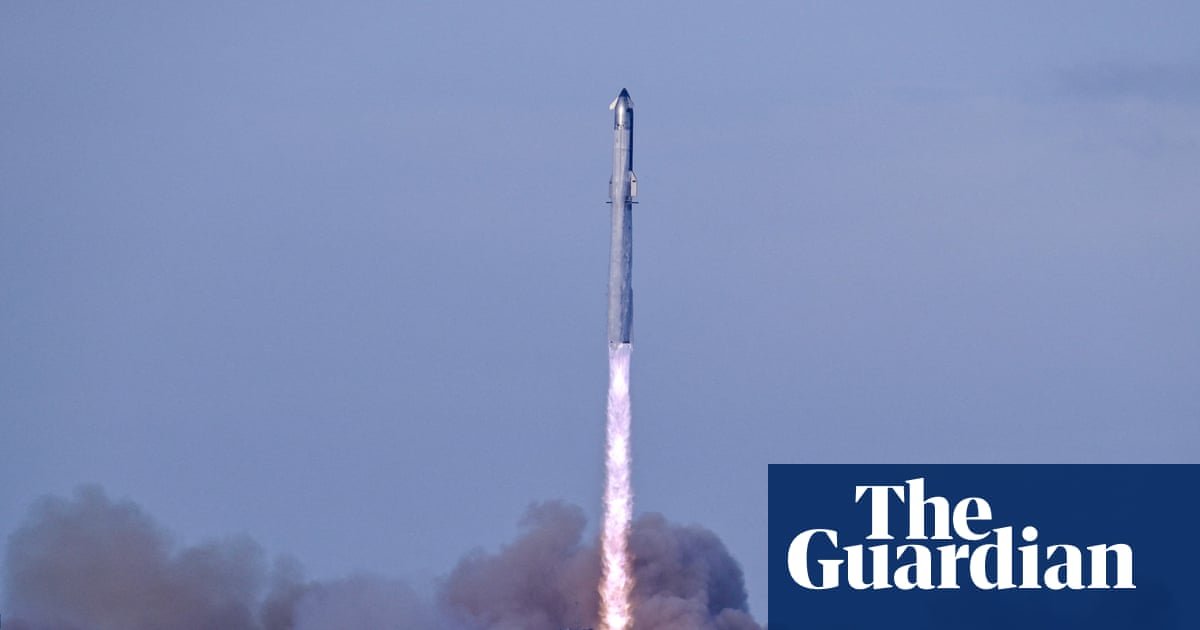
Third time was the charm on Tuesday for the launch of SpaceX’s Starship megarocket after the launch had been scrubbed two times in as many days. The success of this 10th flight proved the spacecraft had overcome its past failures key to the Mars rocket’s reusable design.
The stainless steel behemoth, 403ft (123 meters) tall, lifted off from the company’s Starbase in southern Texas at 6.30pm local time (2330 GMT), to loud cheers from engineering teams, a webcast showed. This mission was to be a test of the ship’s new heat shield tiles and satellite deployment abilities, among hundreds of other upgrades from past iterations.
The rocket’s upper half separated as planned from its Super Heavy booster, the 232-ft-tall first stage that normally returns to land in its launch tower’s giant catch-arms, but on Tuesday targeted the Gulf of Mexico waters to demonstrate an alternate landing engine configuration.
Shortly after reaching space, Starship’s “Pez”-like satellite deployment system dispensed mock Starlink satellites for the first time, a milestone SpaceX either cancelled or failed to reach during past tests.
Starship made a successful splashdown in the Indian Ocean after enduring intense heat through its atmospheric reentry – a crucial phase of the test that has shredded the rocket on past flights.
The 10th test flight comes after a string of explosive failures that raised doubts about whether the world’s most powerful launch vehicle can fulfill founder Elon Musk’s vision of colonizing Mars or helping Nasa return astronauts to the moon.
SpaceX will not attempt to catch the booster from Tuesday’s flight because the component would instead be used for in-flight experiments “to gather real-world performance data on future flight profiles and off-nominal scenarios”.
Monday’s launch scrub was blamed on weather as thick clouds, hanging overhead for much of the day, forced a delay with a mere 40 seconds left on the countdown clock. A Sunday attempt was scrubbed due to a liquid oxygen leak at the Starship launchpad, billionaire Musk wrote on X overnight.
Much is riding on the mission, after the last three flights ended with the upper stage exploding: twice over the Caribbean and once after reaching space. In June, an upper stage blew up during a ground test.
“We’ve had so many tests and it hasn’t proven itself reliable,” Dallas Kasaboski, a space analyst for consulting firm Analysys Mason, told AFP. “The successes have not exceeded the failures.”
The goal is to send the upper stage ship – eventually intended to carry crew and cargo – halfway across the globe before splashing down off north-western Australia.
Outfitted with prototype heat-shield materials, it will deploy dummy Starlink satellites while flying a trajectory meant to stress-test its rear flaps.
The booster, known as Super Heavy, will splash down in the Gulf of Mexico. While SpaceX previously wowed observers by catching the booster in the launch tower’s “chopstick arms”, this flight will instead focus on data collection under less-than-ideal flight profiles.
This year, two Starship tests have failed early in flight, with another failure in space on its ninth flight, and a “catastrophic explosion” of test stand in June that destroyed a Starship and sent debris flying into nearby Mexican territory have tested SpaceX’s capital-intensive test-to-failure development approach, in which new iterations of rocket prototypes are flown to their technical limits.
That ethos is markedly different from SpaceX’s rivals such as Jeff Bezos’s Blue Origin, whose New Glenn rocket made an operational debut in January following years of on-the-ground development and testing. The new Vulcan rocket from United Launch Alliance, co-owned by Boeing and Lockheed Martin, had a similar upbringing before its 2024 debut.
Despite recent setbacks, Starship is not seen as being at a crisis point. SpaceX’s “fail fast, learn fast” philosophy has already given it a commanding lead in launches with its Falcon rockets, while Dragon capsules ferry astronauts to the International Space Station and Starlink has become a geopolitical asset.
Still, Starship presents new challenges. Musk has identified developing a fully reusable orbital heat shield as the toughest task, noting it took nine months to refurnish the space shuttle’s heat shield between flights.
“What we’re trying to achieve here with Starship is to have a heat shield that can be flown immediately,” he said on a webcast Monday.
SpaceX’s Starlink satellite internet business, a major source of company revenue, is also tied to Starship’s success. Musk aims to use Starship to launch larger batches of Starlink satellites, which have so far been deployed by SpaceX’s workhorse Falcon 9 rocket into space.
Musk, for his part, remained bullish. “In about 6 or 7 years, there will be days where Starship launches more than 24 times in 24 hours,” the entrepreneur said on Sunday, replying to a user on X.
Another hurdle is proving Starship can be refueled in orbit with super-cooled propellant – an essential but untested step for the vehicle to carry out deep-space missions.
Time is running short to ready a modified version for Nasa’s lunar lander for 2027, and for Musk to make good on his vow to send an uncrewed Starship to Mars next year.
