

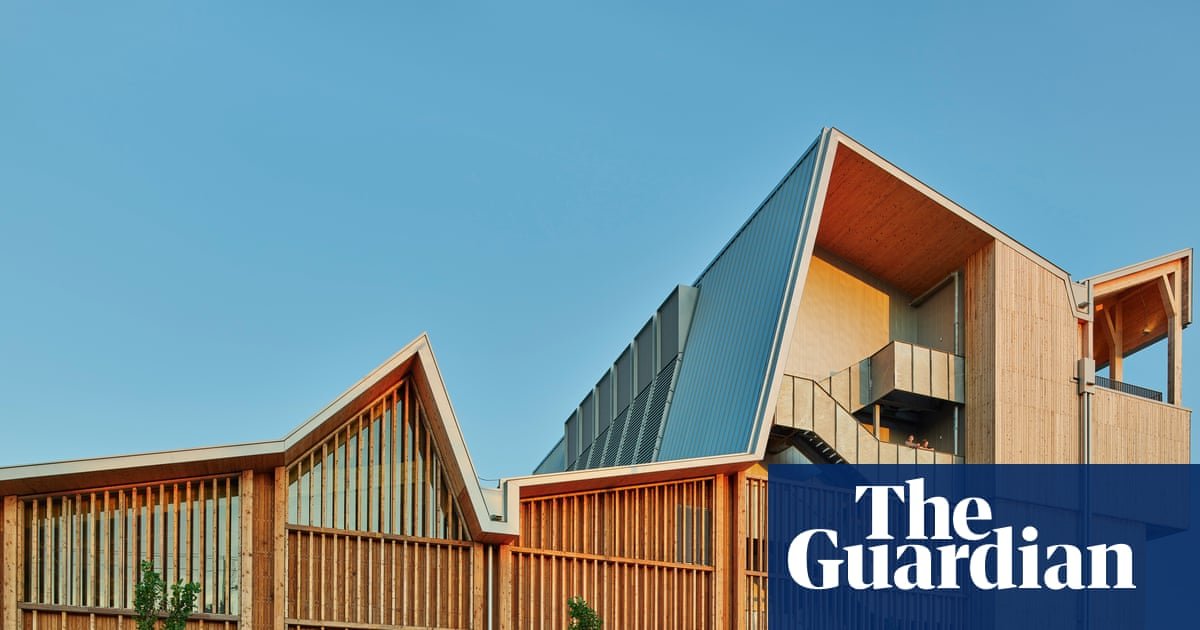
Fringed by a fragmented strip of big box stores, auto repair shops and brick buildings marooned in oceans of asphalt, the state highway of Martin Luther King Jr Boulevard in Fayetteville, Arkansas, is not a place of architectural beauty. And yet, as unlikely as it may seem, this rumbling stretch of road on the edge of this small city is now home to one of the most significant buildings for the future of architecture in North America.
Even at speed, it’s hard to miss. Standing opposite a 200-space Walmart parking lot, the Anthony Timberlands Center for Design and Materials Innovation looks like a group of great big barns caught in a highway pile-up. It begins as a low wooden shed at the back, before suddenly buckling up in jagged folds, its roofline jerking in staccato slopes until it greets the highway with a six-storey shop window. Peer through this glass billboard and you will catch a glimpse of dancing robotic arms, whirring drills, and big wooden building components gliding to and fro on a gantry crane, conjuring the future of low-carbon timber construction.
They wanted something hewn, carved, jointed, woven, layered, laminated – showing all the possibilities of timber
“We imagined the building as a storybook of wood,” says Yvonne Farrell, co-founder of Dublin architects Grafton, the Pritzker prize-winning firm behind the project, with local firm Modus. “They wanted something hewn, carved, jointed, woven, assembled, layered, laminated – showing all the possibilities of building with timber.”
The angular wooden hangar provides a huge new workshop, studio space and auditorium for the University of Arkansas’s Fay Jones school of architecture, which has become known for its hands-on approach to making over the last decade, under the deanship of Peter MacKeith. Having spent 10 years working in Finland, followed by a stint at Washington University in St Louis, MacKeith has been busy trying to inject a more nordic, sylvan attitude into an American building culture that is often stuck in its ways.
A six-storey glass front faces the highway. Photograph: Tim Hursley
“What does it mean to be a school of architecture in a state that is 60% forest?” asks MacKeith. He is standing inside his answer: the school’s new 1,100 sq metre fabrication workshop, where intersecting rows of chunky wooden joists, beams, posts and rafters soar above our heads, rising ever higher with the look of a Piranesian treehouse. “Arkansas has a huge timber industry, but it has historically focused on paper, pulp and dimensional lumber. We’re trying to move the conversation forward, and bring our students closer to the reality of construction and spur the industry on to innovate at the same time.”
This is the fourth mass timber building that the university has completed since MacKeith arrived here in 2014. It follows an impressive library annex, student dormitory complex and research institute, but is by far the most ambitious project, pushing the limits of what the industry can do. It was brave new territory for Grafton, too, which made its name channelling the mighty mineral heft of concrete and stone but had yet to explore the possibilities of trees.
In some ways, the inexperience shows. Grafton’s competition model, displayed in a vitrine in the entrance, is an entirely different creature. It has a similar diving roof profile, but the skeletal structure is made from slender lengths of timber, more redolent of the light-framed Ozark barns and their classic gambrel roofs. Inspiration also came from the delicate criss-crossing wooden structure of the nearby Thorncrown Chapel, designed in 1980 by E Fay Jones, a disciple of Frank Lloyd Wright after whom the school is named. Drawing these influences together, Grafton’s competition images depict a fine matrix of impossibly thin columns and beams, as if the whole thing were held up by a spider’s web of sticks. It betrays a certain naive, if daring, faith in the potential of planks, but their audacity clinched it.
Beefed-up structural members. Photograph: Oliver Wainwright
The built reality looks like the model after a steroid-fuelled weight-training routine. The structural members have been reduced in number but vastly beefed up, while the number of tilting roof planes was also cut on cost grounds. But the sheer heft makes the space no less impressive. Rather than feeling like a scaled-up barn, it now has a heroic, almost Roman quality. While early classical architecture was based on timber carpentry techniques translated into stone, this feels like the logic of concrete construction transmuted into glued-together tree trunks.
Metre-wide columns of glulam (glued laminated timber) plunge from the six-storey-high ceiling, intersecting with equally fat beams, scaled to carry the weight of a five-tonne gantry crane, allowing full-size building prototypes to be hauled back and forth. A gigantic queen post truss hangs from the ceiling (partly steel, but ironically clad in timber for fire-proofing), supporting the weight of the two studio levels and the auditorium, and allowing the wide working area below to be column-free. Just like Grafton’s Kingston Town House in London, an unlikely marriage of library and dance studios, the visual connection between the studio and workshop was key. As MacKeith puts it: “We wanted a building where thinking and making were inseparable.” (Triple glazing helps muffle the whirring robots.)
The school’s philosophy is already evident in the furniture. When construction costs doubled from $21m to $43m (£39), due to Covid-induced inflation and the simultaneous construction of a vast mass timber Walmart headquarters, which absorbed all the labour in the region, the school turned it to their advantage. A project was launched whereby the studio desks would be designed, prototyped and fabricated by students. The resulting design of interlocking plywood and OSB is more thoughtful and beautifully crafted than any off-the-shelf equivalent. (Similar care can be found in the bronze front door handle by Finnish guru Juhani Pallasmaa, MacKeith’s former mentor, who also advised on the project.)
Continuing the didactic theme, different timbers are showcased in their different roles throughout the building: white oak for the stairs, cherry for the handrails and durable black locust for the floors of the outdoor terraces, whose end-grain cobbles make it feel like walking on big butcher’s blocks. These elevated eyries provide welcome respites; you can stand out on the top floor looking across the highway to the forest beyond, and contemplate how its trees were fashioned into the wooden structure overhead.
Studio desks designed, prototyped and fabricated by the university’s students. Photograph: Tim Hursley
Except it wasn’t quite so locally sourced. The elephant in the room is that, while this project was intended as a showcase for Arkansas forestry, bearing the name of the state’s largest privately owned timber company (which donated $10m), much of the wood came from elsewhere. All the way from Austria, in fact.
“We were originally hoping that the state’s mass timber industry would be sufficiently competitive by the time of construction,” says assistant professor Jonathan Boelkins, who was instrumental in steering the project. Arkansas had manufactured big glulam beams before, for the Crystal Bridges art museum, but the firm went out of business. Only one cross-laminated timber (CLT) manufacturer survives, which made the floor and wall slabs for the project, but the primary structure came from Austrian giant Binderholz, shipped and trucked to the site in lengths of up to 12 metres. That situation is likely to continue for some time: even with Trump’s 15% tariffs on timber, the Austrian product still wins on price and precision.
There is hope that this bold building will begin to change that. MacKeith is evangelical about the benefits of wood, on environmental, psychological and economic grounds. And he is determined to shift the state-wide conversation by hosting conferences, workshops and symposia, and talking to the governor and state legislators. “We’re in the middle of the country’s fibre basket,” he says, “and we have all the rivers and roads to transport the materials. The state is currently growing two trees for every one it can harvest, which increases the chance of wildfires, infestation, and deadwood falls, and creates over 15m tonnes of excess biomass a year. We could be using that for CLT and glulam.”
An end-grain cobbled terrace with views of the forest. Photograph: Tim Hursley
The school’s Urban Design Build studio, run by John Folan, has been leading the charge. Hands-on projects with students have ranged from a forest education centre to prototype housing for low-wage workers using a new technology known as wave-layered timber. “It’s a ‘design to income’ strategy,” says Folan, “factoring in the cost of land and materials for someone earning $16 an hour. We start with a nucleus, which can be expanded from there.”
More recently, students have been working with waste sawdust for 3D-printing, combining it with clay and soil. “This new workshop will allow us to take traditional technologies and combine them with advanced manufacturing,” says Folan. “Its form as a central bay, with two saddle bags either side, makes it perfect for building things at scale – and then taking them straight on to a truck through the big garage door.”
Back in Dublin, Grafton is fired up about forests. Its architects are now working on a timber apartment building in Nantes, France; another partly wooden educational building in Firminy; and a writer’s centre in South Korea, with a local master joiner. “We’re not saying everything has to be all timber,” says co-founder Shelley McNamara. “Hybrid structures are often the answer. But here, from our island in the Atlantic, we’ve tried to make something that is an expression of the university’s culture. We hope the building will be a good teacher.”
