

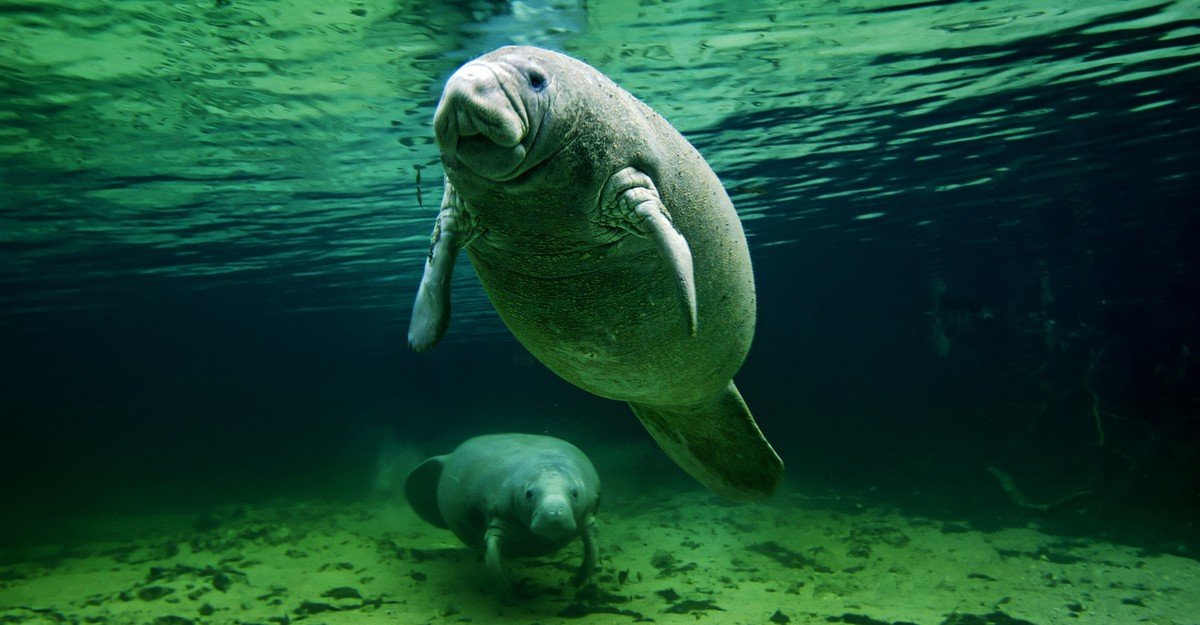
The Indian River Lagoon, a long braid of brackish mangroves and shifting islands, runs along Florida’s Atlantic coast. It is home to 4,300 species, including many of the state’s remaining manatees, whose large, paddle-tailed bodies graze slowly through the shallows. For decades, the lagoon has also been a destination for Florida’s municipal sewage. State law long ago aimed to stop much of the flow from wastewater plants, but in practice continued to allow dumping during heavy rains. Residential septic tanks have kept leaching into the water, too. Over time, that pollution fed algae blooms that choked out the area’s seagrass—manatees’ main food source.
In 2021, a record 1,100 manatees died statewide, driven largely by seagrass loss. The following year a nonprofit group sued the Florida Department of Environmental Protection, claiming that the agency had violated the Endangered Species Act’s prohibition on “harm,” which has long been interpreted to include damage to vulnerable species’ habitats. This interpretation has safeguarded salmon runs in the Pacific Northwest, nesting grounds for sea turtles, feeding areas for whooping cranes, and more—protecting not just individual animals but the ecosystems they rely on. This spring, a federal appeals court agreed the Florida Department of Environmental Protection had a duty to do better, blocking new septic tanks and requiring the agency to launch a supplemental feeding program for manatees.
The boundaries of harm, however, are changeable. Earlier this year, the Trump administration announced a radical reinterpretation of the Endangered Species Act’s regulations, which would limit the definition of the term harm and exclude habitat destruction. Environmental advocates have warned that this change would accelerate extinctions. Roughly 90 percent of listed species are now in danger at least partly because the places they’ve lived have disappeared or been altered because of threats such as climate change or development. “I can’t really overstate how fundamental that ‘harm’ definition is to implementation of the Endangered Species Act as we’ve understood it for decades,” Noah Greenwald, co-director of endangered-species work at the nonprofit Center for Biological Diversity, told me.
In June, the Trump administration announced plans to expedite the act’s permitting process, too, which could further accelerate the loss of essential habitats, Greenwald said. Congress is also considering weakening the act by making it harder to list new species or for environmental groups to sue, as well as undermining related laws such as the Marine Mammal Protection Act. Together, these changes could affect many of the plans that federal agencies are currently required to carry out in order to help endangered populations. These alterations are still under review: More than 350,000 people submitted public comments in the spring about the proposed change to “harm”—with many opposing the proposal or expressing concern about its implications—and no timeline for a final decision has been publicly announced. (The U.S. Fish and Wildlife Service did not respond to a request for comment for this story.)
If the administration does weaken federal habitat protections, which species might decline most dramatically, or quickly be snuffed out, is difficult to say. What is clear is that implementing these changes would fundamentally reorder how and where protections are applied, and consequences would ripple across ecosystems. In Arizona, for instance, the endangered jaguar depends on a corridor of protected land along the U.S.-Mexico border, and proposed construction of additional border wall may soon cut off one of the species’ last remaining ranges in the United States. This would isolate the jaguars from vital habitat, potentially shrinking their genetic diversity and preventing them from reestablishing a stable population in the U.S. Under the administration’s proposed definition, actions such as destroying manatees’ food sources or cutting off the corridors that jaguars use would no longer count as harm to the species themselves, Katherine Sayler, a wildlife biologist at the nonprofit Defenders of Wildlife, told me. Protections that limit wastewater pollution, restrict development in migration routes, or safeguard nesting and breeding grounds could suddenly be undone.
One of the people best placed to understand what this might mean for the country’s plants and animals is Leah Gerber, a population ecologist and the founding director of Arizona State University’s Center for Biodiversity Outcomes. For years, she has tried to develop practical tools to help wildlife managers allocate their limited resources, including writing a handbook on how to analyze extinction-risk estimates. Should the proposed revisions go through, I asked her, how many species might go extinct?
Tallying the actual damage might not be possible for years, she warned, but she agreed to take a stab at a rough estimate. Together with several scientists at Defenders of Wildlife with whom she’d previously collaborated, Gerber turned to a database that describes the location and ecological condition of species and ecosystems, collected by the nonprofit NatureServe. The researchers identified plants and animals that were already in decline and facing substantial short-term risk from habitat loss—species whose populations had dropped by at least 50 percent over 10 years or three generations. Then, they narrowed that group to species severely affected by losses throughout their range.
Using this method, Gerber and her collaborators found that at least 49 of the 1,683 listed species are likely to disappear as a result of losing habitat protections. Those likely affected include charismatic megafauna such as the manatee and the Florida panther, well-known species such as the whooping crane and the North American wolverine, and long-lived creatures such as green and loggerhead sea turtles. But the list also included mussels, fish, and butterflies, “taxa especially sensitive to habitat disruption,” Gerber said.
Aaron Haines, a conservation biologist at Millersville University, in Pennsylvania, told me that these results sound plausible, and that he agreed with the general methods Gerber used. If anything, he said, he would have added in plans for natural-resource-extraction efforts as a factor that might doom additional species.
Talia Niederman, one of Gerber’s collaborators from Defenders of Wildlife, explained that their analysis likely undercounted the number of species that would face an existential threat from the administration’s changes. Untangling the exact danger facing any particular species is hard: Risks from land-use changes, pollution, and climate change are deeply interconnected—and the more pressures you add, the worse the outcomes get. Although those pressures have substantially increased, “direct harm has actually declined over time,” Haines told me.
For many species, Gerber told me, scientists don’t have enough data to know what the tipping point for their survival might be. For species with tiny ranges—such as the Mission blue butterfly near San Francisco, which depends on native lupines that are also vanishing—a single poorly placed development can do irreversible damage. Without historical habitat protections, a butterfly species such as this one might disappear entirely between underfunded surveys, vanishing before anyone realizes, while species such as the manatee may continue shrinking as previous methods of intervention get whittled away.
This new approach to the Endangered Species Act would be indifferent to either outcome, reflecting a deeper shift in how American political leaders view nature. For decades, the law has served not just as a legal tool but as a moral framework for how we think about wildlife. It’s built on the idea that all species have inherent value. By rewriting what counts as harm, the administration is signaling that it’s acceptable for some species to die as the cost of doing business. As Haines put it to me, the central question of the Endangered Species Act is, in essence, “Do we maintain the wildness that identifies us as a nation?” The Trump administration’s answer, it seems, is that it’s okay if some species slip through the cracks.
In their own way, conservationists have been struggling with an uncomfortable question: Can every species really be saved? In the past 50 years, the Endangered Species Act has been remarkably successful at holding in check the erasure of the natural world—keeping disappearing species from extinction—but less so at boosting populations enough to be declared recovered. Gerber previously found that federal managers get only about one-fifth of the funding needed to help endangered species, and that funding is spread unevenly. And so a fault line has developed between those who believe in interventions for every at-risk species, and those such as Gerber, who argue that in the midst of the world’s sixth mass extinction, conservationists need to be explicit about the trade-offs in prioritizing which species to protect—a calculation that the Endangered Species Act was not designed for.
Scientists at the National Marine Fisheries Service, for instance, have spent many years intensively managing the endangered Hawaiian monk seal, including relocating breeding females, vaccinating wild populations against disease, and culling predators. “But some of those sharks aren’t doing well either,” said Gerber, who once worked for the National Oceanic and Atmospheric Administration on a review of the seals’ recovery plan. Looking at the warming water temperatures, the decline of the seals’ prey, and their inexorably changing ecosystem, she started to wonder: Do we prioritize species that are likely to make it? (When I asked NOAA about the seals’ recovery, a spokesperson pointed me to the agency’s public websites, which state that about a third of the population exists today only because of these measures, helping pull them back from the brink of extinction.)
That logic is different from the Trump administration’s proposal, though, in a key way. Gerber’s idea of triage is to direct the resources the United States is willing to put toward conservation where it might matter most. This administration’s notion is something bleaker—that the country should simply care less.
