

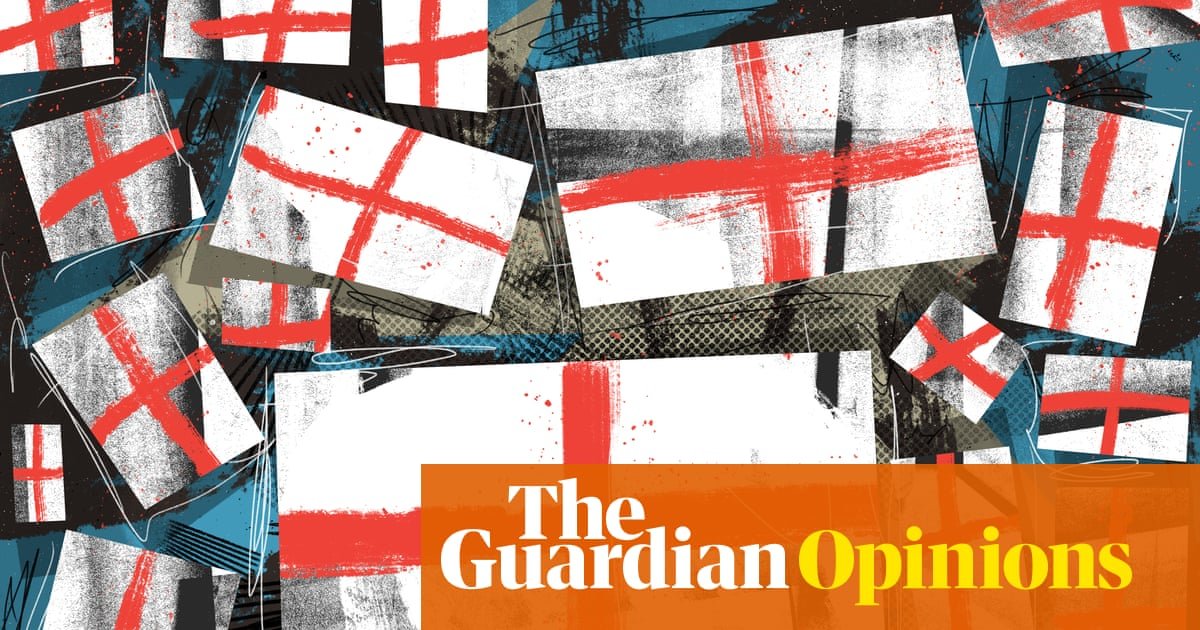
It was a sun-soaked weekday in the West Country, and all I could think about was the flags. Around the sedate Wiltshire town of Devizes, they fluttered from trees and upstairs windows, with crude versions sprayed across roundabouts. In my adopted home town in Somerset, meanwhile, local desperadoes had vandalised a pedestrian crossing close to a school, which had sparked an online row, partly because they had jettisoned their paint cans down a nearby alley. “Apart from the paint being dumped, I applaud them,” said one Facebook post. There was talk of more St George’s crosses appearing at the car park near the GP surgery – and, in among scenes I usually associate with calm and quiet, a sudden and unsettling sense of mischief and menace.
Such is the impact of Operation Raise the Colours, a campaign which seems to have begun in the suburbs of Birmingham. Its origins apparently lie in a few flags being cleared from lamp-posts as the city council tried to install LED lighting. In the hands of online provocateurs, that was enough to confirm stories about woke local bureaucrats denying people their national identity. That narrative has quickly ballooned, with sometimes grimly comical consequences: the dependably restrained Reform UK MP Lee Anderson says that any elected official who supports removing British or English flags “should be removed from office for betraying the very country they serve”, while his party’s council leader in Northamptonshire insists that for health and safety reasons, “we may need to take them down in the best interests of our residents”.
That very small subplot is probably the only halfway amusing part of the story: everything else is deadly serious. Despite claims that it is all about patriotism rather than prejudice, what has materialised up and down the country feels like an unauthorised version of what the Home Office used to call the hostile environment, as if football hooligans have taken control of road markings and street furniture. And the relevant mood music is not exactly subtle. On the campaign’s Facebook page, there are enthusiastic looks ahead to September’s “free speech” rally fronted by the far-right figurehead Tommy Robinson, notices about looming protests outside hotels used to house asylum seekers and terse allusions to the usual conspiracy theories (“our masters have sold us to Islam … the replacement has begun”).
The anti-racist group Hope Not Hate points to known far-right activists who are involved. Picking through it all, one thought repeatedly hits home – that whatever this self-styled operation’s apparently haphazard beginnings, it marks yet another instalment of a story that could not be more serious: the long march of a politics full of audacity and ambition, which is now reaching people and places that the left gets nowhere near.
The result is a self-evident political emergency. For proof, look at Reform UK’s stubborn lead in the opinion polls, and the very real prospect of Nigel Farage becoming prime minister. Consider also the post-Brexit transformation of English Conservatism, and the fact that many Tories’ hopes now lie with Robert Jenrick, the aspiring leader whose recent visit to a protest in Epping put him in close proximity to an infamous far-right activist, and who has loudly endorsed Operation Raise the Colours (Kemi Badenoch soon followed suit, in yet another example of who is really in charge of her party). But also bear in mind something much more frightening: the fact that what is afoot goes far deeper than the manoeuvrings of politicians and parties. It goes into the cultural spaces where people live their lives.
Some of this is all about the grim synergy between the right’s use of disinformation and provocation, and how politics has changed in ways that most of its practitioners seem to barely understand. In the past, orthodox television and what we now call the legacy media ensured that people who supported the merchants of hard-right ideas were exposed to arguments against them. But the 21st century does not work like that: radicalisation happens in sealed-off online spaces that operate according to their own deranged logic, opening a path from unthinking first steps to full-blown conversion. One minute you might be spraying the road just for the likes; the next, you could be disappearing into a mob surrounding a mosque. From the outside, that is a very difficult cycle to break.
But that is not to say that no one should try. At the moment, the new right’s bark is probably worse than its bite: once again, compared with all the talk of mass uprisings and social breakdown, this weekend’s hotel protests were a thoroughly damp squib. But one of the most depressing aspects of this summer has been the sense of progressive forces so dumbfounded and confused by what is happening that they seem almost completely unable to respond, and a feeling that many people in positions of power now accept that ridiculous proposition that England is now the country Farage et al say it is. The Labour party, needless to say, either meekly echoes Farage’s talking points or makes the laughable claim that people shouldn’t support him or his party because of his views on the NHS. Even the trade unions, whose workplace reps and conveners presumably understand people’s support for the new right as a matter of everyday experience, are bafflingly quiet.
And what of any fight on the terrain of popular culture? Older readers will recall a rightward cultural shift and the brief surge of the National Front in the late 1970s, which was met by the inspirational work of Rock Against Racism and the Anti-Nazi League, choking off the far right’s appeal to the young. I can well remember the anxiety and alarm triggered by the surge in popularity of the fascist British National party, which happened twice: 15 or so years ago, when it was undone by dogged Labour campaigning and its own ineptitude, and circa 1994, when the election of a single BNP councillor in east London sparked a huge anti-racism concert, acres of coverage in the music press and the revival of Rock Against Racism’s old spirit.
I know: that was a very long time ago, and comparing then with now risks ignoring how much popular culture has since been diluted and weakened. But there are still musicians with huge platforms and devoted fans, and organisations – such as Love Music Hate Racism – ready to play their part. The prominence of Palestine flags at this year’s festivals proves that music’s radical edges have not been completely blunted; even the most apolitical artists surely understand that what they do is a product of exactly the kind of cultural mixing and open attitudes that the new right wants to squash.
Something else keeps nagging at me. Up until a few years ago, we heard a lot of talk about progressive patriotism, a new vision of England that was truer to 21st-century reality, and the final wresting away of symbols of nationhood from people with the most malign and nasty ideas. It was right that we did: the fact that these conversations never really went anywhere might be one of the reasons we are in such a mess. The noise the new flag-wavers make is getting louder; there are increasingly brazen links between thugs and supposedly mainstream politicians that need to be called out. This is what defines the urgency and fear of this summer: as the Clash long ago sang in a peerless and prescient piece of music titled Clampdown, what are we going to do now?
John Harris is a Guardian columnist
Do you have an opinion on the issues raised in this article? If you would like to submit a response of up to 300 words by email to be considered for publication in our letters section, please click here.
