

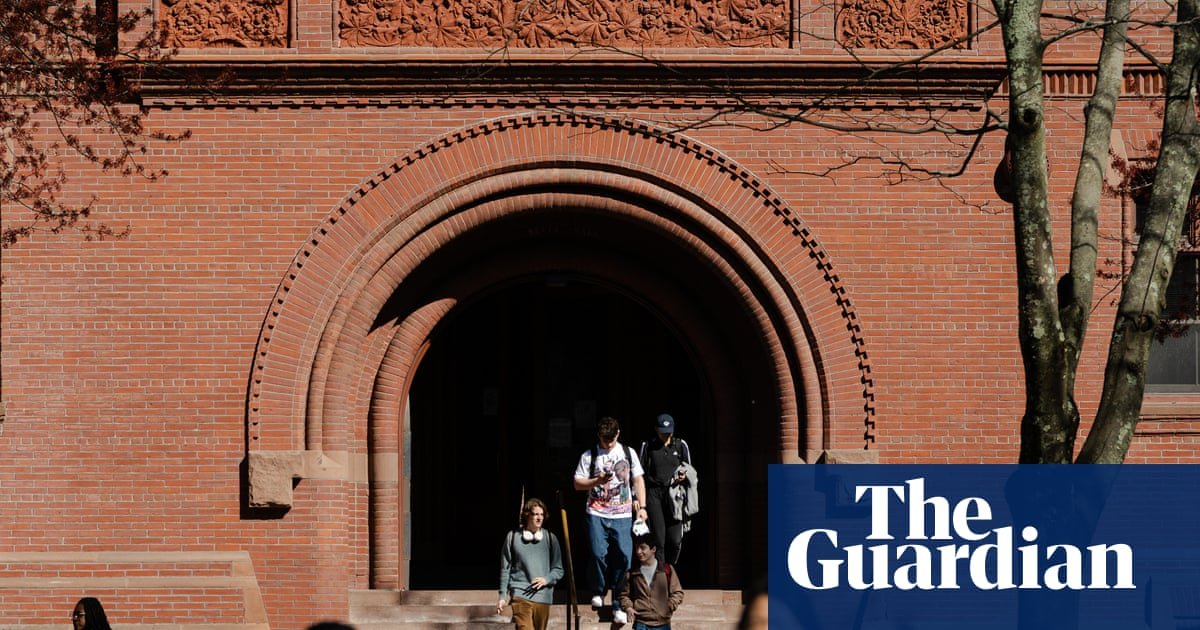
Students and faculty heading back to US colleges and universities from summer break are returning to bruised institutions reeling from the Trump administration’s unprecedented campaign to bend higher education to its ideological will, and are bracing for more uncertainty ahead.
At the University of Utah, the Black student union has lost its funding and campus space – one of many student groups to face the brunt of Donald Trump’s anti-diversity measures. Indiana’s public universities have cut or merged more than 400 degree programs, about one-fifth of their academic offerings, while scores of other universities have made similar cuts as their budgets are on the line. At Harvard and Columbia, certain forms of criticism of Israel will now be punishable as antisemitism. And across the country, schools will see their international student population plummet after the administration erected a host of new barriers to students seeking to travel to the US.
The threat to higher education feels “existential”, said Benjamin Kersten, an art history doctoral student at the University of California, Los Angeles, one of the universities targeted by the president with millions of dollars in cuts. “It makes me wonder how I’m supposed to compartmentalize and conduct the research I was brought here to do.”
Kersten cited nationwide cuts and closures, dwindling research resources, crackdowns on student organizations, rising tuition, and worsening labor conditions for faculty. As a Jewish student involved in pro-Palestinian activism, he decried the administration attacking universities under the pretext of fighting antisemitism.
“Threatening to cut off research funds and make the university pay the administration does nothing to make the campus safer for Jews,” he said. The impact, he added, was being felt “by everyone, from the most vulnerable students and employees to even tenured faculty”.
Todd Wolfson, the president of the American Association of University Professors (AAUP), agrees.
“This is obviously the most intense assault on higher education by the federal government in the history of the United States,” he said. “Everyone is coming into fire.”
Last fall, students returned to campuses to find newly fenced lawns and a string of restrictive measures passed by universities in response to the pro-Palestinian encampments that rocked the nation the previous spring. This year, they are returning to schools where scarcer protests have been punished with expulsions, where foreign students have been snatched off the street by masked federal agents, and where school administrators have been blackmailed by the government to conform to its pro-Israel, anti-diversity agenda or face billions in cuts.
Todd Wolfson, president of the AAUP, in Washington DC on 23 May 2024. Photograph: Michael A McCoy/Getty Images
The new academic year promises further crackdowns and the reality settling throughout US academia that the turmoil of the last months will have a lasting effect.
Already, three leading universities – Columbia, Brown and the University of Pennsylvania – have entered into settlements with the Trump administration, agreeing to millions in payouts and surrendering significant autonomy in an effort to save their federal funding. Linda McMahon, the US education secretary, boasted following the government’s much-watched settlement with Columbia that the deal would “change the course of campus culture for years to come”.
Harvard is the only university to have sued the administration – over both funding cuts and an effort to block the school from enrolling foreign students. While it has scored some early wins in court, it is also reportedly close to making a deal with the White House. Trump has also recently frozen $584m in funding to UCLA, demanding the university pay $1bn to settle antisemitism claims. (A federal judge has ordered part of the funding restored).
Dozens of other universities are facing civil rights investigations over alleged antisemitism, and education advocates expect the number of universities forced into settlements – which they say amount to “extortion” – will grow.
A chilling effect
Trump has described higher education as the enemy, and the assault of recent months fulfills a conservative agenda years in the making.
The administration seized on campus divisions over Israel to impose a definition of antisemitism that critics caution is antithetical to academic inquiry, and freeze billions in grants and contracts – mostly for medical and scientific research. It forced out a university president and backed Republican governors’ efforts to stack the leadership of public universities with conservative ideologues. And the president has signed a flurry of executive orders wielding his axe at everything from equity initiatives to long-established accreditation systems.
On Monday, the White House announced that it had revoked 6,000 international students’ visas since Trump took office and that immigration officials will begin to screen applicants’ social media posts for “anti-American activity”. A recent analysis by Nafsa, a non-profit association of international educators, projected that US universities could see a 30% to 40% decline in new international enrollment this upcoming academic year.
On campuses, the impact has been immediate.
“There is already a chilling effect, fueled by fear and intimidation, that stifles the free exchange of ideas, weakens innovation and curtails global influence,” said Lynn Pasquerella, president of the American Association of Colleges and Universities.
In July, as part of a legal challenge to the administration’s detention of international students and scholars over pro-Palestinian views, professors from universities across the country testified about having canceled travel plans, declined to write op-eds or participate in protests, and abandoned research projects out of fear of being targeted by the administration.
skip past newsletter promotion
Sign up to This Week in Trumpland
A deep dive into the policies, controversies and oddities surrounding the Trump administration
Privacy Notice: Newsletters may contain info about charities, online ads, and content funded by outside parties. For more information see our Privacy Policy. We use Google reCaptcha to protect our website and the Google Privacy Policy and Terms of Service apply.
after newsletter promotion
“Following the arrest and the detention and the threat of deportation of several students … I felt that it was too risky for me to do research in the Middle East,” Nadje Al-Ali, a German anthropologist and former director of the Center for Middle East Studies at Brown University, said in court. “Although these were students, I felt like, OK, next in line will be faculty.”
Some universities, perhaps anticipating the government’s demands, have preemptively gutted diversity initiatives, shut down programs and scholarship related to Palestine, and pursued disciplinary measures against faculty and students who are vocal about Palestinian rights.
Scholars have canceled courses, quit their jobs or left the country rather than submit to what they say amounts to a censorship regime. Others are girding for the academic year ahead with a mix of dread and demoralization.
“There’s a lot of hopelessness and devastation – no one I know is feeling secure in terms of affording rent and groceries, or whether they will be expelled or fired,” said Maura Finkelstein, an anthropologist who last year became the first tenured professor to be fired over her pro-Palestinian advocacy since the war in Gaza started. “There’s real, material fear.”
Finkelstein, who spent the last year touring US campuses to talk about the crackdown on academic freedom on the pretense of fighting antisemitism, noted that many of her colleagues were just trying “to keep their head down and white-knuckle their way through”, even as others were deciding the ethical compromise was not worth it.
“The point of a liberal arts education is to teach critical thinking skills, and now we’re seeing institutional procedures and policies that are making it so that critical thinking is no longer welcomed on campuses,” she said.
The effect has tricked down to the states. In Texas, Ohio and Florida, Republican legislators were already leading the crusade against universities that the Florida governor, Ron DeSantis, accused of “woke indoctrination”. But since Trump returned to office, they have seized on the momentum to further restrict faculty independence, control what can be taught in the classroom and place partisan appointees in administrative roles.
The fight ahead
Education advocates warn of a looming showdown with faculty who are angry their employers aren’t taking more of a stand.
The federal cuts and uncertain climate have led to hundreds of jobs lost, while the impact on scientific and medical research, particularly after the administration cut hundreds of millions in National Institutes of Health funds, is reverberating beyond academia.
Wolfson, the AAUP president, argues that higher education unions representing faculty and staff must link arms with students as well as businesses and other stakeholders outside the university not only to resist the administration’s policies, but also to counter them with a new vision for higher education, including campaigns for free public college, an end to student debt and more funding for science.
“This country is best off when higher education is strong,” Wolfson added, warning of a more “militant” response on campuses in the fall – including, possibly, mass strikes.
“We’re going to need to politicize this fight,” he added. “It’s not an economic strike around our job conditions – it’s a political strike around the future of the sector.”
