

“When it comes to human stuff, I’ll take anything, pretty much,” says Henry Scragg. “As long as it’s been ethically sourced, may I add.”
Speaking from his macabre curiosities shop in Essex in a recent YouTube interview, Scragg wears a shabby bowler hat, has tribal-style face tattoos and a ginger beard that descends into three pendulous dreadlocks.
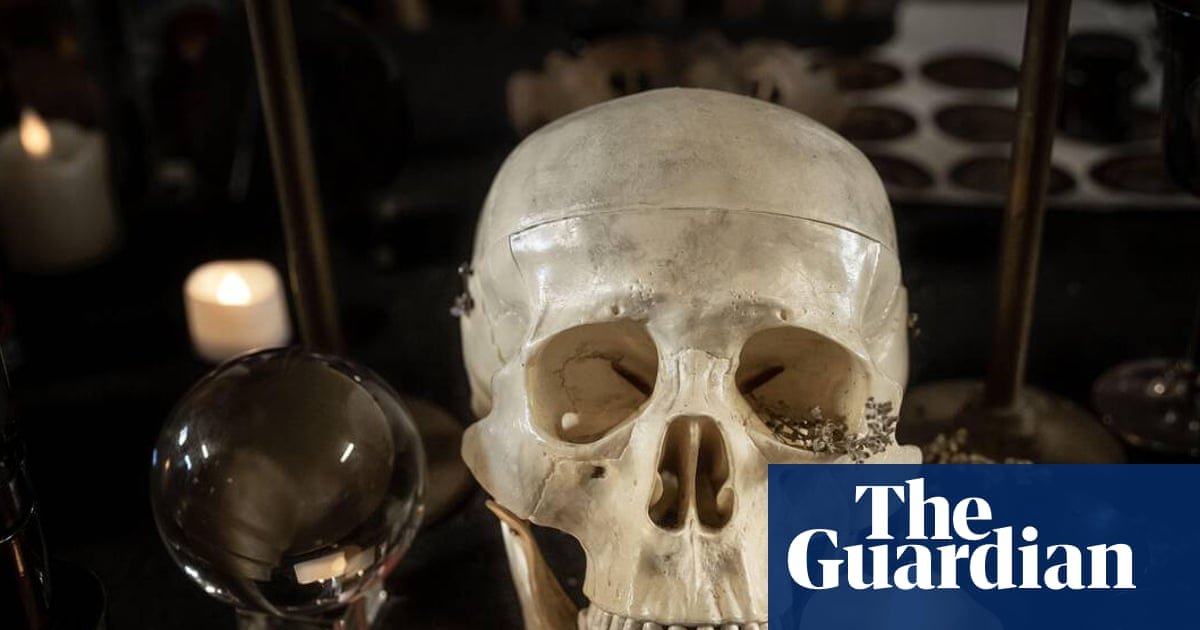
The shop, Curiosities from the 5th Corner, provides a backdrop that could be plucked straight from a Victorian penny dreadful: a foetus of conjoined twins floats in a large medical jar at Scragg’s elbow, shelves of human skulls and a hybrid animal skeleton loom behind. The shop’s website markets a monthly human skull subscription (buyers are sent a skull of the shop’s choice each month), mummified body parts, shrunken heads, and masks and wallets made from human leather.
Henry Scragg at Curiosities from the 5th Corner. Photograph: Guy Corbishley/Alamy
There is no suggestion the sale of these items is illegal, but experts, including Dame Sue Black, one of the UK’s leading forensic scientists, are calling for a crackdown on the trade in human remains.
They say the lack of regulation means much of the buying and selling of skulls and bones falls into a legal grey zone; and that the growing online market risks fuelling a new era of “body snatching”, with reports of bones being removed from crypts and graveyards in the UK and abroad.
“You’ve got people who are breaking into mausolea and who are taking remains away to sell them for people who think this is gothic, quaint [or] supernatural,” said Black, the president of St John’s College, Oxford. “If you can make the sale of a bird’s nest illegal, surely to goodness you can make the sale of a human body illegal. Having a necklace made out of somebody’s teeth isn’t acceptable to people.”
One problem, experts say, lies in how laws are applied. In the UK, desecrating a grave is an offence, but the remains are not technically property so they cannot legally be “owned” or “stolen”. This means it would not automatically be a crime to possess or sell historical human remains, even if they had been unlawfully exhumed.
“It’s gruesome,” said Black. “It’s why we say ‘Rest in peace.’ You don’t expect your body to be dug up and sold.”
Dr Trish Biers, from the department of anthropology at the University of Cambridge, coordinates a taskforce at the British Association for Biological Anthropology and Osteoarchaeology (BABAO) that investigates the sale and trade of human remains. She said there had been a substantial increase in sales in the UK in recent years. In the past five years, the BABAO had blocked more than 200 sales, including from auction houses, shops and online sellers.
You can’t take photos of remains under 100 years old for medical research … but it’s OK to turn a child’s spine into a handbag handleDr Trish Biers
While the market has long been dominated by ex-medical skulls and former museum exhibits, Biers suggested there had been an increase in the sale of skulls described as “archaeological”, the appearance of which is consistent with having been excavated from the ground or exhumed from coffins.
“Social media has completely changed the market,” she said. “It’s not illegal and that’s the problem.”
Similar concerns were raised in March by Mattaeus Ball, a Reading-based trader in “macabre art and oddities” who recently announced he was no longer trading in human remains.
“The waters are becoming too muddy with stolen pieces, pieces that are grave-robbed, so many things that just aren’t right,” he said in an Instagram post. “And people keep thinking I’m dealing in that, when I’m not.” Ball declined to be interviewed.
The Guardian showed images of 10 skulls found on sale on Instagram and other UK online forums to three forensic experts. Several were judged to be ex-anatomical teaching skulls, but others appeared to be coated with dirt or traces of human tissue, which could indicate more recent excavation.
One skull, being sold for £995 on a Belfast-based website, showed signs of root damage, suggesting it had been buried in soil. One expert identified “patches of what could be darker organic matter, possible rootlets in the sutures and orbits, possible rodent gnawing”. The owner of the site said roots and rodents were not the cause of damage.
Another skull, missing several teeth and marketed for £795 on the website of a UK-based shop, appeared to have manganese oxide staining, the Guardian was told, which is consistent with that seen in bodies excavated from old graves.
At least three skulls showed evidence of softening, which occurs when bones are submerged in the acidic material created by decomposition inside a coffin. One of these appeared to have recent damage around the face and a dark, thin, flaky layer “which is what I have seen in skulls that have been taken from coffins”, said Black. “The white areas tell you that it is recent damage as it exposes the non-coloured bone below.”
Dr Nicholas Marquez-Grant, a forensic anthropologist at Cranfield University, said that, based on anatomical features, some of the skulls probably originated from outside the UK, including Asia and Africa, and may date as far back as the 19th century.
When you dig up a human skull … you could hand it to a museum. They’ve already got loads of them so they don’t need any moreHenry Scragg
Paul Boateng, who will meet the culture secretary, Lisa Nandy, next month to appeal for a change in the law, has raised specific concerns about the trade in remains of ancestors from Indigenous communities. “The continual trade in human beings even after death, and their continued objectification even after death, is deeply repugnant and a source of shame to our country,” he said.
Most private trade in human remains falls beyond the remit of the Human Tissue Act 2004, created after the Alder Hey scandal in which children’s organs were removed and stored at the hospital without consent. The act, which enshrines legal requirements around consent, storage and use, covers only remains that are under 100 years old. It also only applies to specific uses, including organ transplants, scientific research and “public display”, which includes museums but which experts say is not routinely interpreted as applying to images shared on social media by sellers.
It means that, while medical research is tightly regulated, collectors and sellers are in effect free to buy, sell and modify human remains, provided they did not acquire them illegally and are not using them for transplant.
“I have to have a licence to curate remains,” Biers said. “You can’t take photos of any human remains under 100 years old if you go to Barts pathology [department]. But it’s OK to turn a child’s spine into a handbag handle. I don’t understand this.”
An item for sale at Cragg’s shop. Photograph: Guy Corbishley/Alamy
“The private use of these things is in a legal void,” says Imogen Jones, a professor of law at the University of Leeds. She suggested recent cases, such as that of the mortuary abuser David Fuller, showed UK law did not reflect the general expectation that dead bodies and body parts should be “treated with a baseline level of dignity respect across all sectors”.
In the podcast interview, Scragg appears to acknowledge some older skulls may have been recently excavated, either to make room for new burials or by other legal means. “When you dig up a human skull, what are you going to do with it? You could hand it to a museum. They’ve already got loads of them so they don’t need any more.”
Selling a skull to “people who will look after it, appreciate it, and put it on a shelf and love it”, he adds, could be viewed as “more respectful than burying it six foot under”.
Other online sellers described coming into possession of bones found by construction or sewage contractors, although few gave the exact provenance. Scragg declined to comment.
A spokesperson for the Department for Culture, Media and Sport said: “All human remains should be treated with respect and dignity. We expect auction houses to scrutinise their activities and for anyone trading in human remains to consider carefully the ethical implications of this activity, which many understandably find deeply disturbing.”
A DCMS source said the theft of any remains would be “an act of repugnant desecration” and that they would expect the police to act “using the full force of the law”.
A spokesperson for the Human Tissue Authority said the actions of anyone undertaking activities using human tissue that fall within its regulatory remit should be guided by the principles of “consent, dignity, quality, and honesty and openness”.
