

This is an edition of the Books Briefing, our editors’ weekly guide to the best in books. Sign up for it here.
One of the more common clichés of modern travel is calling any trip—even a subway ride to an Instagram-famous coffee shop—a pilgrimage. The word originally applied to journeys made to holy places by people so devout that they were willing to endanger their lives to get there. Today, both the risks and rewards of travel tend to be lower, but the activity retains its spiritual character for some, including the novelist Lauren Groff. For the latest installment of The Atlantic’s series “The Writer’s Way,” she traveled to Kyoto in search of the mysterious author of The Tale of Genji, frequently credited as the world’s first novel. She made her way through the crowds swarming Japan’s former imperial capital to find out more about that writer, known to us as Lady Murasaki. But Groff also came across the kinds of spiritual experiences that fire up much of her own fiction.
First, here are four new stories from The Atlantic’s books section:
Groff was in Kyoto in April; the journalist Reeves Wiedeman was there around the same time. In a feature published in June in New York magazine, Wiedeman wrote that the city has become the epicenter of the “age of overtourism”: a once-tranquil historical landmark blighted by travelers racing to take selfies at a handful of clogged sites. Reading it, I wondered how Groff’s essay could wrest meaning from this location—what weaving among the frequent-flying box-checkers could reveal about the Heian era of Japan, a time and place that Groff says is “thrillingly distant to my imagination.”
In Kyoto, Groff did what many tourists do: She made a list and checked off destinations—temples, palaces, and museums associated with Murasaki’s life and work. Yet her most meaningful encounters had as much to do with sensation as place. She describes a feeling of “living outside time” while eating a 7-Eleven egg sandwich and sitting on a clean-swept sidewalk curb; she has an epiphany not while beholding a 10th-century relic but while taking a hot bath downstairs from her hotel room. Her deepest connections to medieval Japan are experiential, rather than physical or intellectual. “I had an inkling that, though my love of Lady Murasaki could be explained only through beautiful abstraction—by meeting her mind in her work,” Groff writes, “I might begin to understand something tangible about her through the wordless animal body.”
This kind of sensory awareness can be found in Groff’s fiction. Her most explicitly religious novel, Matrix, published in 2021, imagined the 12th-century mystic Marie de France as a towering figure who made a British abbey into a power center for medieval women. A heterodox interpretation of Christianity infuses much of her work, as Judith Shulevitz noted in a recent Atlantic essay about her latest novel, The Vaster Wilds. Shulevitz considered the journey in the book, a young woman’s flight from Jamestown in the 17th century, to be a spiritual one—an update, in fact, of The Pilgrim’s Progress—in which communion with nature is achieved through perilous struggle. She called the book “Christian allegory in a post-Christian spirit.” Groff’s recent novels, as my colleague Sophie Gilbert wrote in a profile when Matrix was released, sprang from “the idea that so much of our present suffering comes from a misreading of Genesis. God instructed man to have dominion over Earth and its creatures, and yet dominion, Groff thinks, has been interpreted as domination instead of care: ‘the right to kill, the right to take, and not the right to nurture.’”
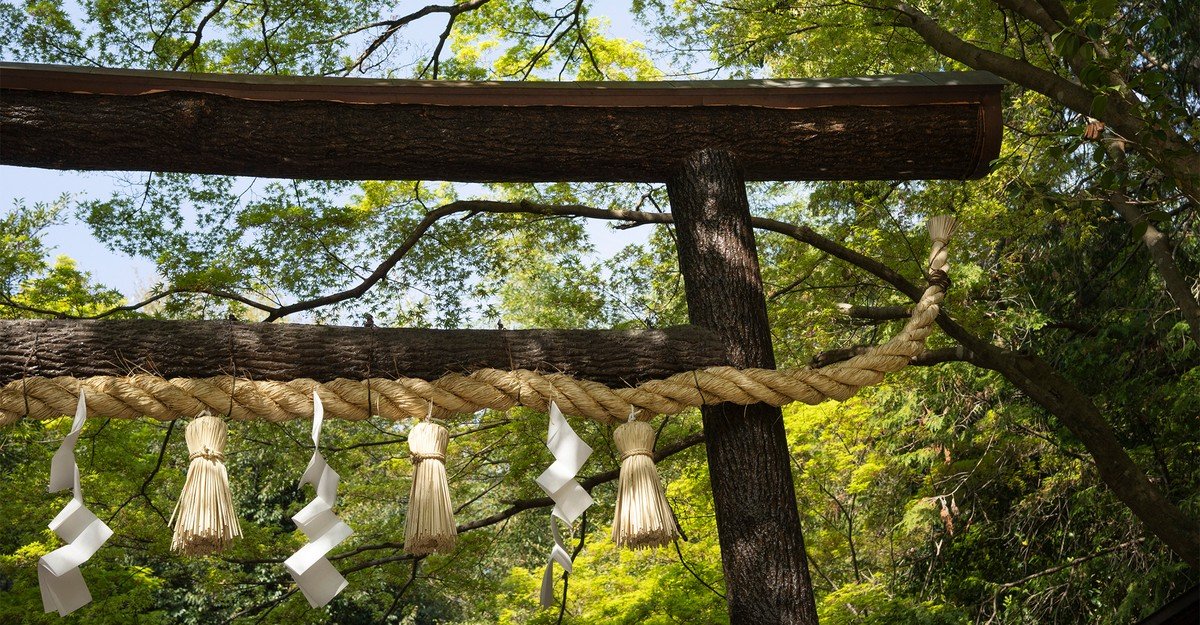
I don’t think it’s a stretch to connect this dichotomy—dominion versus care—with the approach Groff takes in Kyoto, diverging from the flocking tourists that Wiedeman depicts. Groff, a fan (as Shulevitz notes) of the animist-leaning Quaker John Bartram, observes the nature-worship of Japan’s Shinto traditions. She closes her essay with a tea-and-meditation ceremony at the Shunkō-in Temple, a place with no ostensible connection to Murasaki, and yet she gleans something valuable about the often-puzzling structure of The Tale of Genji. She learns from one of the temple’s Buddhist reverends that “the self is a shifting, inconstant phenomenon”; he advises her to “embrace” ambiguity, which is “part of nature.” This instruction helps Groff understand the orderly disorder of Murasaki’s writing; it also teaches her about herself. Perhaps this is—or should be—the goal of every pilgrimage.
Takako Kido for The Atlantic
A Tale of Sex and Intrigue in Imperial Kyoto
By Lauren Groff
A thousand years ago, Murasaki Shikibu wrote The Tale of Genji, the world’s first novel. Who was she?
Read the full article.
What to Read
The Deltoid Pumpkin Seed, by John McPhee
Pilots get most of the public credit for a flight’s successes—but they couldn’t go anywhere without the behind-the-scenes heroes: engineers. McPhee has a rare gift for stepping into the astonishing obsessions of seemingly ordinary working people; here, he uses it to immerse the reader in a decades-long quest to build an entirely new type of aircraft. That potential vehicle, shaped like the titular pumpkin seed, was imagined as a combination of dirigible and airplane. Its siren call, as McPhee shows, was sometimes all-consuming, even life-destroying. In a saga that reaches from the Civil War to the 1970s, one acolyte after another grew convinced that he (this affliction appears to target men exclusively) would be the one who conquered the engineering challenge that had theretofore led only to ruin. Did anyone finally succeed? The fact that you aren’t reading these words in the passenger compartment of a dirigible-airplane hybrid gives you a clue, but McPhee’s storytelling makes readers hope that the mission will somehow pan out. — Jeff Wise
From our list: Six books to read before you get to the airport
Out Next Week
📚 A New New Me, by Helen Oyeyemi
📚 The Second Emancipation: Nkrumah, Pan-Africanism, and Global Blackness at High Tide, by Howard W. French
📚 Breakneck: China’s Quest to Engineer the Future, by Dan Wang
Your Weekend Read
Illustration by Jonelle Afurong / The Atlantic. Sources: Mike Hansen / Getty; mikroman6 / Getty.
Why Is Everything Spicy Now?
By Ellen Cushing
To put it generally and reductively, American food has not always been known for embracing spice. But now a large and apparently growing number of people in this country are willingly chomping down on fruits that have been expressly cultivated to bind to their body’s pain receptors and unleash fury with every bite. “It’s one of the great puzzles of culinary history,” Paul Rozin, a retired psychologist who spent much of his career studying spice, told me. “It is remarkable that something that tastes so bad is so popular.”
Read the full article.
When you buy a book using a link in this newsletter, we receive a commission. Thank you for supporting The Atlantic.
Sign up for The Wonder Reader, a Saturday newsletter in which our editors recommend stories to spark your curiosity and fill you with delight.
Explore all of our newsletters.
