

August 19, 2025
4 min read
These Tiny Disks Will Sail on Sunlight into Earth’s Mysterious ‘Ignorosphere’
With no fuel or engines, tiny explorers will surf sun-warmed air alone to explore high in the skies of Earth and Mars
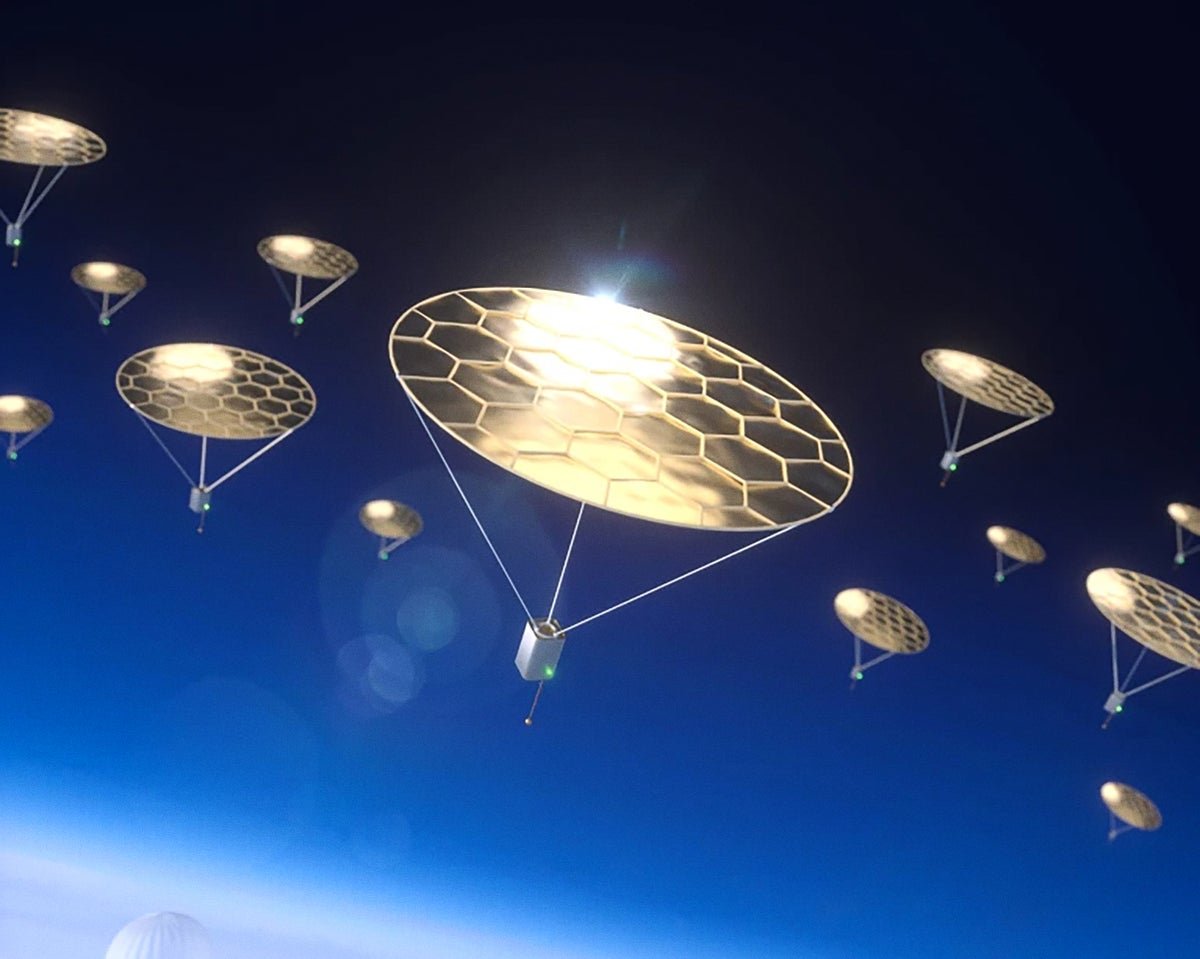
This artist’s impression shows multiple small devices soaring on sunlight at the edges of Earth’s atmosphere.
Schafer et al. Nature (2025)
Scientists have devised tiny featherweight disks that could float on sunlight in Earth’s mesosphere or the thin air of Mars, theoretically even while carrying payloads. Extending about 50 to 85 kilometers above Earth’s surface, the mesosphere is too high to be reached by aircraft and weather balloons but too low for access by satellites, making it one of our planet’s least-studied regions. Consequently, it’s sometimes simply called the “ignorosphere.”
The new centimeter-wide disks are made from two thin perforated membranes of ceramic alumina connected by tiny vertical supports. They are kept aloft by a force called photophoresis: the light-induced movement of small particles at very low atmospheric pressures. In lab experiments simulating mesospheric air pressure and illumination, the researchers showed that their devices could float passively, without any power source. Their paper reporting the results was published in Nature on August 13.
Photophoresis causes gas molecules to bounce more forcefully off the warmer side of an object than the cooler one, creating airflow. In this case, the research team coated the bottom of the disks with chromium to absorb light and heat up more than the top. Thus, gas molecules bouncing off the lower part gained more momentum than those at the top, generating lift similar to how a rocket’s jet produces upward thrust. Perforations in the disks increased this thrust, using an effect called thermal transpiration to passively channel the air from cooler to warmer regions. This enhancement boosted the disks’ performance to surpass photophoretic flyers previously demonstrated by other groups, which had required illumination several times brighter than that of sunlight.
On supporting science journalism
If you’re enjoying this article, consider supporting our award-winning journalism by subscribing. By purchasing a subscription you are helping to ensure the future of impactful stories about the discoveries and ideas shaping our world today.
“The holes in the structure provide more pathways for air to flow,” says materials scientist Ben Schafer, co-lead author of the paper, who conducted the research as a graduate student at Harvard University. “So the air is not only moving around the sides of the structure—it moves through the structure, too, creating these little jets.”
Photophoresis was first demonstrated in the 1870s by the physicist William Crookes. He developed what came to be known as a Crookes radiometer, a toylike device that spins its metallic fins when exposed to sunlight. But because photophoresis only works at very low pressures and generates very weak force, it was long seen as a mere novelty. That began to change a couple of decades ago, Schafer says, as advances in nanofabrication allowed researchers to make devices light enough to levitate using the meager force of photophoresis alone.
Designing the disks to utilize thermal transpiration and optimizing them to carry the biggest possible payloads required careful computational modeling of mesospheric conditions and photophoretic forces, Schafer says. That prep work allowed the team to make informed trade-offs between, for instance, the density of the perforations and number of supports versus the resulting lofting force at a given atmospheric pressure. This “gave us really good insight into what would make an efficient structure” for mesospheric flight, he says.
Using a laser to mimic sunlight, the researchers demonstrated photophoretic levitation on their centimeter-scale structures in a low-pressure chamber in the lab. They also designed a six-centimeter-wide version of the disk to carry a 10-milligram payload—which, in theory, would be enough to power a small communications system with a radio-frequency antenna, a solar cell and integrated circuits. The team calculates that this larger version of the disk could stay aloft at an altitude of 75 km during daytime; in summertime at polar latitudes, it could even achieve constant mesopheric flight, sustained after sundown by the photophoretic force of infrared light emanating from Earth’s gradually cooling surface.
Ruth Lieberman, a heliophysicist who worked on earlier attempts at photophoretic technology but wasn’t involved in this project, calls it a brilliant design. “As long as the sun is shining, these things will work,” she says. “They are also made out of very inexpensive materials. Once you get past the prototype phase and can figure out how to manufacture [at scale], it strikes me as a really potentially fantastic solution for observing the atmosphere at very low cost in a way that gets you very good spatial temporal coverage.”
Schafer envisions a future in which swarms of these structures are used for atmospheric sensing and telecommunications not only in Earth’s mesosphere but also in the tenuous atmosphere of Mars, which exhibits similarly low pressures. Schafer has co-founded a company based in part on the new research that is developing new iterations of the disks and planning to launch payload-free atmospheric test flights as early as 2026.
Creating disks truly capable of pulling their own weight in the mesosphere or beyond is a more formidable task—akin to a five- to 10-year project, Schafer says. “If you wanted to put a payload on board these devices, I think it’s certainly doable, but it’s going to take a lot of time and work,” he says. Scaling up is going to be a materials manufacturing challenge, he adds, that warrants more research.
