

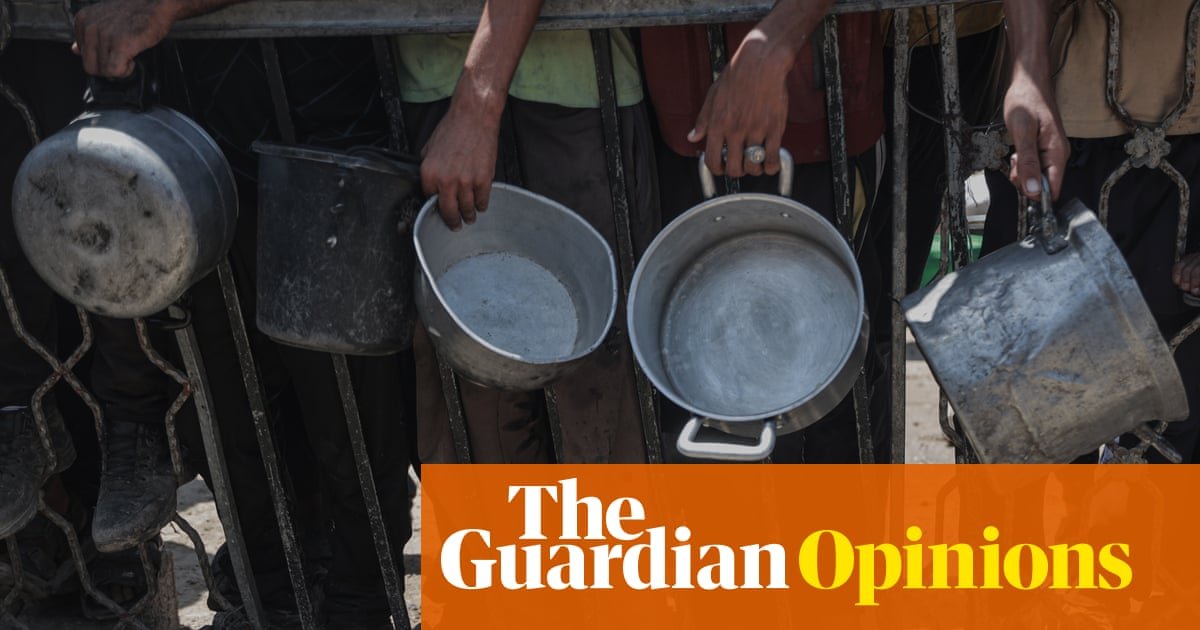
I must admit: I write this piece while starving – too hungry to think clearly, too weak to sit upright for long. I do not feel ashamed because my starvation is deliberate. I refuse my hunger even as it decays me. I can survive no other way.
Since 2 March 2025, Israel has imposed a full blockade on Gaza. Little aid – food, medicine, fuel – is getting in or being distributed. The markets are empty and bakeries, community kitchens and fuel stations are shuttered.
On 27 July, the World Health Organization confirmed 74 deaths from “malnutrition” in Gaza this year – 63 of them in July. Among the dead are 24 children under the age of five and one older child. Starvation is avalanching, nearly unstoppable.
Famine is no longer a threat – it is here. My stomach cramps … my fingers ache, parched from lack of fluids
A trickle of aid was dropped. The humanitarian agency Médecins Sans Frontières has called these airdrops “notoriously ineffective and dangerous”. The distribution points of US and Israeli-backed Gaza Humanitarian Foundation have been denounced as “death traps”, the UN warning that the system violates humanitarian principles and has cost more lives than it has saved.
Famine is no longer a threat – it is here. Some days, my stomach cramps as I try to revise a single paragraph. My fingers feel dry and achy, parched from lack of fluids. Hunger is loud. I read, but hunger is shouting in my ear. I write, but the maw snaps with every keystroke.
A man holds humanitarian aid supplies dropped by parachute near Gaza City. Médecins Sans Frontières has called the airdrops ‘ineffective and dangerous’. Photograph: Anadolu/Getty
And when I try to still myself, to think in the meagre pleasures of drone-infused quiet, my mind floats: what rabbit hole could I be down if I were in a library? Oh, for a coffee in between articles. A sandwich in between sentences. A snack alongside a lazy perusal of the latest issue of TESOL Quarterly.
I wonder: how can I keep my mind sharp when my body has gone so thin and dehydrated?
The hunger starts with a rumble, and it spreads so quickly. My legs barely carry me to the nearest internet cafe. There, I try to keep up with work and commitments, charge my devices, and catch a brief connection to the outside world. But with a heavy laptop bag on my shoulder, the journey feels less like a short walk and more like crossing a desert.
Some days, survival comes down to a single sachet of Plumpy’Nut, a peanut-based nutrient paste usually distributed for free in famine zones, but here sold for about $3.50, a price many can no longer afford. If you are more fortunate, you might buy a few overpriced fortified biscuits.
But the problem is not just paying for food. It is about accessing money in the first place. With every bank in Gaza damaged and not a single functioning ATM left, cash has become both scarce and essential. Online transactions, or Eftpos, are not common here – almost all purchases depend on cash.
After nearly two years of war, banknotes are torn and worn, and often rejected in shops. Getting money from your own account can be exploitative: withdrawing through an informal money exchange outside standard bank processes can cost up to 50% in commission.
Old and worn-out banknotes have to be repaired as Gaza runs out of hard currency. Photograph: Saeed MMT Jaras/Getty Images
This deeply contradicts the spirit of Gaza – known for its generosity, where neighbours always looked after one another, and where, for as long as many of us can remember, no one went to bed hungry if someone else had food to share.
That spirit has not vanished. People still share what little they have. But the scale of deprivation has grown so severe that even the most generous hands are now often empty. Families go to bed hungry and wake up hungry.
One day in particular, I had been working nonstop, pushing through dizziness and exhaustion. By the time I reached the stairs to my apartment, my legs were barely holding me up. My blood sugar had crashed. I collapsed just as I reached my bedroom. I was rushed to the nearest GP, where I was given an IV [intravenous fluids] to stabilise me.
I was back at work … I could not afford to stop. The urgency to bear witness outweighed the need to rest
The next morning, I was back at work. Not because I had recovered, but because I felt I could not afford to stop. There were interviews to conduct and transcribe, students to support, messages that needed to be sent. The urgency to bear witness outweighed the need to rest.
This is not about ego. It is about refusing to disappear. About resisting the slow erasure that comes with war and famine. About insisting that our thoughts and our work continue, even when it must be done in the ruins. In Gaza, to be an academic today is to refuse to be reduced to a statistic.
There are days when continuing feels impossible. The body simply gives out. Reading leaves me light-headed. Concentration slips away. Teaching becomes a battle to remain coherent.
And beyond the physical toll, there is another erosion – of identity. As scholars, we are meant to cultivate emancipatory and liberatory thinking among our students. But when our daily realities are hunger, grief and displacement, we begin to question whether we are still fulfilling that role.
Living conditions are harsh and ever worsening in Gaza City. Photograph: Anadolu/Getty
What does it mean to be a scholar when the conditions needed to think, teach and create are stripped away? What does academic freedom mean when intellectual, political and pedagogical freedom is restricted by siege? What does it mean to mentor youth towards critical inquiry when we ourselves are battling to stay upright? These questions linger, not as abstract concerns but as lived tensions. Still, we carry on. Because to stop would be to relinquish one of the last remnants of our agency.
skip past newsletter promotion
Sign up to Global Dispatch
Get a different world view with a roundup of the best news, features and pictures, curated by our global development team
Privacy Notice: Newsletters may contain info about charities, online ads, and content funded by outside parties. For more information see our Privacy Policy. We use Google reCaptcha to protect our website and the Google Privacy Policy and Terms of Service apply.
after newsletter promotion
I often find myself caught between two difficult choices in the classroom: either avoid discussing the crisis, fearing retraumatising my students; or confront it directly, opening space for collective reflection. Both paths are fraught, yet driven by the same hope – to use education not only to inform, but to liberate in helping students believe their voices still matter.
The work goes on. Research calls. Project check-ins. Webinars. Recorded lectures. Training sessions, though they must often pause. This is our reality. Still, we show up: attending classes, writing proposals, giving talks, joining conferences, publishing. Not because we are strong or brave, but because we believe in the transformative power of education. And because to stop would be to give in to silence.
Solidarity means changing the way the world works … adapting deadlines, waiving fees, opening access and making space for voices from Gaza and beyond
Yet, the most basic truth remains difficult to say aloud: we are hungry. Not by accident, but by design. When did naming that become taboo? For days, split lentils have been my only meal. Finding flour is a scavenger hunt.
And when we do manage to gather ingredients, baking over an open fire is exhausting, physically and emotionally. We burn wood from broken furniture to make bread. Used notebooks and scrap paper become fuel; otherwise, we must buy wood just to finish the job. This is not just about hunger. It is about being forced to fight for survival in silence.
Lighting a fire is a daunting challenge. Matches have run out. Lighters are nearly impossible to replace – and when one is available, it can be prohibitively expensive.
Those who still have a working lighter refill it cautiously with small amounts of gas. In many cases, families or neighbours share a single flame, passing it from household to household – another quiet act of solidarity and enduring spirit.
A handful of spilled lentils in dirt can be all someone has to eat as food shortages intensify in Deir al-Balah. Photograph: Anadolu/Getty
So we keep documenting. Not out of heroism, but to remain present. Because behind every report, every footnote, every lecture lies a deeper truth: knowledge is still being produced in Gaza. Even now. Especially now.
What does solidarity mean when some of us must think, teach and work while starving? What does inclusion mean when access to food, water and safety determines who gets to take part?
This is not a call for charity. It is a call to face an uncomfortable truth: solidarity is meaningless if it does not name – and challenge – the systems that keep people excluded while they struggle to survive under siege, occupation and deliberate deprivation.
True solidarity means asking hard questions: Who gets to speak? Who is heard? Who can keep learning and imagining a future when bombs fall and hunger bites?
Solidarity means changing the way the world works with those in crisis: adapting deadlines, waiving fees, opening access to books and journals, and making space for voices from Gaza and beyond – not as victims but as equal partners. It means understanding that grief, hunger and destroyed infrastructure are not “disruptions” to work – they are our current conditions of life.
To generate knowledge in the context of hunger is to think through pain. To teach students who have not eaten and still tell them their voices matter. To insist, against all odds, that Gaza still thinks, still questions, still creates.
That, in itself, is an act of resistance.
