

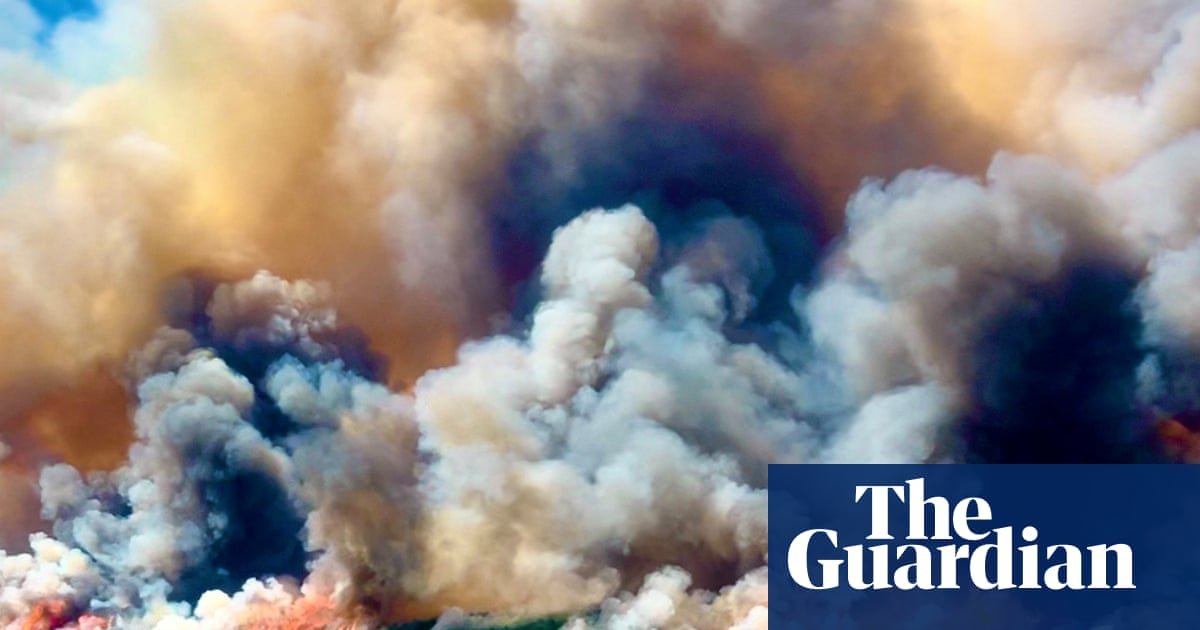
Road closures, evacuations, travel chaos and stern warnings from officials have become fixtures of Canada’s wildfire season. But as the country goes through its second-worst burn on record, the blazes come with a twist: few are coming from the western provinces, the traditional centre of destruction.
Instead, the worst of the fires have been concentrated in the prairie provinces and the Atlantic region, with bone-dry conditions upending how Canada responds to a threat that is only likely to grow as the climate warms.
Experts say the shift serves as a stark reminder that the risk of disaster is present across the thickly forested nation.
In recent weeks, tens of thousands of people have been evacuated from their homes due to the wildfires. Saskatchewan and Manitoba have been the worst hit, covering more than 60% of the area burned in Canada. But the fires have also seized strained resources in Atlantic Canada, where officials in Newfoundland and Labrador are struggling to battle out-of-control blazes.
In response to the crisis, the Newfoundland premier, John Hogan, said on Wednesday morning he would temporarily ban off-road vehicles in forested areas because the province “simply cannot afford any further risks, given the number of out-of-control wildfires we have”.
The ban follows a similar move by Nova Scotia, where a 15-hectare (37-acre) out-of-control fire is burning outside the provincial capital, Halifax. In addition to barring vehicles in wooded areas, Nova Scotia officials so shut down hiking, camping and fishing in forests, a decision reflecting the troubling fact that nearly all fires in the province are started by humans.
“Conditions are really dry, there’s no rain in sight, the risk is extremely high in Nova Scotia,” the province’s premier, Tim Houston, told reporters. “I’m happy to make sure that we’re doing everything we can to protect people, to protect property and try to just get through this fire season and really just pray for rain.”
Fires have even erupted in Ontario’s Kawartha Lakes region, a collection of rural communities less than 100 miles (160km) north of Toronto that are a popular summer destination for residents of Canada’s largest city.
For a country of sprawling landmass, fires have long been a common feature of the hot spring, summer and autumn. But for the last century, a mix of geography, climate and industry meant that the biggest and hottest fires – and the vast majority of destruction – have been concentrated in Canada’s western provinces.
That changed in 2023 when Canada had its worst fire season on record and the thick haze of smoke blanketed the US.
New York blanketed with smoke from Canadian wildfires in 2023. Photograph: David Dee Delgado/Getty Images
“We had fire everywhere. We had evacuations everywhere. We had smoke at a scale that was remarkable,” said Paul Kovacs, the executive director of the Institute for Catastrophic Loss Reduction at Western University. “And so for the first time, we had a different thought about wildfires as a country. With all of the smoke, it became a global conversation. This year is repeating all of that. This is a national issue. This can show up anywhere.”
Kovacs, whose organisation focuses largely on preventing structural loss, said more buildings had been destroyed this year compared with 2023, and he warned that a majority of the residents of the most fire-prone parts of the country, such as British Columbia and Alberta, had not yet taken steps to protect or “harden” their homes from fire risk.
He hopes that a broader national recognition of fire risk spurs people in other parts of the country to reassess how vulnerable their home or business might be to a fast-moving blaze.
“That’s the behavioural change we’re hoping to see next, because there will be many years of fires to come,” he said. “The size of the burned area will not go back to where things were 25 years ago. This is just our new reality and we need to be prepared. We need a change in mindset and a recognition that this can, and probably will, happen in so many parts of our country.”
Already, nearly 7.5m hectares (18.5m acres) have burned across Canada in 2025, far above the 10-year average.
Despite the national threat, there is no one-size-fits-all approach to reducing risk, said Jen Baron, a postdoctoral researcher at the University of British Columbia’s Centre for Wildfire Coexistence.
“British Columbia and Alberta have long been the poster children for this wildfire problem for a long time, but other regions are beginning to experience some of those same challenges,” she said. “This speaks to the pervasiveness of climate change: even if a location was relatively low fire risk in the past, with the extended droughts that we’re seeing, that’s no longer the case now and into the future.
“Even though some parts of the country are having a wet year on average, things across the board are still warmer and drier than they were in the past.”
That uncertainty has prompted a multimillion-dollar funding effort from the federal government to study risk and adaptation, because “there are very few parts of Canada that would be totally protected from wildfire”, Baron said.
With an international focus on wildfires, experts like Baron hope the recent years of immense blazes and choking smoke can spur a response that acknowledges the legacy of forestry industry practices, urban encroachment into the wilderness and the Indigenous stewardship of forests.
“We’re just starting to catch up to the scale of the problem,” she said. “Wildfire is a natural ecological process, but it’s become increasingly challenging to manage with changing climatic conditions.”
The concerns in Canada echo those emerging across the Atlantic as southern Europe grapples with one of its worst wildfire seasons in two decades.
In Spain, officials were scrambling on Sunday to contain 20 major wildfires. The prime minister, Pedro Sánchez, said during a visit to the north-western region of Galicia: “There are still some challenging days ahead and, unfortunately, the weather is not on our side.”
After fires killed three people and burnt more than 115,000 hectares, Sánchez said his government would seek to put forward a “national pact” to deal with the climate emergency.
“We need to reflect deeply on how we can rethink our capabilities, not only in terms of responses but also in terms of preventing everything related to the climate emergency, whether it be fires, storms, or any other climate-related natural disaster,” he said.
In Portugal, the area burned by wildfires this year is 17 times higher than in 2024, at about 139,000 hectares, according to preliminary calculations by the Institute for the Conservation of Nature and Forests. Across Europe, countries such as Greece, Bulgaria, Montenegro and Albania have requested help from the EU’s firefighting force as exhausted officials battle forest fires, fuelled by record-breaking temperatures, dry conditions and strong winds.
In Canada, Baron said the mild nature of this year’s western fire season provided a glimpse into the country’s future.
“Instead of one big fire year every 15 or 20 years, every year will be big in some part of the country,” she said. “We really don’t know exactly how climate change is going to continue. It doesn’t drive things in linear ways. And we can’t predict where there’s going to be a drought next year. But it will be somewhere.”
Additional reporting by Ashifa Kassam
