

The morning begins with a sense of anticipation – the calm before 1,200lbs of explosives detonate a stream culvert buried 10ft in Alaska’s Tongass national forest.
Jamie Daniels, 53, and his crew of Tlingit forestry workers take cover in a glade of alders.
A few minutes earlier, together with the US Forest Service and a Southeast Alaska Watershed Coalition (SAWC) watershed scientist, they fed high-grade explosives into the galvanized aluminum culvert on a 40ft sled made of spruce trees. The goal now is to vaporize it, along with the rocks on top.
Crouched 1,000ft away from the blast site, Jack Greenhalgh, the US Forest Service master blaster veteran, shouts: “Fire in the hole!”
He presses a remote detonator. Seconds later, four 50lb bags of ammonium nitrate and fuel oil (Anfo) go off.
A boom echoes across the valley, and the air goes liquid as a shockwave sweeps over the group, causing workers to grip hard hats. Football-sized splinters of granite shoot into the sky. Leaves flutter to the ground. A cloud of acrid smoke blows over.
“Stand by until we clear the area,” Greenhalgh mumbles, climbing out from behind his berm to inspect the damage – or success, depending on how one looks at it.
Workers slide a sled built of spruce saplings loaded with explosives into a metal culvert left by loggers in the 1980s and 90s. Photograph: Brendan Jones/The Guardian
The area where the group works is called Cube Cove, a 22,000-acre (8,900-hectare) addition to the 1m-acre Kootznoowoo wilderness on Admiralty Island, where the Tlingit people have lived, hunted and fished for at least 10,000 years. The wilderness makes up a chunk of the 17m-acre Tongass – by far the largest national forest in the United States.
The Tlingit have long considered Admiralty Island, or Kootznoowoo, as sacred ground – a place of spiritual significance, ancestral knowledge and connection to a traditional subsistence lifestyle. Chartreuse-colored leaves of the spiny devil’s club, mustard-colored seaweed on the rocks and citrus-scented spruce tips create a distinct rainforest aroma.
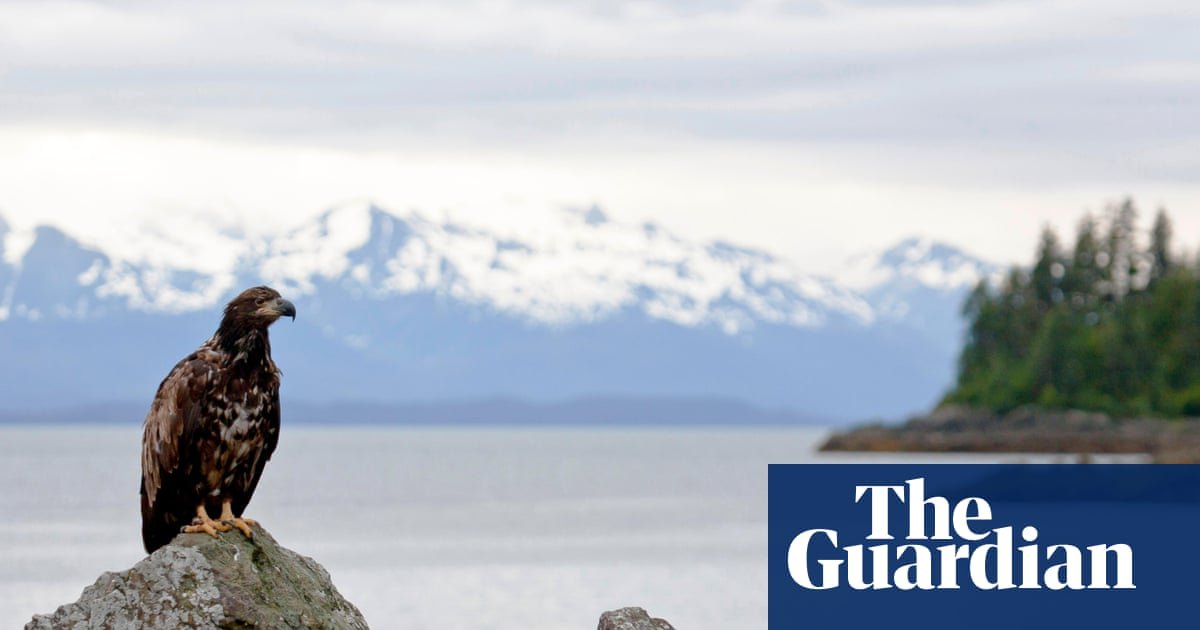
Kootznoowoo means “fortress of the bear”, a fitting name for a landscape home to the highest density of brown bears in North America. The landscape carries the marks of centuries of stewardship – from strips of yellow cedar used for ceremonial baskets to totem poles reflecting intricate clan histories. Eagles soar high above, chalky heads on pivot as they watch for herring or juvenile salmon.
This morning, Daniels wears a bright orange safety helmet, his hands calloused from carving a 12in (30cm) block of Sitka spruce into a brown bear’s head. He lives in Angoon, 15 miles (24km) south of Cube Cove along the coast of the island, population 341. His clan house is shd’een hit, the Steel house, and he comes from Deisheetaan Naahaachuneidii, the original Raven Beaver clan of the Edge of the Nation people.
Daniels emerges onto the old logging road, and gestures across the valley. “All of this, it’s not just land to us. It’s our ancestors’ land. We’re here doing more than just fixing roads or removing culverts – we’re reconnecting with our history, our identity and our future. Every culvert we remove, that’s a promise to our children that the land will heal.”
Jimmy Carter being given the name ‘Haa Hoo Woo’ by Chief Matthew of the Tlingit tribe during a White House ceremony in Washington, 4 May 1979. Photograph: Charles Tasnadi/AP
In the 1970s, Daniels’s relatives along with others from Angoon fought to protect the island from clearcutting, holding bake sales, bingo games and raffles to fund trips to Washington DC. In 1978, elders met with Jimmy Carter. In 1980, the Alaska National Interest Lands Conservation Act (Anilca) formalized protections for the Kootznoowoo wilderness, now part of the Admiralty Island national monument.
However, that designation came with an asterisk: the sale of 22,890 acres of ancestral Tlingit hunting and fishing grounds to the Shee Atiká Corporation, one of the 13 Native corporations created during the Alaska Native Claims Settlement Act in 1971.
Over the next three decades, more than 80% of that land was clearcut. Culverts, like the one the team is blowing up today, were inserted, blocking the passage of baby salmon upriver.
In 2020, the forest service purchased the Cube Cove land from Shee Atiká for $18m. The agency, alongside Kootznoowoo Inc, the Indigenous corporation based in Angoon, and SAWC, embarked on a five-year project to restore ecological functions, reconnect streams and support the traditional practices of the Tlingit people. The addition of Cube Cove signified the largest transfer of land into formal wilderness designation in the forest service’s history.
“The purchase of this land opened a door,” Daniels reflects. “It gave us the chance to reconnect with these lands in a way that honors our ancestors and what they knew – how to live in harmony with nature, not dominate it.”
‘Kootz’ crew member Walt Washington. Photograph: Brendan Jones/The Guardian
When he was growing up in Angoon, Daniels recalls, his uncles and cousins talked about hunting and fishing in the area before the clearcutting.
“My grandmother spoke of a ‘small sockeye run’ from here. I always thought she was talking about just a few fish. But actually, it’s thousands of fish – just kokanee salmon, which look like small sockeye.”
Since 2022, Daniels and his crew – including his 24-year-old son Justin; 33-year-old Roger Williams; and 41-year-old Walt Washington – have been working to undo decades of damage.
“We’re trying to get this forest back on its feet,” Daniels explains. “But it’s not just the trees. We’re restoring the entire ecosystem: the fish, the wildlife and the cultural traditions connected to this land.”
A legacy of restoration
Following the all-clear from Greenhalgh, SAWC watershed scientist Kelsey Dean slings a forest service Pulaski – part ax and part adze – over her shoulder and follows the old logging road to the blast site. She describes dense thickets of spruce as “dog hair trees” where deer can’t forage, and bears can’t hunt deer.
This six-day hitch we’re participating in is just the second blasting session in a much larger effort. At the end of five years, the team will have removed 80 of the 89 culverts left by loggers, and three bridges, Dean says.
“We’re restoring habitat, improving hydrologic function and strengthening the land’s resilience. After that, it’s hands off,” she says, releasing the Pulaski to underline the point.
Up ahead, a reddish-brown haze settles over the blast site. The crew gathers along the banks and stares into a triangular trench where the culvert once ran.
Sean Rielly, a former wilderness ranger and forest service recreation specialist, slaloms down the mud and begins removing shards of the shattered culvert. Daniels and his crew follow, pushing boulders out of the new streambed. Suddenly, the goop of mud and alder leaves releases, flooding downhill. After an hour of work, a small mountain stream flows freely.
“Now,” Dean says, “we watch for fish.”
The fish are anadromous, she explains – a fancy word that means they spawn and then die. Their decaying bodies provide food for the carnivorous spruce, hemlock and cedar trees in a healthy stand of old growth. The salmon also sustain the brown bears prowling the island, their coats glossy with salmon oil, their humps shifting as they patrol the rivers, waiting for the salmon to arrive.
A truck carrying recently cut old-growth trees in the Tongass national forest on Prince of Wales Island, Alaska, on 2 July 2021. Photograph: The Washington Post/Getty Images
The Cube Cove project reaches its midpoint at a moment when the Trump administration renews logging efforts in the Tongass. In June, the US Department of Agriculture announced plans to remove the Roadless Rule protections, exposing 7m acres of the Tongass to extensive clearcuts. Ecologists warn that cutting much of the old growth could release massive amounts of carbon stored in the trees.
In fact, Dean says, when federal funding dried up, Cube Cove progress stalled. Luckily, SAWC was able to use wetlands mitigation money from the state of Alaska to account for the shortfall.
“It’s unfortunate, what’s happening. The region is just now starting to recover from the violence of clearcutting,” says Rob Cadmus, director of SAWC. “At Cube Cove, what we’re doing essentially is cleaning up the mess left from logging. Going back to those timber bonanza days would be unconscionable, from an economic, environmental and psychic standpoint.”
Master blaster Jack Greenhalgh writing notes. Photograph: Brendan Jones/The Guardian
Federal subsidies have long made old-growth logging in the Tongass artificially profitable. By selling timber below market value and covering high costs like road building and transportation, the government incentivizes larger logging companies from the lower 48 to cut down trees, despite the fact that south-east Alaska’s economy is shifting toward eco-tourism and fishing – industries that depend on preserving the Tongass intact, rather than transforming the mountains into a moonscape, with no habitat left for salmon to spawn.
As the crew works with hand tools, Dean inspects the flow of water, while Greenhalgh examines the composition of dirt. The two assess whether a second “cleanup shot” of explosives might be necessary before abandoning the site. Hand tools can take care of the rest, they decide.
As the sun sets over the mouth of the valley, the group begins a 3.5-mile hike along the logging road back to the ATVs and forest service truck. Along the way, Daniels nods toward an alternating series of oven-mitt-shaped prints in the ground – evidence of the island’s apex predators.
“Bear have survived here for thousands of years,” he says. “And so have we. All of that makes what’s happening today feel really personal.”
Rielly catches up and talks about all the time he spent behind a desk justifying the need for mechanized equipment and explosives and the minimum tool necessary to help the region’s recovery. In 2024, a youth group from Angoon removed a culvert barely beneath the ground using only standard forest service hand tools: Pulaskis, shovels, mattocks and rakes.
The effort took seven days.
“If we don’t do this work, the land will continue to degrade. Culverts clog, landslides are triggered, watersheds are blocked,” Rielly says. “This is the only way to get the job done quickly, especially in such remote terrain.”
Through the scrim of spruce saplings, stumps of ancient old-growth loom: cedar, hemlock and spruce recorded at more than 1,000 years old. The group crosses the Ward Creek bridge, held in place by steel girders 8ft wide covered by creosote timbers. These will be removed at the end of the project, when the crew erases their footprints. On the other side of the bridge, Daniels, Washington and Williams hop on the ATVs, while the rest of the group pile into the truck for the 12-mile trip back to camp.
A totem pole at the entrance of Náay I’waans, the Great House/the Whale House, the only traditional Haida longhouse left in the US, in the town of Kasaan in the Tongass national forest on Prince of Wales Island, on 4 July 2021. Photograph: The Washington Post/Getty Images
After showers in the ocean, the group congregates around a driftwood bonfire on the beach, where thousands of logs were once dumped and rafted together, on the way to the mill. Dean sips from a can of lime sparkling water – a treat in the remote area. Dressed now in flannel pajamas, Washington perches on a rock. He describes his work in the forest as engaging in a cycle of “destruction and renewal”.
“The land will heal itself if left alone,” he says. “But sometimes you have to set a bone before it can heal properly. I know that this hard work we’re doing out here is for my children, and for their children down the line.”
“What you’re seeing here is a version of the next generation of conservation – partnerships that connect people, place and purpose,” Cadmus of SAWC says. “When we’re out here working side by side, we build a bond that’s stronger than words. At the end of the day, that’s what heals us. We’re all in service to the land.”
