

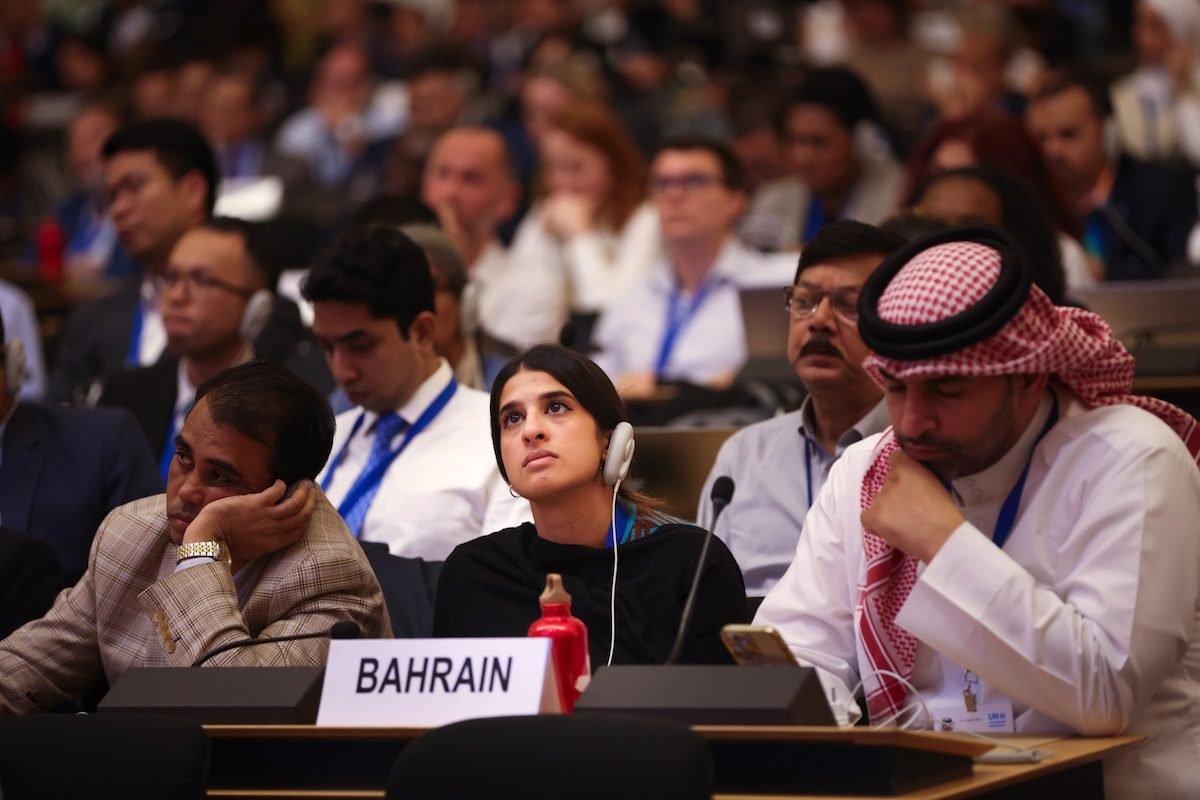
Diplomats from around the world concluded nine days of talks in Geneva — plus a marathon overnight session that lasted into the early hours of Friday — with no agreement on a global plastics treaty.
During a closing plenary that started on Friday at 6:30 a.m. — more than 15 hours after it was originally scheduled to begin — nearly all countries opposed an updated draft of the U.N. treaty that was put forward by the negotiating committee chair, the Ecuadorian diplomat Luis Vayas Valdivieso. Many of the delegates said the text did not reflect their mandate under a U.N. Environment Assembly resolution to “end plastic pollution” by addressing the “full life cycle” of plastics.
“We are truly sad to say that we will not have a treaty to end plastic pollution here in Geneva,” the head negotiator for Norway, Andreas Bjelland Erikse, told the chair. Valdivieso wrapped up the meeting just after 9 a.m. with the promise that they would continue at a later date.
The decision ends a contentious week and a half of discussions during the “resumed” fifth session of negotiations over a U.N. plastics treaty, which started in Geneva on August 4. Delegates had arrived in the city hoping to finalize a treaty by Thursday, having already overrun their original deadline to complete the agreement by the end of 2024.
Signs of a logjam were apparent even within the first few days of the talks, however, as countries hewed to the same red lines they’d stuck to during previous negotiations. A so-called “like-minded group” of oil-producing countries said it would not accept legally binding obligations and opposed a wide range of provisions that other nations said were essential, including controls on new plastic production, as well as mandatory disclosures and phaseouts of hazardous chemicals used in plastics.
During a plenary on August 9, three observers independently told Grist that the negotiations felt like “Groundhog Day,” as countries reiterated familiar talking points. A norm around consensus-based decision-making discouraged compromise from all countries, though the like-minded group — which includes Bahrain, Iran, and Kuwait, Saudi Arabia, and Russia, among other countries — was particularly intransigent and understood it could simply block proposals rather than shift its positions. Instead of whittling down a draft of the treaty that had been prepared late last year during the previous meeting in Busan, South Korea, delegates added hundreds of suggestions to it, placing a deal further from reach.
Over the course of the Geneva talks, delegates rejected two new drafts of the treaty prepared by Valdivieso: one released on Wednesday, which was so objectionable that countries said it was “repulsive” and lacked “any demonstrable value;” and the most recent one published just hours before Friday’s 6:30 a.m. plenary. Many expressed their preference to revert back to the Busan draft as a basis for future discussions.
Despite Friday’s outcome, the plastics treaty does not yet appear to be dead. Virtually all countries expressed an interest in continued negotiations — the EU delegate Jessika Roswall said she would not accept “a stillborn treaty” — and many used their mic time during the closing plenary to remind others of what’s at stake.
“We cannot ignore the gravity of the situation,” a negotiator from Madagascar said. “Every day, our oceans and ecosystems and communities are suffering from the consequences of our inability to make decisive and unified actions.” Tuvalu’s delegate, Pepetua Election Latasi, said failing to enact a treaty means that “millions of tons of plastic waste will continue to be dumped in our oceans, affecting our ecosystem, food security, livelihoods, and culture.”
Still, without a change in the negotiations’ format — particularly around decision-making — it’s unclear whether further discussions will be fruitful. The norm around “consensus-based decision-making” means the threat of a vote can’t be used to nudge obstinate countries away from their red lines; unless decision-making by a majority vote is introduced then this dynamic is unlikely to change. “This meeting proved that consensus is dead,” said Bjorn Beeler, executive director of the International Pollutants Elimination Network, a coalition of health and environmental organizations. “The problem is not going away.”
Other nonprofits and advocacy groups staged several silent protests during the Geneva talks raising this same point, displaying signs reading, “Consensus kills ambition.”
Senimili Nakora, one of Fiji’s delegates, said during the closing plenary that “consensus is worth seeking if it moves us forward, not if it stalls the process.” Switzerland’s negotiator, Felix Wertli, said that “this process needs a timeout,” and that “another similar meeting may not bring the breakthrough and ambition that is needed.”
Other countries raised broader concerns about “the process” by which negotiations had proceeded. Meetings had been “nontransparent,” “opaque,” and “ambiguous,” they said during the plenary, likely referring to unclear instructions they had received from the secretariat, the bureaucratic body that organizes the negotiations.
Inger Andersen, the U.N. Environment Programme’s executive director, told reporters on Friday that it at least had been helpful to hear countries more clearly articulate their red lines. “Everyone has to understand that this work will not stop, because plastic pollution will not stop.”
The plastics industry, which has opposed controlling plastic production and phasing out groups of hazardous chemicals, said it would continue to back a treaty that “keeps plastics in the economy and out of the environment.” Marco Mensink, council secretary of the International Council of Chemical Associations, said in a statement: “While not concluding a global agreement to end plastic pollution is a missed opportunity, we will continue to support efforts to reach an agreement that works for all nations and can be implemented effectively.”
Environmental groups, scientists, and frontline organizations were disappointed to leave Geneva without an ambitious treaty. They said it would have been worse, however, if countries had decided to compromise on key provisions such as human health and a “just transition” for those most likely to be affected by changes to global recycling and waste management policies, including waste pickers.
Under the circumstances, they applauded delegates for not agreeing to the final version of the chair’s text. “I’m so happy that a strong treaty was prioritized over a weak treaty,” said Jo Banner, co-founder of the U.S.-based organization The Descendants Project, which advocates to preserve the health and culture of the descendants of enslaved Black people in of a swath of Louisiana studded by petrochemical facilities
“It feels like our voices have been heard,” added Cheyenne Rendon, a senior policy officer for the U.S. nonprofit Society of Native Nations, which has advocated that the treaty include specific language on Indigenous peoples’ rights and the use of Indigenous science.
By contrast, observers’ voices were literally not heard during the final moments of the concluding plenary in Geneva. After more than two hours of statements from national delegations, Valdivieso turned the mic over to a parade of young attendees, Indigenous peoples, waste pickers, and and others who had been present throughout the week and a half of talks. But only one speaker — from the Youth Plastic Action Network — was able to give a statement before the United States and Kuwait asked the chair to cut them off and conclude the meeting.
It is now up to the plastics treaty secretariat to set a date and time for another round of negotiations, which are not likely to happen until next year. In the meantime, all eyes will be on the U.N. Environment Assembly meeting in December, where Andersen is expected to deliver a report on the negotiations’ progress — or lack thereof — and which could present an opportunity for the like-minded countries to lower the ambition of the treaty’s mandate: the statement spelling out what the treaty is trying to achieve. Some environmental groups fear that Iran, Russia, Saudi Arabia, and others will try to change the mandate so that it no longer refers to the “full life cycle” of plastics, but just plastic pollution — thus turning the treaty into a waste management agreement rather than one that addresses the full suite of plastics’ harms to health and the environment, including during the material’s production.
Banner said she doesn’t feel defeated; in fact, she’s “more passionate than ever” to keep fighting for legally binding restrictions on the amount of plastic the world makes.
“I’m planning to survive,” she added, and to do that, “we have got to stop the production of plastic.”
—Joseph Winters, Grist
ALSO ON YALE E360
Plastics Reckoning: PVC Is Ubiquitous, But Maybe Not for Long
