

Sue thrusts both hands deep into the rich, dark, soil, grabs a fistful and lets it trickle through her fingers. “Look at this, just look. This is an antidepressant, a natural antidepressant.”
Around her in the polytunnel, tomato plants bend with the weight of their produce, and seed trays freshly planted with winter salad are spread out over wooden trestles: the product of her morning’s work.
Sue stands, reaches for an empty seed tray and continues filling it with soil. She could be any gardener preparing the next season’s harvest, but her eyes tell a different story.
The vine-covered terrace and large communal table for group lunches. Photograph: Jim Wileman/The Guardian
“I had a very professional senior job, a big, well-paid job,” she says. “But I was leading this ridiculous double life. I had this really pressurised professional career and at the same time I was going out with a major drug dealer.
“It was a really horrible toxic relationship, very manipulative. Long story short, he was violent to me, I had enough and I picked up a chair and smashed him round the head with it. But unfortunately, it nearly killed him, he had a fractured skull and was unconscious. I ended up being done for actual bodily harm.”
Outside the polytunnel, a path meanders through lush vegetation, past a wildlife pond, alongside the chicken run to the outside edges of the land. Birdsong from the swaying natural borders of ash, birch and oak bursts the silence. A small plaque nearby is inscribed in the memory of Erwin James, the convicted murderer turned author, prison reformer and journalist, who died in January 2024. The words on the slate below it are his: “LandWorks – an oasis of hope.”
That hope was spawned 12 years ago in a small portable building with no electricity or running water, in what was then a bramble-covered field, when LandWorks founder Chris Parsons offered three prisoners on day release the chance to experience how nature, and working within and for it, might be transformative for their lives.
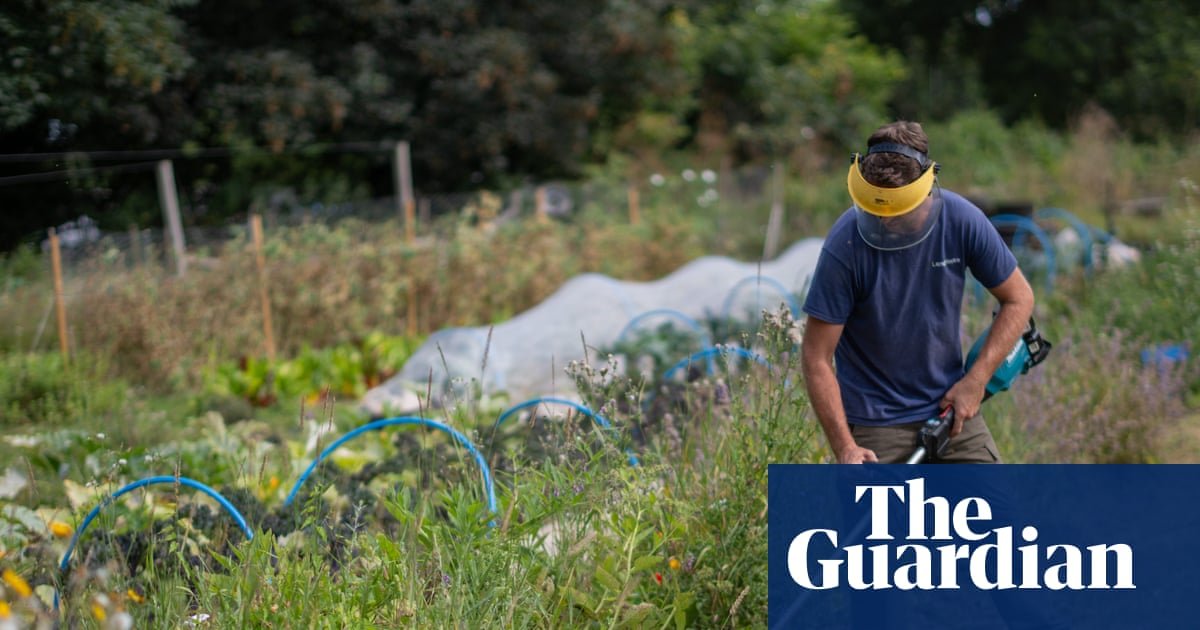
Sitting deep in the south Devon countryside, on the Dartington estate outside Totnes, LandWorks today is a haven of tranquillity spread across nearly three acres of allotments, workshops, wildlife ponds, a market garden, and at the centre a vine-covered terrace and a large communal table for group lunches, which has more than a passing resemblance to a Greek taverna.
An ex-prisoner is instructed in woodworking. Photograph: Jim Wileman/The Guardian
Within the natural beauty, men and women carrying the weight of violent pasts, the stigma of imprisonment, a history of abuse, mental health problems and drug and alcohol addiction come to try to change the path of their lives.
At the core of LandWorks is a community of people using the environment around them to provide a living; 25% of the charity’s income comes from what its trainees grow and produce from the land, which is sold at the shop on site. Prisoners on licence, or on suspended or community sentences, come on six- to nine-month placements where they learn to work the land, to produce a huge variety of vegetables year round, including tomatoes, radishes, beetroot, parsnips and leeks. They are taught to cook the food they harvest, build outdoor furniture from trees felled nearby, and every day they sit and eat together around the large table beneath the vines.
“People feel they are safe, they are surrounded by nature, immersed in it all, hidden,” said Parsons. “To hear the birds twittering, the wind through the trees, especially if you have just come out of a crack den or a noisy prison, to come here and go out in the field all morning to pick the food that we are going to have for lunch, and return from the fields to sit together and eat food they have grown and cooked. It is subtle, it is a contrast to the chaos they have been living in, it is a slow process.”
Chopping homegrown tomatoes for lunch. Photograph: Jim Wileman/The Guardian
The success of this particular algorithm of nature, teamwork, community and productivity might be hard to pin down, but appears to be stark. Former prisoners who are supported by LandWorks are far more able to sustain a life away from crime, drugs and chaos.
A toxic cocktail that includes a lack of housing, probation cutbacks, stigma, drugs, trauma and social exclusion have ensured that most prisoners in England and Wales fail to resettle back into the community after their release without being drawn back to crime.
Ministry of Justice figures show prison sentences of less than 12 months have a reoffending rate of 59.2%. Reoffending rates for adults released from prison and given community orders or suspended sentences are 35.2%. The social and economic costs of failing to resettle prisoners in a life away from crime, costs the taxpayer an estimated £18bn each year.
At LandWorks, reoffending rates within one year of trainees finishing their placement are consistently around 5%.
Nick Hardwick, the former chair of the parole board and HM inspector of prisons, says LandWorks provides one of the best examples in the country of how to reduce reoffending, turn lives around and prevent future victims. As the Justice Committee investigates why reoffending rates remain so high, Landworks is being held up as an example that could be followed across the country.
skip past newsletter promotion
Our morning email breaks down the key stories of the day, telling you what’s happening and why it matters
Privacy Notice: Newsletters may contain info about charities, online ads, and content funded by outside parties. For more information see our Privacy Policy. We use Google reCaptcha to protect our website and the Google Privacy Policy and Terms of Service apply.
after newsletter promotion
Research about the mental and physical healing nature can provide goes back decades, but Parsons did not start out with the idea of creating an environmental charity to aid the resettlement of ex-offenders. “It was something that evolved,” he said. “I was always interested in growing and working the land, and as we were surrounded by nature it just seemed the right thing to do.
“The larch here was felled just up the road, and we used it to build out our site. Very quickly, we were growing veg for ourselves; we had chickens, and the first few guys who came used to make scrambled eggs every Friday morning because they didn’t get that in prison,” he said.
Chris Parsons, the founder and director of LandWorks. Photograph: Jim Wileman/The Guardian
For former prisoner Jimbob, being out in the natural environment is what helped him the most. “A bit of fresh air and no pollution,” he said in a recorded verbatim account of his experiences. “I love … the whole different seasons … like when you start seeding the seeds … watching that plant and you’re watering it, bit of weeding around it and that, and then before you know it, you’re cropping it and taking it to the shop and putting it in the shop … and eating it at dinner.”
LandWorks keeps in touch with the vast majority of its trainees, and some are employed within the charity. Mark was one of the first prisoners to arrive on licence during his last year of a seven-year prison sentence for death by careless driving, in which a 91-year-old man was killed in a high-speed car accident.
“People in prison used to say the air smells different on the other side of the fence,” he said. “When I came through the gate at LandWorks I just forgot about everything, it was gone. What has always stuck with me, when I came here it was four and a half years after the accident, Chris and the people here were the first professionals to ask me how I was. I totally understand I wasn’t the victim, but when you are responsible for someone’s death – the guilt … It was huge to be asked that, it was like a release of pressure.”
Probation officer Gabriel Broaders has brought more than 100 offenders to LandWorks over the years. The impact on individuals with chaotic, abusive pasts when they connect with nature remains remarkable to him. “I always remember meeting a young lad at the train station after he had been here for the first time; this hot, sweaty, smiling face. He had a T-shirt on, his fingernails had dirt underneath them and he just started talking excitedly about what he had been doing, ‘digging in the earth … doing stuff’.”
Back in the polytunnel, Sue tidies up as the lunch bell rings and the trainees begin to gather around the table for a home-cooked lunch.
Sue (left) filling seed trays in the polytunnel with volunteer Hannah Stevens. Photograph: Jim Wileman/The Guardian
Sue reached LandWorks through a lucky meeting with someone in the probation service, after being given a suspended sentence for actual bodily harm, due to her mitigating circumstances as a victim of domestic violence. Now studying for a diploma in landscape design, she intends to create a gardening project along the lines of LandWorks, to help other ex-prisoners change their lives as she has hers.
“What they do here, it is about the people, and the environment around us. What you get here is encouragement, kindness, a non-judgmental attitude. That is not something you get anywhere else in the criminal justice system.”
